Part 1: The Public Line
They told me the charity board meeting was for donors only… not knowing I was the woman who founded it forty years ago. Then my granddaughter opened the photo album they kept on display.
The November wind whipping off the Hudson River had a way of finding every worn thread in my old wool coat. It was the same camel-hair coat I’d worn decades ago when I was walking the freezing streets of the Bronx, handing out thermoses of hot soup to women who had nowhere else to go.
Tonight, at seventy-eight years old, I wasn’t walking the Bronx. I was walking up the velvet-roped steps of the Grand Astor Hotel in Manhattan.
“Grandma, are you sure we’re in the right place?” my twelve-year-old granddaughter, Maddie, asked, her teeth chattering slightly as she adjusted her small knitted scarf. “Everyone here looks like they’re going to the Oscars.”
She wasn’t wrong. Through the towering revolving glass doors, the lobby was a sea of glittering diamonds, custom-tailored tuxedos, and silk evening gowns. The sign in the foyer, printed in tasteful, minimalist gold foil, read: Haven House: 40th Anniversary Gala & Board Assembly.
“We’re in the exact right place, sweetheart,” I said, squeezing her hand. “I just need to see what they’ve done with the place.”
Fifteen years ago, a brutal, prolonged battle with late-stage leukemia had forced me to step away from Haven House, the women’s shelter I had built from a single rented basement into a city-wide network. I had handed the reins to a trusted board of directors, fully believing the mission was safe. Recovery had taken years, and even after I went into remission, I had kept my distance, living a quiet life upstate, trusting the glossy annual reports they mailed me.
But recently, the reports had stopped showing the faces of the women we were supposed to be helping. Instead, they showed galas. They showed celebrities. And lately, I had been hearing whispers from old friends in the social work sector—whispers that made my blood run cold.
So, I brought Maddie. I wanted her to see the legacy her grandmother had built, but more importantly, I needed an honest pair of eyes. I needed to know if Haven House was still a sanctuary, or if it had become something else entirely.
We stepped into the warmth of the lobby. The scent of roasted truffles and expensive champagne hung heavy in the air. We bypassed the main ballroom entrance and headed toward the mahogany doors of the Astor Suite, where a placard read: Executive Board Meeting – Closed Session.
I reached for the brass handle, but a manicured hand slammed flat against the wood, stopping me.
“Excuse me. Can I help you?”
I turned to see a woman in her late thirties. She was wearing a sleek, emerald-green designer gown that probably cost more than it took to feed a shelter full of women for a month. Her hair was pulled back into a severe, perfect chignon, and her eyes swept over my frayed coat and Maddie’s simple school dress with thinly veiled disgust.
This was Victoria Lane. The new Executive Director. I recognized her from the glossy mailers.
“I’m here for the board meeting,” I said, my voice steady, though my heart was beginning to hammer a familiar, battle-ready rhythm against my ribs.
Victoria let out a short, breathy laugh that held no humor. “The board meeting? Ma’am, this is a private assembly for platinum-tier donors and executive staff prior to the gala. If you’re looking for the public donation line or the community outreach desk, that’s downstairs in the basement level near the coat check.”
She pointed a perfectly manicured finger toward a dark stairwell at the far end of the lobby. Downstairs. Out of sight.
“I am not here to drop off a canned good, Ms. Lane,” I said, reading her gold nametag. “I need a seat in that room. I have some very pressing questions about the operational budget and the recent shelter admissions criteria.”
Victoria’s smile vanished, replaced by a cold, corporate mask. She stepped fully in front of the door, blocking my path. “I don’t know how you know my name, or how you slipped past security, but you are not on the list. Unless you have a check for fifty thousand dollars in that pocket, you have no business discussing our operational budget. Security will be happy to escort you out if you don’t step away.”
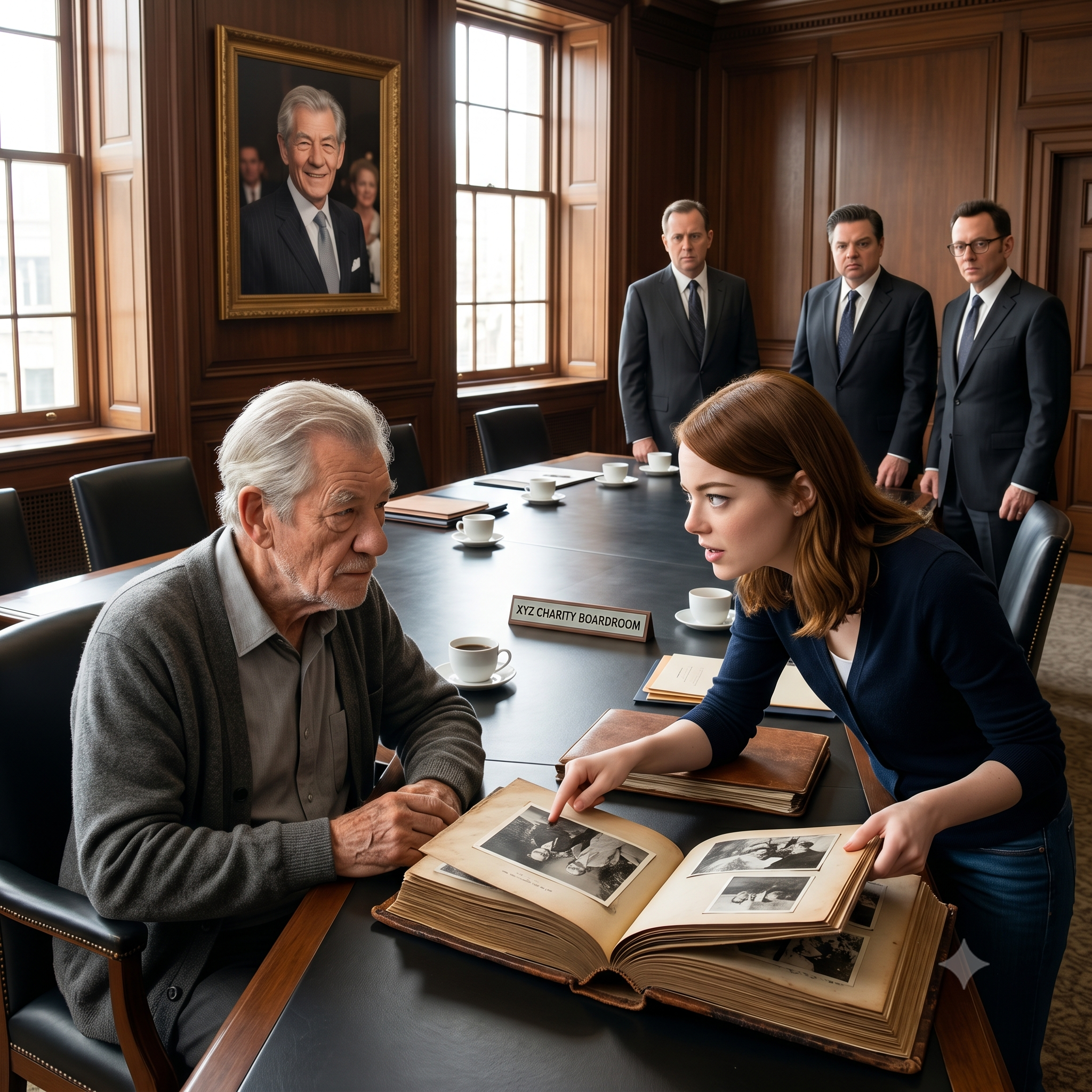
While Victoria was delivering her ultimatum, Maddie had wandered a few feet away. In the center of the antechamber, resting on a velvet-draped podium and illuminated by a pinpoint spotlight, was a massive, leather-bound book. The gold lettering on the cover read: Haven House: A History of Hope.
Maddie, always the curious reader, had carefully flipped the heavy cover open. She bypassed the glossy modern pages of galas and celebrity endorsements, flipping back to the very beginning. The pages here were thick, holding black-and-white polaroids and newspaper clippings.
“Grandma?” Maddie’s clear, high voice cut through the tense silence between Victoria and me.
“Don’t touch that!” Victoria snapped, stepping toward the podium. “That is a fragile archival display.”
Maddie ignored her. She kept her finger pressed against a faded photograph on the very first page. It was a picture of a much younger woman in a camel-hair coat, standing in front of a dilapidated brick building with a freshly painted sign that read Haven House. The woman in the photo was holding a sleeping toddler wrapped in a blanket, surrounded by three other women who looked exhausted but safe.
Maddie looked from the photo, to my face, and then up at Victoria, her brow furrowed in pure, innocent confusion.
“Grandma,” Maddie asked loudly, her voice echoing in the opulent hallway. “Why are you in their book if they don’t know you?”
Victoria froze. Her eyes darted to the photograph, then back to my deeply lined face. For the first time, she really looked at me. She saw past the old coat and the gray hair. She saw the same piercing blue eyes that were immortalized in the ink of that first page.
“Wait,” Victoria breathed, the color draining from her cheeks. “You’re… Eleanor Price?”
“I am,” I said, standing taller, the weight of my seventy-eight years suddenly feeling like armor rather than a burden. “And I believe I am well past due for a board meeting.”
Part 2: The Locked Doors
The silence in the antechamber was deafening, broken only by the distant, muffled sounds of a jazz band playing in the main ballroom.
Victoria Lane stared at me, a myriad of calculations running behind her eyes. The initial shock quickly morphed into something defensive, calculating, and surprisingly hostile. There was no joy in her recognition. There was only panic.
“Eleanor,” Victoria finally said, her voice dropping to a harsh whisper. She didn’t use an honorific. She didn’t welcome me. “We… we were told you retired permanently to upstate New York. That your health—”
“My health is fine, Victoria. No thanks to the stress of reading your recent financial filings,” I replied, stepping closer to the podium. I looked down at the book.
As I glanced at the pages that followed my photograph, the reality of my suspicions clicked into place. It was worse than I thought.
The first page had my picture—a token nod to the past. But flip the page, and the narrative abruptly shifted. My name was noticeably absent from the ‘Milestones’ section. The history had been aggressively sanitized, rewritten to highlight corporate mergers, real estate acquisitions, and Victoria’s own aggressive fundraising campaigns over the last five years. I hadn’t just been forgotten; I had been systematically erased. She was building her own personal brand on the foundation of my life’s work.
“Maddie, sweetheart,” I said without taking my eyes off Victoria. “Close the book. We’re taking it with us.”
Maddie nodded, snapping the heavy leather cover shut and wrapping her arms around it.
“You can’t take that,” Victoria hissed, stepping forward, her polite veneer entirely shattered. “That is gallery property. Look, Eleanor, I appreciate what you did back in the dark ages of this charity, but things have changed. We operate on a different level now. We court high-net-worth individuals. We have a brand to maintain.”
“A brand?” I echoed, the word tasting like ash in my mouth. I reached into the deep pocket of my coat and pulled out a stack of folded papers. “Is that why you closed the downtown intake center? To protect your brand?”
Victoria swallowed hard, glancing nervously toward the mahogany doors of the boardroom. “The downtown facility was an eyesore. It was bringing down property values, and our major donors didn’t feel safe touring it. We reallocated those funds.”
“Reallocated,” I read from my papers, my voice rising in volume. “You reallocated them to this gala. To catering. To PR firms. Last night, the temperature dropped to twenty-two degrees. I called the new main shelter anonymously. I asked if they had a bed for a woman with no ID and a history of substance abuse. Do you know what they told me, Victoria?”
She didn’t answer. Her jaw was clenched so tight I thought it might snap.
“They told me,” I continued, stepping right into her personal space, “that Haven House only accepts ‘pre-screened, low-risk candidates.’ They told me to try the city overflow tents. Tents. In freezing weather.”
My hands were shaking, not from age, but from a profound, white-hot fury. “You are turning away the exact women this foundation was built to save, just so your shelter looks clean for the donor brochures. You’re curating poverty to make it palatable for rich people.”
“We are ensuring the long-term financial viability of the organization!” Victoria snapped back, finally losing her temper. “You don’t understand modern philanthropy, Eleanor! You can’t just throw open the doors to every addict and vagrant and expect billionaires to cut you checks! We have a reputation!”
“You have a graveyard,” I whispered fiercely. “And you are funding this party with the dirt.”
I didn’t wait for her to respond. I didn’t wait for security. I turned my back on her and walked straight past the boardroom.
“Where are you going?” Victoria cried out, panic finally breaking through her corporate armor. “The board meeting is in here! Eleanor, stop!”
“I’m done with closed-door meetings,” I said over my shoulder. “Come on, Maddie.”
I pushed through the heavy double doors leading not to the private boardroom, but directly into the main ballroom.
The sheer scale of the waste hit me like a physical blow. Massive crystal chandeliers bathed the room in golden light. Tables draped in silk were topped with towering centerpieces of imported white orchids. Hundreds of the city’s wealthiest elites sat sipping champagne, laughing, completely insulated from the freezing streets just beyond the walls.
I walked straight down the center aisle. Maddie stayed right by my side, clutching the heavy history book to her chest like a shield.
Heads began to turn. The whispers started. I didn’t belong here in my frayed coat and sensible shoes. I was a ghost crashing a banquet.
I saw Victoria sprinting down the side aisle, desperately signaling to a pair of large security guards near the stage, but I was already there. I climbed the short flight of stairs to the main stage, walking past a stunned string quartet.
I reached the podium. I tapped the microphone.
Thump. Thump.
The booming sound echoed through the cavernous room. The jazz band stopped playing. The laughter died down. Hundreds of faces turned to look at the old woman at the microphone. Out of the corner of my eye, I saw the security guards rushing the stage, but Victoria threw her hands out, stopping them. She knew that forcibly dragging an old woman off the stage in front of the press and the platinum donors would be a PR nightmare she couldn’t spin.
I looked out at the sea of wealth. Then, I looked down at Maddie. I took the heavy leather book from her hands and placed it on the podium, opening it back up to the first page.
“Good evening,” I said, my voice steady, amplified by the state-of-the-art sound system. “My name is Eleanor Price. Forty years ago, with a borrowed loan and a rented basement, I founded Haven House.”
A murmur rippled through the crowd. Some of the older donors gasped, recognizing me.
I looked to the side of the stage, locking eyes with Victoria Lane, who was staring at me with pure, unadulterated terror.
I placed my hand on the faded photograph of my younger self.
“I didn’t come here tonight to take my name back,” I said, my voice echoing off the crystal chandeliers, loud enough to shake the dust from the rafters.
“I came to reopen the doors you locked from the inside.”
News
THE DAP THAT STARTED A M*RDER: The Missing 30 Seconds Before The Fatal Stabbing!
THE SILENT BETRAYAL: The Deadly “Invitation” That Put a Bl*de in the Tent and Cost Austin Metcalf His Life For over a year, the narrative of the Memorial High School track meet tragedy was brutally simple: a 17-year-old team leader…
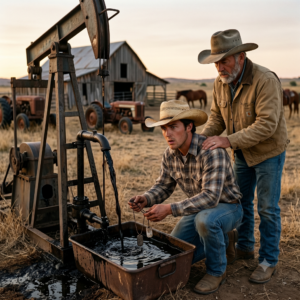
I Restarted the Abandoned Pumpjack to Save My Ranch… Then Black Water Came Out With My Brother’s Dog Tags
Part 1: The Nodding Donkey I am Elias Boone, and I am watching my legacy turn to dust in the West Texas sun. If you’ve never lived through a true Texas drought, you don’t know what silence sounds like. It’s…
I Opened My Grandfather’s Dry Well to Save My Horses… Then It Started Breathing Back
I Opened My Grandfather’s Dry Well to Save My Horses… Then It Started Breathing Back My name is Caleb Mercer. I run a fourth-generation horse ranch out in the dust-choked plains of eastern Montana. Two weeks ago, the heatwave hit…
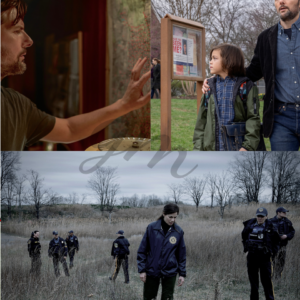
Copycat or Wrongfully Convicted? The 20-Year-Old Lie Haunting Netflix’s Next Masterpiece.
A Stolen Son, An Estranged Father, and a Deadly Secret: Inside Netflix’s Most Anticipated Thriller, ‘The Whisper Man’ By The Entertainment Desk | Releasing August 28, 2026 on Netflix There is a specific kind of terror that comes not from…

“HOLD YOUR HEAD HIGH”: Why The Anthony Family’s Delusion Is Becoming Dangerous…
THE ULTIMATE GRIFT: A $634K Mystery, A “Penniless” M*rderer, and the Tone-Deaf “Sweet Boy” Delusion Outraging a Nation If the Frisco community thought the 35-year prison sentence handed down to 19-year-old Karmelo Anthony would bring an end to the psychological…
THE PR STUNT BACKFIRES: Did The Girlfriend’s Post Just Ruin His “Penniless” Appeal?
THE ULTIMATE GRIFT: A $634K Mystery, A “Penniless” M*rderer, and the Tone-Deaf “Sweet Boy” Delusion Outraging a Nation If the Frisco community thought the 35-year prison sentence handed down to 19-year-old Karmelo Anthony would bring an end to the psychological…
End of content
No more pages to load