I Sold the New Livestock App… and Bought a Dog Too Old to Run
I Sold the New Livestock App… and Bought a Dog Too Old to Run
Part 1: The Silicon Sky and the Slower-than-Dirt Dog
“You canceled the SkyHerd Premium subscription,” my father said, his voice dangerously low. It wasn’t a question. He was staring at his iPad, violently tapping a screen that had just gone dead.
I leaned against the weathered rail of the corral, pulling my Stetson lower against the biting Colorado sun. “I didn’t just cancel the subscription, Dad. I sent the drones back to Denver. The GPS collars are sitting in a cardboard box in the barn.”
My father finally looked up, his face flushed a deep, furious crimson. “That technology cost this ranch fifteen thousand dollars, Luke! It mapped the herd! It gave us real-time biometric tracking! And you traded it for… for what?”
He pointed a shaking finger at the dirt near my boots.
Lying there in the dust, panting softly, was Ranger. He was a Border Collie mix, though you could barely tell anymore. His muzzle was completely white, his left eye was clouded with cataracts, and his back hips were so locked with arthritis that his walk was more of a sideways shuffle.
“I bought back Grandpa’s dog,” I said firmly. “Cost me fifty bucks at the Henderson auction. They were going to put him down because they said he was too old to run.”
My father let out a harsh, mocking laugh that echoed off the sides of the barn. “He is too old to run! He’s thirteen years old! You traded a fleet of aerial drones for a dog that walks slower than a newborn calf. The whole county is already laughing at us. Miller told me at the feed store that I should buy you a walker and some tennis balls for your new ‘ranch hand.'”
“Let them laugh,” I replied, kneeling down to scratch Ranger behind his tattered ears. The old dog leaned into my hand, letting out a low, contented groan. “The tech was killing our herd.”
My father scoffed and turned away, but I knew I was right.
When Dad had brought in the SkyHerd system three months ago, he thought it was the silver bullet for our struggling cattle operation. On paper, it was flawless. You could sit in the air-conditioned living room and see exactly where all three hundred head of cattle were grazing.
But a microchip only tells you where an animal is. It doesn’t tell you why they are there.
Within weeks, the system began to tear the herd apart. The drones, programmed to do fly-overs and “herd” stragglers back to the main group, were absolute terrors. A cow doesn’t understand a buzzing, four-propeller piece of plastic in the sky. To them, it sounded like a massive hornet.
It was especially disastrous for the new mothers. When a drone swooped in to nudge a heifer back to the perimeter, the mother would panic. Their maternal instincts went into overdrive, making them erratic and aggressive. Calves were getting trampled. Mothers were abandoning their babies in the brush to flee the mechanical buzzing. We had a dashboard of perfect data, but out in the pasture, the cows were stressed, losing weight, and breaking their legs.
So, I pulled the plug. I drove into town, found the man who had bought Grandpa’s old dog two years ago after Grandpa passed, and I brought Ranger home.
The mockery from the neighboring ranches was immediate. Whenever I rode out on my horse, old Ranger shuffling a hundred yards behind me, I’d see trucks slow down on the county road just so the drivers could laugh.
But what the neighbors didn’t see was the profound, instinctual genius of a dog who had spent a decade mapping every square inch of this Colorado mountain terrain in his head.
Ranger couldn’t sprint to flank a rogue bull anymore, but he didn’t need to. He knew the land better than any satellite. When a sudden, dry thunderstorm rolled over the peaks, the GPS app would have just shown dots scattering. Ranger, however, would sniff the ozone in the air, let out two sharp barks, and slowly lead the herd toward the low-lying alder groves—the one place on the ranch where lightning never struck.
He knew exactly which creek crossings had mud too deep for a calf, positioning his old, aching body right in the middle of the dangerous paths to force the herd to a safer crossing. He didn’t herd with speed; he herded with absolute, undeniable authority. The cows remembered him. They respected him.
The herd’s stress levels plummeted. The calves were staying with their mothers. Peace returned to the valley.
But there was one thing about Ranger that unsettled me.
Despite his encyclopedic memory of the ranch, there was one place he absolutely refused to go: the South Pasture. It was a lush, beautiful section of land at the base of the foothills, dominated by a massive, ancient cottonwood tree.
Whenever the herd drifted near it, Ranger would stop dead. He would sit in the dirt, the fur on his spine standing straight up, and let out a low, mournful whine. If I tried to ride my horse in that direction, the dog would deliberately block my path, growling softly.
I thought it was just the quirks of an old dog’s memory—maybe he had been bitten by a rattlesnake there years ago.
I had no idea that Ranger wasn’t avoiding a memory. He was guarding a secret.
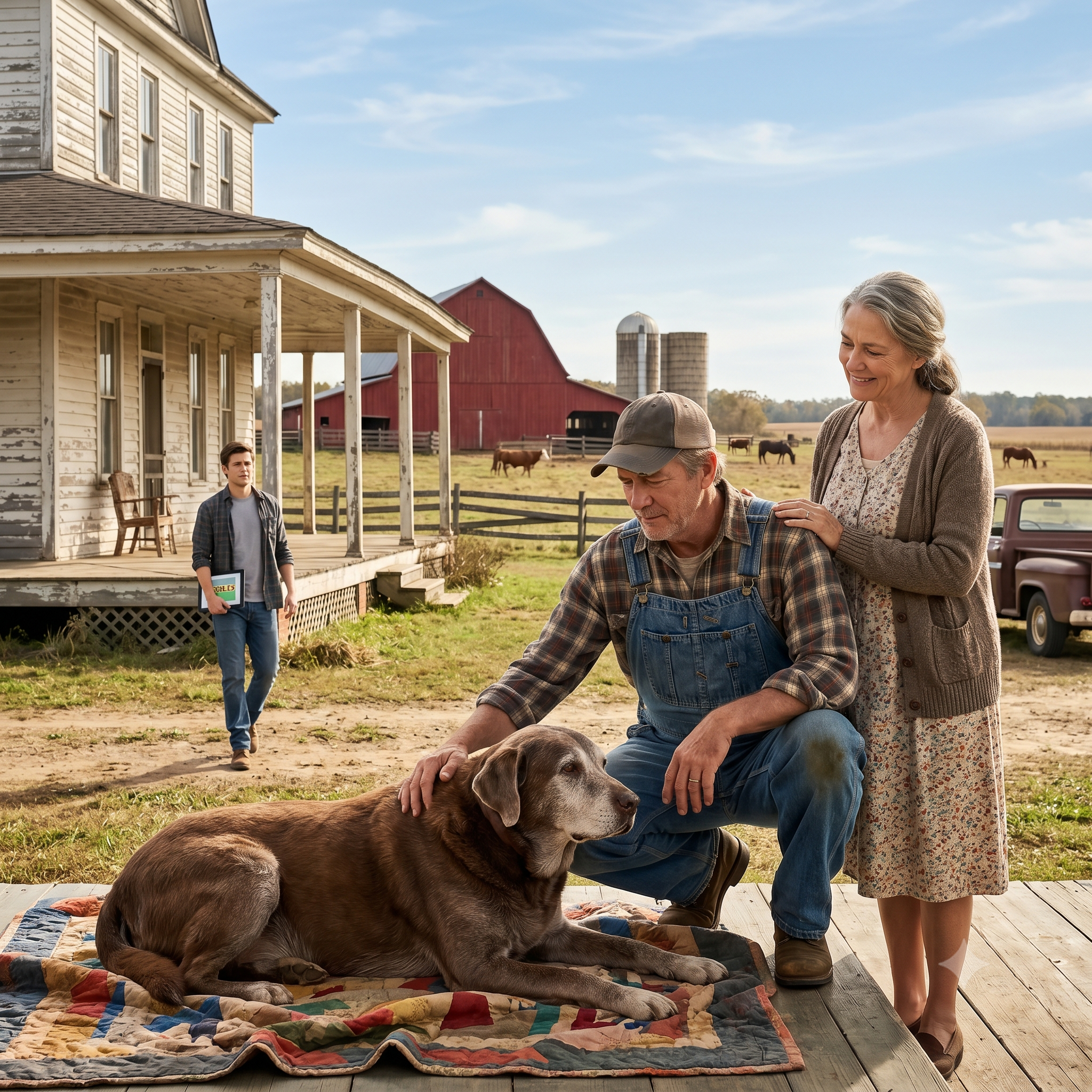
Part 2: The Whiteout and the Cottonwood Secret
Late October in the Rockies is a gamble. One minute you’re sweating in a t-shirt, and the next, the mountains decide to remind you who’s really in charge.
It happened on a Thursday afternoon. The temperature plummeted twenty degrees in ten minutes, and a massive, localized inversion trapped a thick, suffocating layer of mountain fog inside our valley.
It wasn’t just a mist; it was a total whiteout. Visibility dropped to less than five feet. The air was heavy, damp, and freezing.
My father burst out of the house, panic etched into every line of his face. “The herd is up on the upper ridge!” he shouted, his voice muffled by the dense fog. “They were grazing near Dead Man’s Drop! If they get spooked in this whiteout, they’ll walk right off the edge of the ravine!”
“I’ll get the ATV!” I yelled back.
“The drones!” he screamed, sprinting toward the barn. “We need to get the drones in the air to locate them!”
He spent ten agonizing minutes trying to launch the SkyHerd drone. But the moisture in the heavy fog coated the sensors instantly. The cameras showed nothing but a blinding gray wall. The GPS signals bounced uselessly off the dense atmospheric pressure. The technology was completely, utterly blind.
“We’re going to lose them,” my dad whispered, staring at the blank screen in his hands, utterly defeated. “They’re going to walk off the cliff.”
I didn’t answer. I whistled, a sharp, low tone.
From out of the gray mist, Ranger limped forward. His coat was damp, but his one good eye was locked onto mine.
“Find ’em, buddy,” I said softly, pointing toward the invisible ridge. “Find the babies.”
Ranger didn’t hesitate. He dropped his nose to the dirt, inhaling deeply, and began his slow, agonizing shuffle up the mountain.
I followed him on foot, leading my horse by the reins, trusting my life entirely to an arthritic, half-blind rescue dog. The fog was disorienting. Every tree looked like a ghost. I lost my sense of direction within ten minutes. If Ranger had stopped, I would have been completely lost on my own property.
But he didn’t stop. He navigated purely by scent, picking up the rich, musky odor of the herd and the subtle smell of trampled sagebrush.
We walked for what felt like hours. Suddenly, Ranger froze. He let out a sharp, commanding bark.
I hurried forward. Through the swirling gray mist, a massive shape appeared. It was a mother cow. Then another. And another.
Ranger had found them.
But my blood ran cold when the fog shifted for a fraction of a second. Just ten yards ahead of the herd, the ground abruptly vanished into the yawning, rocky abyss of Dead Man’s Drop. The cows had been inching forward in the blindness, minutes away from a fatal plunge.
Ranger calmly walked to the edge of the ravine, putting his body between the cliff and the cattle. He let out a series of low, rhythmic barks—not aggressive, just steady. The tone of an old master telling his students to turn around.
The herd shifted. Guided by the dog’s voice, they slowly turned their backs to the cliff and began marching down the safe trail toward the lower valley.
When the last calf passed us, I dropped to my knees in the wet dirt and buried my face in Ranger’s damp fur. “You did it, old man,” I choked out. “You saved them.”
The trek down took hours. By the time we reached the valley floor, the sun was beginning to burn through the fog, leaving the sky a bruised, twilight purple.
But instead of heading toward the barn, Ranger deviated from the path.
He turned sharply, his pace quickening with an urgency I hadn’t seen in him since I bought him. He headed straight for the South Pasture.
“Ranger! No! Barn!” I called out, exhausted.
He ignored me. He pushed through the tall grass, heading directly toward the massive, ancient cottonwood tree—the exact place he had been terrified to go for months.
Curiosity overrode my exhaustion. I tied my horse to the fence and followed him.
When I reached the base of the cottonwood, Ranger wasn’t whimpering or cowering. He was digging.
His front paws, usually stiff with arthritis, tore into the damp earth with a frantic, desperate energy. Dirt flew into the air as he excavated a spot right between the massive roots of the tree.
“Hey, stop,” I said, reaching down to grab his collar. “What are you doing?”
But my hand froze mid-air.
About a foot down, Ranger’s paws hit something metallic. He clamped his teeth onto it and pulled hard, dragging it out of the dirt and dropping it directly onto my boots.
It was a small, tarnished silver chain.
My breath hitched in my throat as I picked it up. The silver was heavily oxidized, caked in mud, but the heavy metal nameplate in the center was still intact. I rubbed my thumb over the dirt to reveal the engraving.
SAMMY
My stomach violently dropped.
Sammy was my older brother. He died twenty years ago when I was just a toddler. My father had always told me Sammy had passed away from severe childhood leukemia in a hospital down in Denver. We had an empty urn on the mantle because Dad said he couldn’t bear to keep the ashes.
I stared at the heavy dirt beneath the cottonwood tree.
If Sammy died in a hospital bed in Denver… why was the medical ID bracelet he never took off buried three feet deep in the dirt of the South Pasture?
I looked up. The fog had finally cleared enough to see the porch of the main house.
My father was standing there, staring dead at me, and he was holding a rifle.