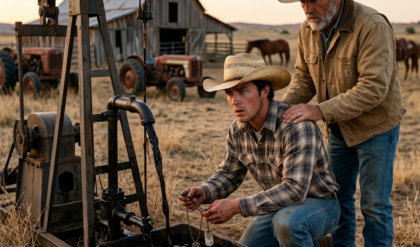
Part 1: The Nodding Donkey
I am Elias Boone, and I am watching my legacy turn to dust in the West Texas sun.
If you’ve never lived through a true Texas drought, you don’t know what silence sounds like. It’s the sound of the wind scraping across cracked mud where a creek used to be. It’s the sound of buzzards circling high above, waiting for another one of your Brangus heifers to give up and drop into the mesquite brush.
We had sixty head of cattle left. By Tuesday, we had forty-five.
I was desperate. The municipal water lines didn’t reach out to our acreage, and our main solar well had been sucking up nothing but sand for three weeks. If I didn’t find water by the weekend, I was going to lose the ranch that had been in the Boone family for four generations.
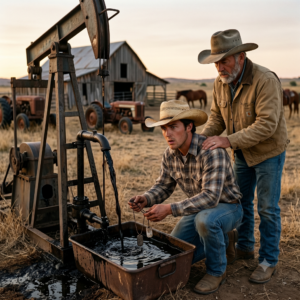
That desperation drove me to the far eastern edge of our property line, right up against the limestone ridge. Out there, half-swallowed by tumbleweeds and rust, sat an abandoned pumpjack.
We always called it the “Nodding Donkey.” It hadn’t operated in twenty years. Not officially, anyway.
My older brother, Caleb, and I used to run this ranch together. He was a force of nature, a former Army Ranger who came back from Afghanistan with a bad knee but a fierce love for this land. Three years ago, he went out to the eastern ridge to check on some downed fencing near that old pumpjack.
He never came back.
Sheriff Miller organized a search party that lasted four days. They brought dogs. They brought ATVs. They found nothing. A week later, Miller sat at my kitchen table, took off his Stetson, and told me what he thought. “Elias, Caleb had ghosts. You know he did. The war changed him. Sometimes, men like him just need to walk away. He probably hitched a ride on Interstate 10 and started over.”
I never believed it. Caleb wouldn’t abandon the ranch, and he sure as hell wouldn’t abandon his dog, Buster, who waited on the porch for a month after he vanished.
But grief makes you tired, and running a dying ranch alone makes you numb. Over the years, I avoided the eastern ridge. It felt like a graveyard.
Until the drought.
I remembered my father telling me once that the old pumpjack sat over a defunct exploratory well that had hit a massive, deep-water pocket before the oil company capped it. If the casing was still good, maybe—just maybe—I could rig the diesel engine to pull water up from the deep aquifer.
When I went into town to buy replacement gaskets and a heavy-duty filter for the old rig, the locals looked at me like I was a dead man walking.
“You ain’t messin’ with that rusted-out rig on the ridge, are you, Elias?” asked Tom Hanes, the owner of the feed store, wiping grease off his hands with a dirty rag.
“Got no choice, Tom. Cows are dying.”
Tom shook his head, his eyes shifting away from mine. “Leave it be, son. That ground is sour. Your daddy knew it, and Caleb knew it. You go digging around out there, you’re gonna wake up things that are better left asleep.”
I ignored him. People in small towns always have ghost stories about abandoned things.
The next morning, I drove my beat-up Ford F-150 out to the ridge. The heat was already blistering by 8:00 AM. I spent six hours tearing apart the pumpjack’s motor, replacing rotted belts, clearing out packrat nests, and priming the engine. My hands were bloodied and slick with decades-old grease.
Finally, just as the sun started to dip and paint the Texas sky a violent shade of purple, I grabbed the pull-cord on the auxiliary generator.
Cough. Sputter.
I pulled it again, putting my entire back into it.
The engine roared to life, spitting out a thick cloud of black diesel smoke. A second later, the massive steel gears groaned. The counterweights shifted, squealing in protest, and the great metal head of the pumpjack slowly bowed down.
Up. Down. Up. Down.
The rhythm shook the ground beneath my boots. I ran over to the release valve, holding an empty five-gallon bucket beneath the thick iron pipe, waiting for the sweet, life-saving rush of water.
I waited. The machine shrieked and pounded. Ten minutes passed.
Then, I heard it. A deep, hollow gurgling sound coming from miles beneath the earth. The pipe shuddered.
I braced myself, expecting a blast of clear, cold water.
Instead, the pipe violently coughed, and a thick, heavy stream of liquid exploded into the bucket.
It wasn’t water. And it wasn’t oil.
It was pitch black, but it didn’t have the thick, rainbow-sheen viscosity of crude. It was watery, freezing cold, and reeked of sulfur, rust, and heavy chemicals. It smelled like battery acid and rotting copper. The fumes immediately made my eyes water and my throat burn.
“What the hell?” I gagged, stumbling back as the bucket overflowed, spilling the black sludge onto the parched earth. Where it touched the dead grass, the weeds seemed to instantly wither and smoke.
I lunged forward to hit the kill switch on the engine, but as I reached over the catch-grate beneath the main valve, something shiny caught my eye.
The machine was sputtering, choking on debris. I looked down into the heavy-duty mesh filter I had just installed. Trapped in the steel wire, coated in the horrifying black liquid, was a tangle of metal.
I killed the engine. The sudden silence was deafening, broken only by the hiss of the black water soaking into the dirt.
My hands shaking, I reached into the foul-smelling sludge in the filter grate. My fingers brushed against a metal chain.
I pulled it out.
I wiped the toxic, black muck off the metal on the leg of my jeans. My breath caught in my chest. My knees gave out, and I hit the dirt hard.
Lying in the palm of my hand were two silver dog tags.
BOONE, CALEB J. O POS
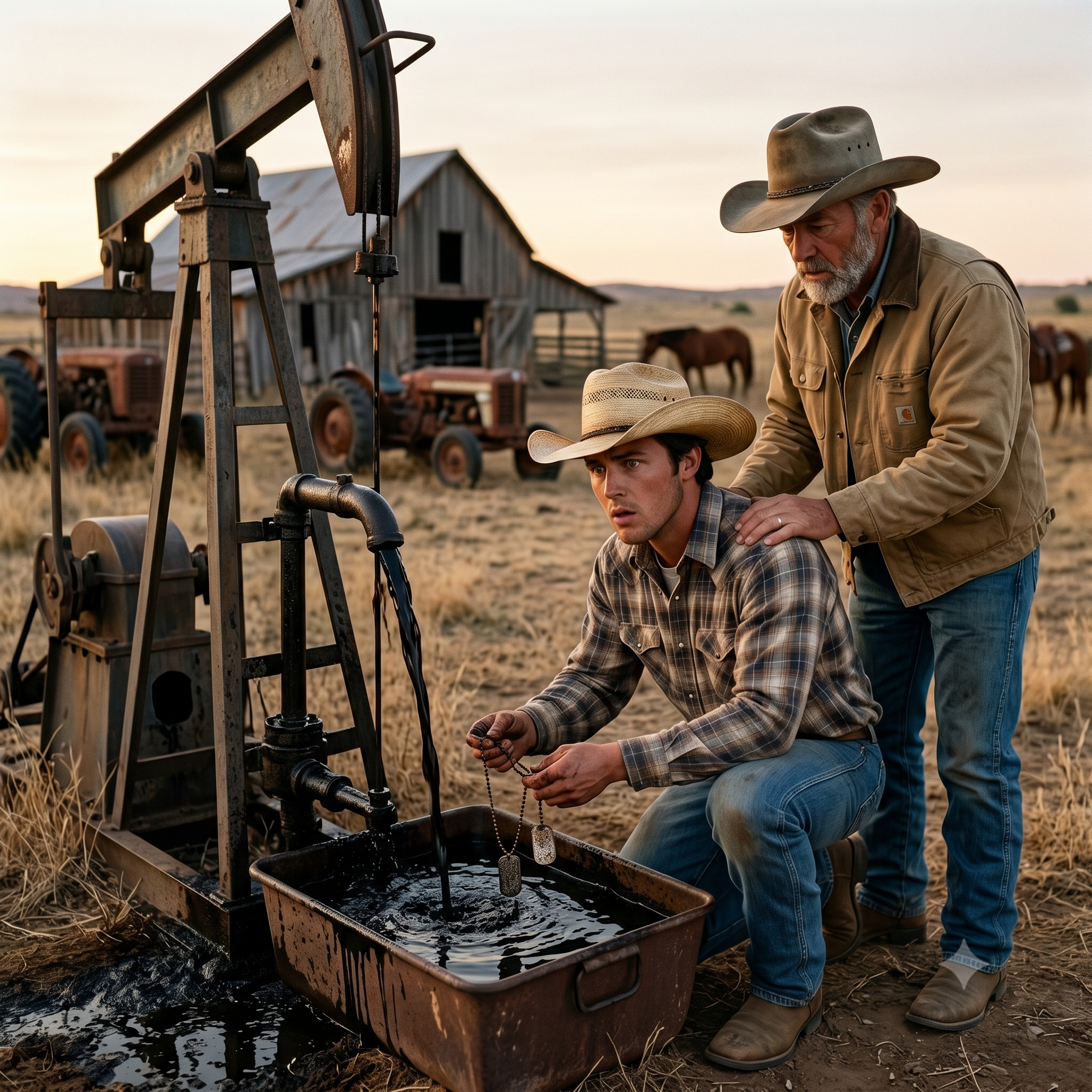
My brother’s tags. The ones he never, ever took off.
My mind spun into a state of pure panic and denial. If his dog tags came out of the well… did that mean Caleb was down there? Did he fall in? But the well casing was barely eight inches wide. A grown man couldn’t fit down that hole.
I wiped my face, leaving a streak of toxic black sludge across my cheek, and forced myself to look at the machinery.
That’s when I noticed it.
The heavy vibrations of the engine had rattled away years of packed dirt and tumbleweeds from the base of the pumpjack. Beneath the concrete foundation, barely visible in the fading light, was a secondary pipe.
It wasn’t going down into the earth. It was going horizontal.
I grabbed my heavy Maglite flashlight from the truck and knelt in the mud. The pipe was massive, at least three feet in diameter, made of reinforced industrial steel. It bypassed the well entirely and burrowed straight into the side of the limestone ridge behind the pumpjack.
The machine wasn’t pumping from the deep aquifer. It was pumping from whatever was hidden inside that hill.
And my brother’s dog tags had just been flushed out of it.
Part 2: The Devil’s Aquifer
I didn’t call the sheriff. Not after he had written Caleb off as a runaway. If there was a secret buried on my land, I was going to unearth it myself.
I grabbed a pickaxe, a crowbar, and my Winchester rifle from the truck.
I followed the trajectory of the buried pipe, walking up the slope of the limestone ridge. The brush here was impossibly thick, choked with thorny mesquite and dead scrub oak. About fifty yards up, I noticed an unnatural depression in the rocks. The brush hadn’t grown here; it had been deliberately piled up to hide something.
Swinging the pickaxe wildly, I tore the dead branches away. My heart was hammering against my ribs like a trapped bird.
Beneath the brush lay a heavy, rusted steel grate set into the stone—an access hatch. A heavy padlock secured it, but thirty years of West Texas weather had eaten away at the iron. One solid swing of the crowbar shattered the lock.
I heaved the grate open. A blast of cold, chemical-scented air hit me in the face, carrying that same metallic, rotten-egg stench of the black water.
I clicked on my flashlight, illuminating a steep set of concrete stairs leading down into the pitch black. Cocking my rifle, I began my descent.
The air grew colder with every step. The stairs spiraled down for what felt like fifty feet before opening up into a massive, cavernous space. I swept my flashlight beam across the darkness and gasped.
This wasn’t a natural cave. It was a man-made concrete bunker, easily the size of a football field. Industrial pipes ran along the ceiling, and massive storage tanks loomed in the shadows.
It was an illegal waste injection site.
I realized instantly what I was looking at. Fracking companies generate millions of gallons of highly toxic wastewater—laden with heavy metals, radioactive isotopes, and lethal chemicals. Disposing of it legally costs a fortune. Pumping it secretly into an abandoned, unmapped underground cavern? That’s free.
The pumpjack outside wasn’t designed to pull anything up. It was a camouflage mechanism. When it ran, it masked the sound of the subterranean pumps injecting millions of gallons of toxic sludge into the earth.
My flashlight beam caught a large metal logo bolted to the side of the main holding tank: APEX ENERGY.
The same company that had leased the mineral rights to the adjoining county ten years ago.
I kept walking, the crunch of my boots echoing off the concrete. Near the back of the cavern, my light illuminated something that made my blood run cold.
A makeshift campsite.
There was a rotting sleeping bag, a camping lantern, and a stack of empty MRE wrappers. I ran over to it. Sitting on an overturned milk crate was a leather-bound notebook. Caleb’s notebook.
I opened it, shining my light on the pages. They were filled with Caleb’s frantic, jagged handwriting. Dates, times, license plate numbers of tanker trucks that had sneaked onto our property in the dead of night.
“May 12th,” one entry read. “They’re pumping it directly into the limestone fissures. The containment tanks are leaking. The sludge is leaching down into the primary aquifer. That’s why the Henderson’s cattle died. That’s why the water in the north well tastes like copper. They’re poisoning the whole damn county.”
I flipped the page.
“May 14th. I have the proof. I’ve taken photos. I’ve mapped the injection lines. I’m taking this to the EPA tomorrow. I have to tell Dad first.”
My breath hitched. Dad.
Arthur Boone had been a hard man, proud to a fault. He passed away from a sudden heart attack two years ago, a year after Caleb disappeared. I always thought a broken heart killed him.
I turned to the final page of the journal. There was a folded piece of paper tucked inside. It was a photocopy of a legal document.
I unfolded it, my hands shaking uncontrollably.
It was a Non-Disclosure and Settlement Agreement between Apex Energy and Arthur Boone. Dated May 15th—the day after Caleb’s last journal entry. The day Caleb vanished.
The document outlined a lump sum payment of $1.5 million to Arthur Boone in exchange for his “absolute silence regarding the subterranean operations on the eastern ridge.” It also included a clause releasing Apex Energy from any liability regarding “the unfortunate and accidental passing of Caleb Boone on company-leased property.”
My stomach violently rebelled. I dropped to my knees, dry-heaving into the dust.
My father knew.
He didn’t just know about the poisoning of the land. He knew Caleb had been caught down here by Apex fixers. He knew they had killed his oldest son and dumped his body—likely right into one of those toxic holding tanks. And to save the ranch from bankruptcy, to pay off the bank, my father took their blood money and signed away his son’s life. He let the sheriff call him a runaway.
“Oh, God, Dad… what did you do?” I whispered to the empty, toxic dark.
I sat there for an eternity, the weight of the betrayal crushing the air out of my lungs. The ranch I was killing myself to save was built on a foundation of poison and my brother’s blood.
Eventually, the survival instinct kicked in. The fumes were making me lightheaded. I grabbed Caleb’s journal, shoved the settlement paper into my pocket, and practically sprinted back up the concrete stairs, bursting out into the cool night air.
I collapsed by the truck, gasping for clean oxygen. The stars above West Texas were brilliant and indifferent to my shattered world.
I sat against the tires of my F-150 and pulled the dog tags out of my pocket. They were still grimy from the toxic sludge. I took my canteen and poured clean water over them, rubbing the metal between my thumb and forefinger to clean off the remaining black residue.
As the grime washed away, I noticed something odd about the second tag. Caleb had always carried a standard issue tag, but the second one felt thicker.
I shined my flashlight on it. It wasn’t standard issue. Caleb had taken a piece of scrap metal, cut it to the size of a dog tag, and used a military stamping kit to punch letters into it. He must have done it down in that bunker, realizing he was trapped, knowing they were coming for him. He threw it into the intake pipe, praying that one day, somehow, it would get flushed out.
I traced my thumb over the raised metal letters.
The message was stamped clearly onto the back:
ELIAS. IF YOU FIND THIS, THEY KILLED ME. DON’T DRINK THE WATER FROM THE NORTH WELL. AND ELIAS… THE SHERIFF IS ON THEIR PAYROLL. TRUST NO ONE.
A cold shiver crawled up my spine, freezing the sweat on my neck.
I looked up from the tags.
In the distance, at the end of the long dirt road leading to my property, I saw headlights cut through the darkness. Two vehicles. Moving fast.
They weren’t flashing police lights, but as they got closer, the moonlight caught the familiar silhouette of Sheriff Miller’s cruiser, followed closely by an unmarked black SUV.
The engine of the pumpjack had alerted them. They knew I had turned it on.
I looked at the tags. I looked at my rifle.
The drought had almost killed me, but now, the real fight was about to begin.
News
THE DAP THAT STARTED A M*RDER: The Missing 30 Seconds Before The Fatal Stabbing!
THE SILENT BETRAYAL: The Deadly “Invitation” That Put a Bl*de in the Tent and Cost Austin Metcalf His Life For over a year, the narrative of the Memorial High School track meet tragedy was brutally simple: a 17-year-old team leader…
I Opened My Grandfather’s Dry Well to Save My Horses… Then It Started Breathing Back
I Opened My Grandfather’s Dry Well to Save My Horses… Then It Started Breathing Back My name is Caleb Mercer. I run a fourth-generation horse ranch out in the dust-choked plains of eastern Montana. Two weeks ago, the heatwave hit…
Copycat or Wrongfully Convicted? The 20-Year-Old Lie Haunting Netflix’s Next Masterpiece.
A Stolen Son, An Estranged Father, and a Deadly Secret: Inside Netflix’s Most Anticipated Thriller, ‘The Whisper Man’ By The Entertainment Desk | Releasing August 28, 2026 on Netflix There is a specific kind of terror that comes not from…

“HOLD YOUR HEAD HIGH”: Why The Anthony Family’s Delusion Is Becoming Dangerous…
THE ULTIMATE GRIFT: A $634K Mystery, A “Penniless” M*rderer, and the Tone-Deaf “Sweet Boy” Delusion Outraging a Nation If the Frisco community thought the 35-year prison sentence handed down to 19-year-old Karmelo Anthony would bring an end to the psychological…
THE PR STUNT BACKFIRES: Did The Girlfriend’s Post Just Ruin His “Penniless” Appeal?
THE ULTIMATE GRIFT: A $634K Mystery, A “Penniless” M*rderer, and the Tone-Deaf “Sweet Boy” Delusion Outraging a Nation If the Frisco community thought the 35-year prison sentence handed down to 19-year-old Karmelo Anthony would bring an end to the psychological…
AUSTIN DESERVES BETTER Why We Cannot Let The Mob Rewrite This Tragedy…
THE SICKEST TWIST YET: A Grieving Family Hunted, Death Threats, and the Toxic Mob Trying to Rewrite Austin Metcalf’s M*rder The Collin County justice system handed down a 35-year prison sentence to 19-year-old Karmelo Anthony, officially convicting him of the…
End of content
No more pages to load