We hauled up a $35,000 “Sea Urchin.” We should have cut the net.
The North Atlantic doesn’t apologize. It just takes. I’ve known this since I was old enough to bait a trap. But what we pulled up from the depths of Casco Bay, three days before Halloween, didn’t feel like a take. It felt like an offering. And I knew, the second the winch started screaming, that we should have refused it.
My name is Caleb. I’m thirty-two, the age when you stop dreaming about being an oceanographer and accept that your destiny is to be a third-generation fisherman on a greasy lobster boat. I work for Captain Silas. Silas is a good captain, which is a nice way of saying he’s a hard man who loves money almost as much as he loves a low diesel bill.
That morning was brutal. The fog was a cold, wet rag against my face. The water wasn’t grey; it was slate-black, churning with the promise of an unforecasted gale. We were a few miles out, running pots, when the tragedy happened. The bottom trawler net snagged.
Silas, swearing in a dialect only other Maine fishermen understand, engaged the main winch. It didn’t budge. The hydraulic lines whined, a pitch I’d never heard, even when hauling thousand-pound anchor rocks.
— “Damn it, Caleb! Go to the stern. It’s too heavy. If the cable snaps, it’ll cut you in half,” he yelled over the engine’s roar.
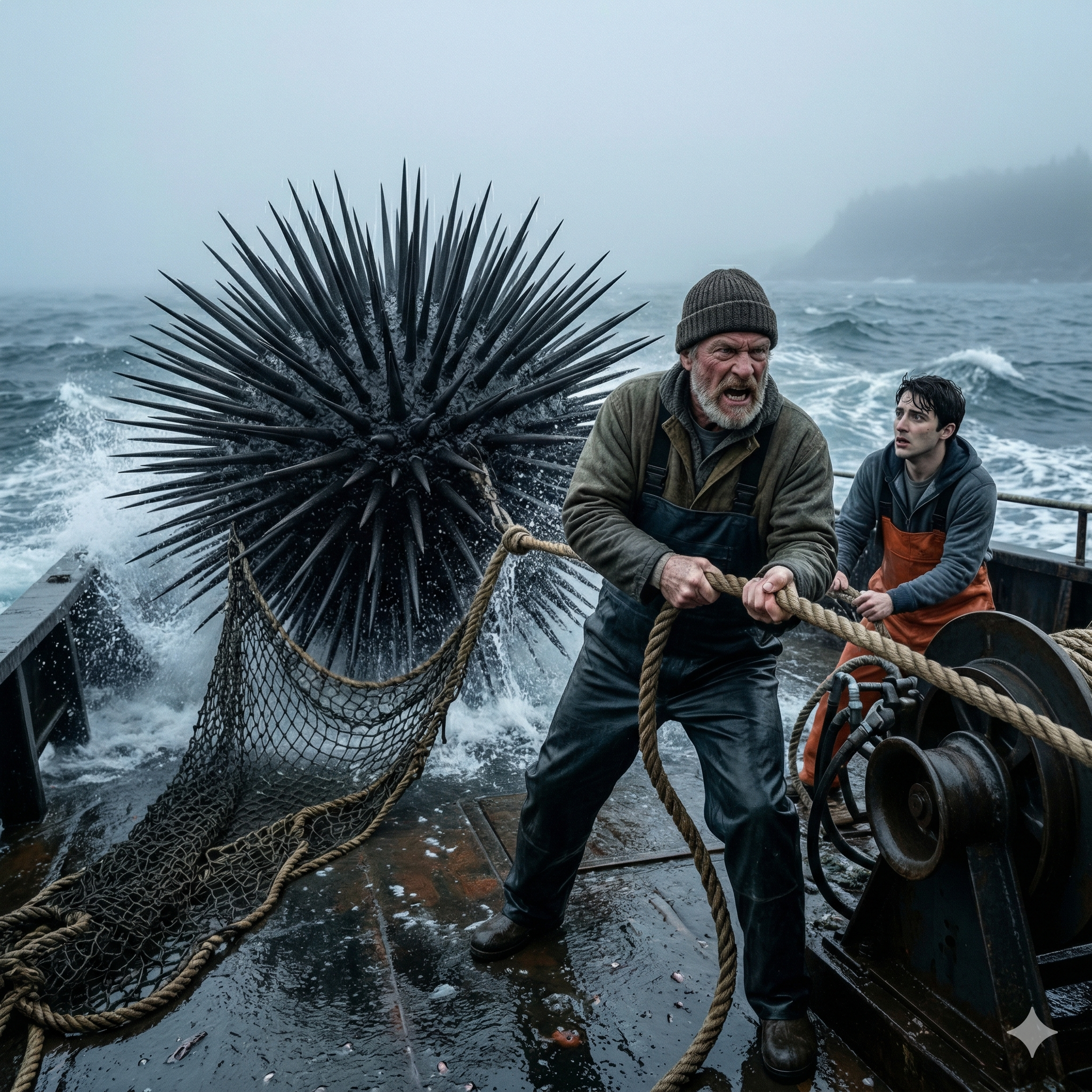
I moved. I hated the stern. It’s where the sea feels closest. Through the churning water, a shape began to emerge. It wasn’t the irregular blob of a granite rock. It was too symmetric. Too… wrong.
It was a perfect black sphere, perhaps eight feet in diameter, surfacing like a submarine. As it broke the water, the winch gave a final, agonizing lurch, and the wooden gunwale of the trawler The Sea Hag groaned.
— “Holy…” Silas’s curse died in his throat.
We were looking at a giant sea urchin. No, that’s too quaint a term. We were looking at a Goliath Urchin. The spines were blacker than charcoal, each one thick as a spear shaft, maybe two feet long. They were packed so densely it looked like a terrifying, spiked armor plating.
The ocean was suddenly dead silent. The wind dropped. No seabirds cried. Just the slosh of the water around this monstrous, dark star.
Silas, the practical man, immediately found his voice.
— “Look at the size of it! Caleb, look! The roe… if it’s an urchin, that much high-grade uni is worth more than a whole season of bugs.”
My skin crawled. I’ve visted a lot of marine labs. I knew urchins don’t get this big. Not on Earth.
— “I don’t know, Captain. It doesn’t look like any urchin I’ve ever seen. It’s too heavy. Too… regular. Let’s just cut the net. It’s pulling us too low.”
The Sea Hag was already listing slightly under the weight of the brute. Silas just stared at the 1,200-pound black sphere with a greed that was genuinely terrifying.
— “Cut the net? Are you simple? We just hit the jackpot. This is some prehistoric, deep-water mutation. Scientists will pay millions. Fish buyers will fight to their death for this.”
It took three hours, another fisherman (Old Pete) whom we called for backup, and enough marine cable to tie up a cruise ship. We had to use the hydraulic crane to lift the sphere. When its spines finally met the wooden deck, the Sea Hag shuddered, the wood splintering. I swear I heard the sphere give a dull, resonant hum when it made contact.
We inspected it. No eyes. No mouth. No apparent sense of up or down. Just a sea of two-foot spikes, making a dry, rattling, bone-on-bone sound when the boat rocked. When I brushed against one, my finger went numb instantly.
We got back to the dock at 4 PM. We couldn’t hide it. The Sea Hag was running low and heavy. The whole town of Port Elizabeth was already there. Old Man Silas’s phone had been busy.
The local news was filming. A crowd of locals, eyes wide, whispered:
— “Must be from the government test range out on the shelves.”
— “Looks like a mine. A spiky, organic mine.”
— “It’s worth a fortune!”
Silas was holding court, his face alight with dollar signs. Me? I just couldn’t look away from the way the crowd’s cell phone lights absorbed into the creature’s spikes, rather than reflecting off them. It didn’t feel like a “discovery.” It felt like we had just cracked open a coffin that had been resting on the sea floor for millennia, and the thing inside was beginning to wake up.
We didn’t know yet, but Old Man Silas had already sold it. The “Sea Urchin” was gone before we could even find a scale big enough to weigh it. And that’s when the real nightmare started.
PART 2: THE AUCTION OF BONES AND THE THAWING VOID
Title: We sold the “Goliath Urchin” for $35,000. Now the town is screaming.
By 7:00 PM, the atmosphere at the Port Elizabeth dock had shifted from curiosity to something feverish. A man had arrived in a black SUV—not a government official, but a private “collector” Silas had met through a back-channel contact in the high-end seafood trade. He went by the name Mr. Vance.
Vance didn’t look at the sphere with wonder; he looked at it with recognition. He handed Silas a briefcase. Thirty-five thousand dollars in cold, hard cash. No taxes, no questions. Silas was vibrating with joy.
— “Get it into the cold storage locker,” Vance commanded, his voice as dry as salt. “It must remain at near-freezing temperatures. Do not let the core temperature rise.”
We moved it into the town’s communal bait-and-catch locker, a massive concrete room chilled to 34°F. As we rolled it on a heavy-duty dolly, the “lộp cộp” sound—that bone-on-bone rattling—became deafening. It wasn’t just rolling; the spikes were shifting.
Vance locked the door and told everyone to go home. He said he’d be back at dawn with a specialized transport team.
I couldn’t sleep. My hand, the one that had brushed the spike, wasn’t just numb anymore. It was turning a translucent, bruised purple. And it was cold. No matter how many blankets I piled on, my fingers felt like they were dipped in liquid nitrogen.
Around 2:00 AM, my phone buzzed. It was Pete, the guy who helped us haul it in.
— “Caleb… you need to get down to the locker. The power went out across the whole waterfront. The cooling system is dead.”
I jumped in my truck. When I arrived, the docks were eerily quiet. The fog had returned, thicker than before, smelling of rotted kelp and something metallic. Silas was there, frantic, trying to kick-start the backup generator.
— “It won’t turn over!” he screamed. “The oil is like sludge. It’s too cold!”
He was right. Even though it was a mild October night, the air around the concrete locker was freezing. Frost was forming on the outside of the building.
Then, we heard it.
A sound that didn’t belong in nature. It wasn’t a roar. It was a high-pitched, harmonic vibration, like thousands of glass flutes shattering at once. It was coming from inside the locker.
— “Open the door,” I whispered, though every instinct told me to run.
Silas grabbed the heavy iron handle. It was frozen shut. He hammered at it with a crowbar until the ice cracked, and the door swung open.
A wave of black vapor rolled out. It wasn’t smoke; it was a mist that seemed to drink the light of our flashlights. In the center of the room, the “Goliath Urchin” was no longer a sphere.
It had unfolded.
The 1,200-pound object had bloomed like a nightmarish flower. The 40cm spikes weren’t spikes—they were ribs. Long, articulated, jet-black bones that were now twitching and clawing at the concrete floor.
It wasn’t an animal. It was a vessel.
In the center of the “ribs,” where the core should have been, there was no meat, no roe, no “uni.” There was a humanoid shape, curled in a fetal position. It was small, the size of a child, but its skin was the same matte-black as the spikes. It had no face—just a smooth, obsidian surface where eyes and a mouth should be.
And it was thawing.
As the room warmed up from the open door, the creature’s “ribs” began to pulse. The sound of “lộp cộp” wasn’t the spikes hitting each other; it was the sound of its joints snapping into place.
Silas reached out, his greed still outweighing his sanity.
— “That’s… that’s not a fish. That’s an artifact. If the body is intact, it’s worth millions—”
— “Silas, get back!” I yelled.
But it was too late. One of the black ribs whipped out with the speed of a serpent. It didn’t pierce him. It just touched his arm.
In an instant, Silas didn’t scream. He simply stiffened. I watched in horror as his skin turned that same translucent purple, then gray, then solid black. Within three seconds, his entire arm had become brittle, turning into the same bone-like material as the creature.
The creature in the center of the ribs began to uncurl. It stood up, its movements jerky, like a stop-motion film. It didn’t look at us—it didn’t have eyes—but it tilted its smooth head toward the open sea.
Then, it let out that harmonic vibration again.
From the dark waters of the harbor, dozens of similar hums answered back. Huge, black shapes began breaking the surface of the water near the docks. Hundreds of them.
They weren’t “urchins” we had found. We had fished an anchor out of the water. This thing was a beacon, and by bringing it into the warmth of the town, we had signaled that the surface was ready.
I’m writing this from the cab of my truck, driving as fast as I can toward the mountains. I can see the lights of Port Elizabeth flickering out in my rearview mirror. The radio is nothing but that glass-flute screaming.
If you live near the coast, and the fishermen bring in something “strange” and “valuable”…
Don’t look at the price tag.
Run.
I haven’t slept in forty-eight hours. My truck is parked in a rest area outside of a small town in the White Mountains, New Hampshire. The heater is blasted to the max, but I can’t stop shivering. It’s not just the cold; it’s my hand.
The purple bruising has moved past my wrist. The skin there isn’t skin anymore. It’s hard, like polished obsidian, and when I tap my fingernail against my forearm, it makes a dull, hollow clink. Like bone. Like the “urchin.”
I turned on the radio ten minutes ago. It doesn’t matter what frequency I find—top 40, country, emergency weather broadcasts—it’s all gone. There’s just that sound. The “Glass Flutes.” It’s a rhythmic, pulsing vibration that makes the dashboard of my truck rattle. It feels like it’s trying to recalibrate my heartbeat.
I pulled up a livestream from a pier-cam in Portland, Maine, before the cell towers started failing.
The water wasn’t blue or gray anymore. It was shimmering with black. Thousands of those spheres—those “anchors”—had surfaced. They weren’t just sitting there. They were opening.
On the screen, I saw a Coast Guard cutter try to approach one. The ship didn’t even get within fifty yards before the harmonic sound hit it. Through the grainy footage, I watched the steel hull of the ship turn from white to a brittle, matte black in seconds. The boat didn’t sink; it shattered like a frozen lightbulb, spilling men into the water who never even resurfaced. They just became part of the black reef growing beneath the waves.
Then I saw them.
The things from inside the ribs. The “Pilots.”
They don’t swim like fish. They move through the water with a terrifying, jerky grace, standing upright on the surface of the sea as if the laws of physics had been rewritten for them. They were walking toward the shore. Hundreds of smooth, faceless, obsidian figures, their “ribs” trailing behind them like capes made of spears.
My phone buzzed one last time. A text from Pete. He stayed behind to try and find his family.
Caleb. It’s not an invasion. It’s a harvest. They aren’t killing us. They’re… converting. Silas isn’t dead. I saw him on the dock. He’s standing there, but he’s black stone now. He’s singing, Caleb. He’s making the flute sound. Don’t come back. Stay in the light. Stay warm. They hate the—
The text cut off.
I looked at my arm. The blackness is at my elbow now. I realized why Mr. Vance wanted it kept in the cold storage. It wasn’t to keep it fresh. It was to keep it dormant. These things are biological superconductors. They thrive on heat. They absorb energy—thermal, electrical, even the warmth of a human body—and use it to “bloom.”
By bringing that thing into the locker, by trying to “sell” it, we didn’t just find a treasure. We provided the spark.
Outside my truck, the woods are silent. But the frost on the trees is turning black. The snow falling isn’t white; it’s gray soot, smelling of salt and ancient lungs.
I can hear a car pulling into the rest area. It’s driving slowly. No headlights. Just that low, humming vibration coming from its engine.
I’m looking at the lighter in my cup holder. It’s the only heat source I have left. My hand is almost completely stone now. I can’t feel the pain anymore, only a strange, rhythmic pull toward the east. Toward the ocean.
If you can still hear me, if you’re still “warm”…
Burn it. Burn everything. Don’t let the cold in. Because once the music starts, you don’t just listen to it.
You become the instrument.
News
🤯 THE LOCKET, THE TAPE, & THE DETECTIVE: The Final Twist in the Kruger Investigation.
THE GRAVE SPEAKS: A Hidden Locket, a Smuggled SD Card, and the Final Trap That Broke the Kruger Syndicate PRETORIA — Just when the corrupt political elites of South Africa thought they could manage the fallout of the Kruger National…

“MY SON WAS TREATED LIKE AN ANIMAL.” THE FATHER’S UNTOLD STORY.
SOUTHAMPTON — The click of metal handcuffs is a sound meant to signify the capture of a dangerous criminal. But on a freezing December night in 2025, that sharp, metallic snap became the soundtrack to one of the most profound…
💔 5 WORDS THAT SHAMED A NATION: “DON’T THINK YOU HAVE, MATE.”
SOUTHAMPTON — The click of metal handcuffs is a sound meant to signify the capture of a dangerous criminal. But on a freezing December night in 2025, that sharp, metallic snap became the soundtrack to one of the most profound…

THE 2037 DREAM IS DEAD: How A Single “Hot Mic” Recording Just Guaranteed Mackenzie Will Never Walk Free
THE “HOT MIC” BOMBSHELL: Leaked Audio And Prison Secrets Just Destroyed Mackenzie Shirilla’s Netflix Lie For Good 🎙️🛑 “I am not a monster. I am a driver in a tragedy.” Millions of viewers watched the tear-streaked face of 21-year-old Mackenzie…

THE WHISTLEBLOWER SPEAKS: Why A Netflix Editor Risked Everything To Expose Mackenzie Shirilla’s Sickening Act
THE “HOT MIC” BOMBSHELL: Leaked Audio And Prison Secrets Just Destroyed Mackenzie Shirilla’s Netflix Lie For Good 🎙️🛑 “I am not a monster. I am a driver in a tragedy.” Millions of viewers watched the tear-streaked face of 21-year-old Mackenzie…
💔 THE PLOT TWIST NO ONE SAW COMING: We Finally Know Where The Mother Is.
🚨 SHOCKING DISCOVERY: Police Breached A “Fake Wall” Inside The Temple Home. The True Source of the “Odor” Finally Revealed. By Senior Investigative Desk Dateline: Temple, Texas — June 2, 2026 When Temple Police Department tactical teams first breached the…
End of content
No more pages to load