The Bride at His Door Knew the Song His Dead Mother Sang Only Once
Part I: The Song of the Winter Wind
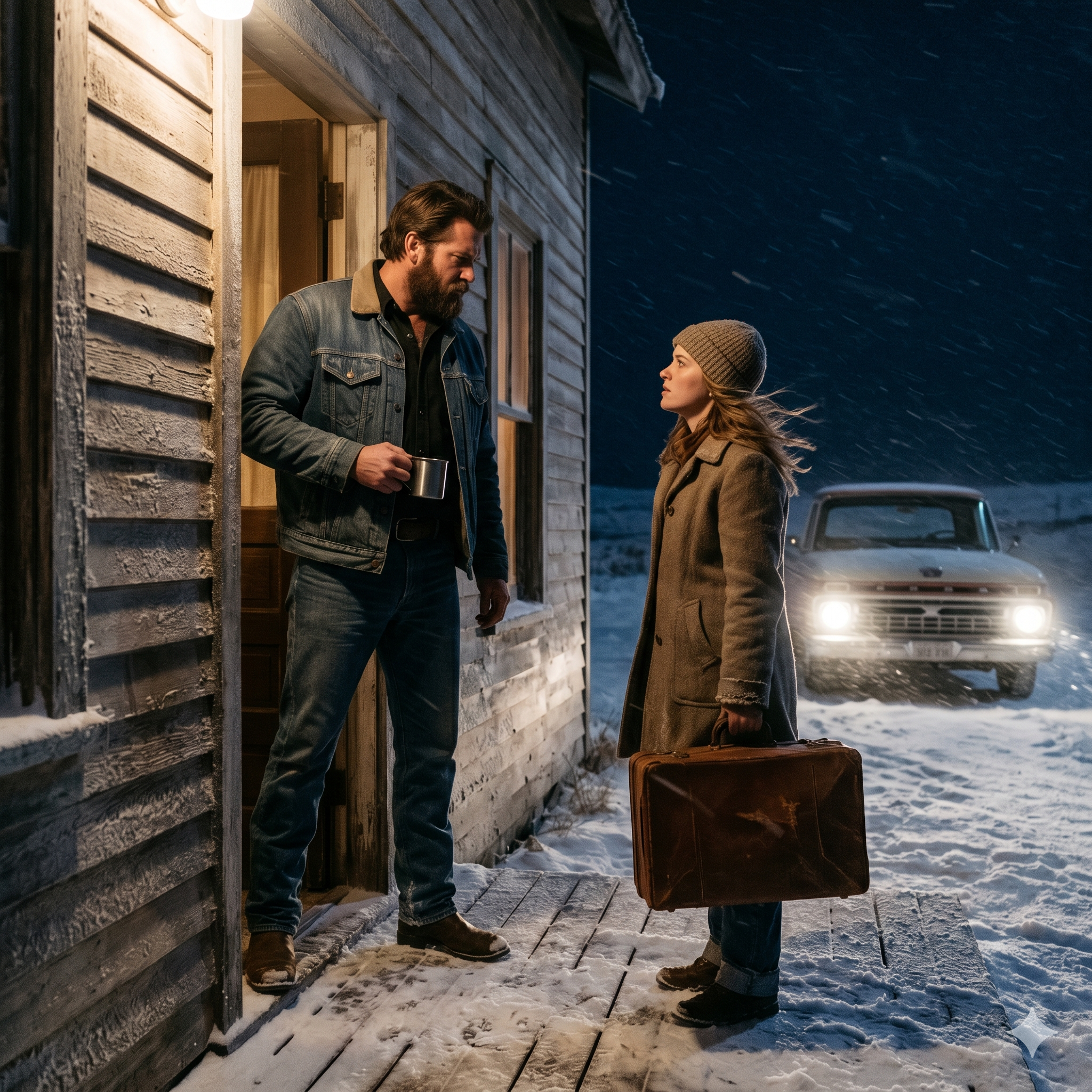
The Dakota badlands did not welcome the weak, and they certainly did not welcome strangers. The winter wind howled across the frozen plains like a wounded animal, rattling the heavy timber beams of the Everett Ranch. Cole Everett stood by the frost-choked window, a steaming mug of black coffee in his calloused hand, watching the headlights of a solitary pickup truck cut through the driving snow.
He was twenty-eight, a man carved from the unforgiving landscape he worked—hardened, solitary, and steeped in a bitter legacy. When his father, Harlan Everett, died of a sudden stroke two months ago, he left behind a sprawling cattle empire, a mountain of debt, and a final, ironclad clause in his will: Cole was to marry a woman Harlan had selected, or forfeit the ranch to the bank.
Cole had every intention of sending the woman packing. He didn’t want a mail-order bride, and he definitely didn’t want a stranger invading the quiet tomb his childhood home had become.
The truck idled just long enough for a slight figure to step out into the knee-deep snow. Sarah Lane pulled her thin wool coat tight around her shoulders, her dark hair whipping wildly in the gale. She grabbed a battered leather suitcase and trudged toward the porch.
Cole didn’t open the door until she knocked. When he did, he blocked the threshold, his towering frame casting a long, imposing shadow.
“Miss Lane,” Cole said, his voice a low rumble that barely carried over the wind. “You’ve made a long trip for nothing. My father was a manipulative old man who liked playing god from his deathbed. You can sleep in the guest room tonight because of the storm, but tomorrow morning, I’m driving you to the station in Bismarck. I’ll write you a check for your trouble.”
Sarah didn’t retreat. Her eyes, a striking, stormy grey, met his with a quiet defiance. She didn’t look like a woman desperate for money, nor did she look like a submissive bride. She looked like someone who had survived her own winters.
“I didn’t come here for your money, Mr. Everett,” Sarah said, her teeth chattering as she pushed past him into the warmth of the foyer. “And I didn’t come here because I wanted to marry a stranger. I came because your father sent my aunt a letter, promising answers about my family if I showed up. So, until I get those answers, I’m not going anywhere.”
Cole’s jaw tightened. “My father was a liar. Whatever he promised you, it died with him.”
He turned on his heel, leaving her standing in the hallway.
The rest of the evening passed in suffocating silence. Cole retreated to his father’s study to pore over the ranch’s failing ledgers, while Sarah confined herself to the small guest room at the end of the hall. As the night deepened, the blizzard outside intensified, throwing heavy sheets of ice against the windowpanes.
Around midnight, Cole finally closed the ledgers, rubbing his burning eyes. The house was dead quiet, save for the whistling wind. He walked down the darkened hallway, intending to get a glass of water, when he froze.
A sound was drifting out from beneath Sarah’s door.
It was a voice, soft and incredibly clear, humming a melody that made the blood in Cole’s veins run ice cold. He stopped breathing. The humming transitioned into softly sung words.
“Hush now, the winter is keeping… the secrets the frozen earth hides. Where the silver river is weeping, the forgotten shadow abides…”
Cole stumbled back, his shoulder slamming into the wall. It was a bizarre, haunting lullaby, devoid of the usual comforting rhymes.
But it wasn’t the lyrics that paralyzed him. It was the fact that he had only heard that song exactly once in his entire life.
He was six years old. It was the middle of the night. His mother, Martha, had been standing in his bedroom, tears streaming down her bruised face. She had stroked his hair, sung that exact, strange lullaby, kissed his forehead, and walked out the front door. She had vanished into a snowstorm just like this one, abandoning him to a cold, ruthless father. The town gossip said she had run off with a traveling rodeo hand.
Cole didn’t think. He crossed the hall and threw Sarah’s door open.
Sarah gasped, dropping the silver hairbrush she was holding. She was sitting on the edge of the bed, wearing a plain cotton nightgown.
“Where did you learn that?” Cole demanded, stepping into the room. His chest heaved, his voice raw and terrifying. “Who told you to sing that?”
“Excuse me?” Sarah scrambled backward, clutching the blanket to her chest. “Get out of my room!”
“The song!” Cole shouted, pointing a shaking finger at her. “Where the silver river is weeping.” “Where the hell did you learn that song, Sarah?!”
Sarah stared at him, bewildered and terrified by the raw anguish breaking through his stoic facade. “I… my mother,” she stammered. “My mother used to sing it to me when I was a little girl. Before she died.”
Cole felt the floor tilt beneath him. “Your mother?”
“Yes,” Sarah said, her voice trembling. “Abigail Lane. She said it was the only thing she had left of the place where I was born. A place she was forced to leave behind.”
Cole ran a hand over his face, his mind racing, connecting dots that shouldn’t exist. “My mother sang that to me the night she disappeared,” he whispered, the anger draining away, leaving only a hollow, terrifying confusion. “Twenty-two years ago. I’ve never heard another living soul sing it since.”
Sarah lowered the blanket, her grey eyes widening. “Cole… my mother didn’t write that song. She told me it was a hymn. A hymn sung by the nuns at the place where she gave birth to me.”
“Nuns?” Cole frowned. “I was born at the county hospital in Bismarck.”
“I wasn’t,” Sarah said, walking over to her suitcase. She unzipped a hidden compartment and pulled out a worn, yellowed envelope. She held it out to him. “My aunt gave this to me after your father’s letter arrived. It’s my birth certificate. I was born at St. Jude’s Home for Unwed Mothers. It was a secluded, private facility in the Black Hills. It burned down twenty years ago.”
Cole took the paper. The name was there. St. Jude’s.
“My father,” Cole said slowly, his voice dropping to a harsh whisper, “never let me see my original birth certificate. He said it was lost in a flood.”
He looked at Sarah, really looked at her for the first time. The storm raged outside, but inside the cramped guest room, the air was suddenly electric with a shared, horrifying realization.
“If your mother and my mother knew the same secret hymn,” Cole said, “they were at St. Jude’s together.”
“And if your father arranged for me to come here, just as he was dying…” Sarah swallowed hard. “He wasn’t trying to find you a wife, Cole. He was trying to bring me to this ranch.”
Part II: The Sins of the Father
They didn’t sleep. The hostility that had defined their introduction dissolved, replaced by a desperate, frantic alliance.
Cole led Sarah down to his father’s study. Harlan Everett had been a paranoid man, keeping his most sensitive documents locked in a heavy cast-iron safe hidden behind a false bookshelf. Cole knew the combination—his father’s wedding anniversary, a date the old man had always treated with bitter irony.
36-12-04.
The heavy metal door swung open with a groan. Inside lay stacks of deeds, promissory notes, and a locked metal cash box. Cole grabbed a heavy brass letter opener from the desk and wedged it under the latch of the box, prying it open with a violent snap.
Inside the box were no deeds or money. There were two files, thick and bound with rotting rubber bands.
One was labeled Martha. The other was labeled Abigail.
Sarah gasped, her hand flying to her mouth. She reached out and touched her mother’s name. “He kept files on her? Why?”
Cole opened the first file. It was a collection of medical records, payment receipts, and a logbook bearing the crest of St. Jude’s Home for Unwed Mothers. As Cole read through the documents, the rigid, structured reality of his entire life began to disintegrate.
“Harlan paid St. Jude’s a small fortune in the winter of 1996,” Cole muttered, tracing the fading ink. “He made a massive donation to the diocese. But it wasn’t charity. It was a payoff.”
He pulled out a faded admittance form. Patient: Martha Everett. Condition: Seven months pregnant. Severe physical trauma. Sent by husband for ‘rest.’
Cole felt a wave of nausea. His father hadn’t just been strict; he had been abusive. He had sent Cole’s mother away to hide what he had done to her.
Sarah opened the second file. “Look at this,” she said, her voice shaking as she smoothed out a document. “My mother, Abigail Lane. She was admitted to St. Jude’s the very same week. She was a teenager, unmarried. Her family sent her away in disgrace.”
Cole flipped to the back of his mother’s file. He found the birth records. Date of Birth: December 14, 1996. Time: 11:42 PM. Child: Male.
Sarah looked at her own file. Date of Birth: December 14, 1996. Time: 11:55 PM. Child: Female.
“We were born on the same night,” Sarah whispered. “Thirteen minutes apart.”
“Wait,” Cole said, pulling a secondary sheet of paper from the bottom of the box. It was a blood typing chart, certified by a private laboratory ten years ago. It had Harlan’s name, Martha’s name, and Cole’s name.
Cole’s blood type was O-negative. Harlan’s was AB-positive. Martha’s was AB-positive.
Cole stared at the paper, his mind blanking. Biologically, it was absolutely impossible for two AB parents to have an O-negative child.
“I’m not his son,” Cole breathed, stepping back from the desk, the paper slipping from his fingers. “Harlan wasn’t my father. Martha wasn’t my mother.”
Sarah picked up the paper, her eyes scanning the data. She then looked down at her own mother’s medical file. Abigail Lane: Blood Type O-negative.
The room spun. Sarah looked at Cole, the truth hitting her with the force of a physical blow. “My mother… Abigail. She was O-negative.”
Cole looked at Sarah, really looked at the shape of her jaw, the stormy grey of her eyes—eyes that looked exactly like the portraits of Harlan Everett hanging in the hallway.
“You,” Cole choked out. “You’re the Everett.”
The horrific sequence of events played out in the dusty air of the study. Harlan Everett needed a male heir to secure the ranch and his legacy. When his wife, Martha, gave birth to a girl at St. Jude’s, and a destitute, unmarried teenager gave birth to a boy thirteen minutes later, Harlan used his wealth and power to force the nuns to switch the infants.
Cole was the illegitimate son of a teenager. Sarah was the true, rightful heir to the Everett empire.
“He stole you,” Sarah whispered, tears streaming down her face. “He took you from my mother. And he gave me to her to hide the truth.”
“And when my mother—Martha—found out,” Cole realized, his voice hollow, “when she found out her real daughter had been taken from her, she couldn’t live with it. That’s why she was crying that night. She didn’t run off with another man. She was running away to find you.”
But Harlan had made sure she never made it out of the badlands.
“This is why he put the marriage clause in the will,” Sarah said, stepping toward him. “He knew he was dying. He knew that legally, I had no claim to the ranch because on paper, I’m a Lane. But he couldn’t stand the thought of his empire going to a boy who didn’t share his blood. By forcing us to marry, he ensured his biological daughter got the ranch, without ever having to confess to kidnapping and fraud.”
“We can’t get married,” Cole said, the absurdity of the situation wrapping around his throat. “It’s a lie built on a graveyard of lies. If we bring this to the courts, the bank will seize the ranch while the probate lawyers drain the accounts dry investigating it.”
“Then we don’t tell the courts,” Sarah said fiercely. She walked over to the desk, her grey eyes burning with a sudden, fierce Everett fire. “We own this land. You bled for it your whole life, Cole. And it’s my birthright. Harlan wanted to use us as pawns from beyond the grave. We play his game, we get married on paper, we secure the deed, and then we destroy his legacy from the inside out.”
Cole looked at the woman standing before him. She wasn’t a fragile mail-order bride. She was a weapon, forged in the same tragedy that had shaped him.
“There’s something else,” Sarah said. She was holding the very last piece of paper from the bottom of the cash box. It was a heavily redacted, classified incident report from the local sheriff’s department, dated the week after they were born.
She looked up at Cole, her face suddenly devoid of all color.
“Cole… the records at St. Jude’s,” Sarah whispered, her hands trembling so violently the paper rattled. “There weren’t two babies born that night.”
Cole stepped closer, his brow furrowed. “What do you mean?”
Sarah placed the paper on the desk. The ink was faded, but the typed words at the bottom were clear.
“Cole… one of us was born to replace the one who died.”
News
🤯 THE LOCKET, THE TAPE, & THE DETECTIVE: The Final Twist in the Kruger Investigation.
THE GRAVE SPEAKS: A Hidden Locket, a Smuggled SD Card, and the Final Trap That Broke the Kruger Syndicate PRETORIA — Just when the corrupt political elites of South Africa thought they could manage the fallout of the Kruger National…
“MY SON WAS TREATED LIKE AN ANIMAL.” THE FATHER’S UNTOLD STORY.
SOUTHAMPTON — The click of metal handcuffs is a sound meant to signify the capture of a dangerous criminal. But on a freezing December night in 2025, that sharp, metallic snap became the soundtrack to one of the most profound…
💔 5 WORDS THAT SHAMED A NATION: “DON’T THINK YOU HAVE, MATE.”
SOUTHAMPTON — The click of metal handcuffs is a sound meant to signify the capture of a dangerous criminal. But on a freezing December night in 2025, that sharp, metallic snap became the soundtrack to one of the most profound…

THE 2037 DREAM IS DEAD: How A Single “Hot Mic” Recording Just Guaranteed Mackenzie Will Never Walk Free
THE “HOT MIC” BOMBSHELL: Leaked Audio And Prison Secrets Just Destroyed Mackenzie Shirilla’s Netflix Lie For Good 🎙️🛑 “I am not a monster. I am a driver in a tragedy.” Millions of viewers watched the tear-streaked face of 21-year-old Mackenzie…

THE WHISTLEBLOWER SPEAKS: Why A Netflix Editor Risked Everything To Expose Mackenzie Shirilla’s Sickening Act
THE “HOT MIC” BOMBSHELL: Leaked Audio And Prison Secrets Just Destroyed Mackenzie Shirilla’s Netflix Lie For Good 🎙️🛑 “I am not a monster. I am a driver in a tragedy.” Millions of viewers watched the tear-streaked face of 21-year-old Mackenzie…
💔 THE PLOT TWIST NO ONE SAW COMING: We Finally Know Where The Mother Is.
🚨 SHOCKING DISCOVERY: Police Breached A “Fake Wall” Inside The Temple Home. The True Source of the “Odor” Finally Revealed. By Senior Investigative Desk Dateline: Temple, Texas — June 2, 2026 When Temple Police Department tactical teams first breached the…
End of content
No more pages to load