Part 1: The Dust and the Clay
Chapter 1: The Price of Gold
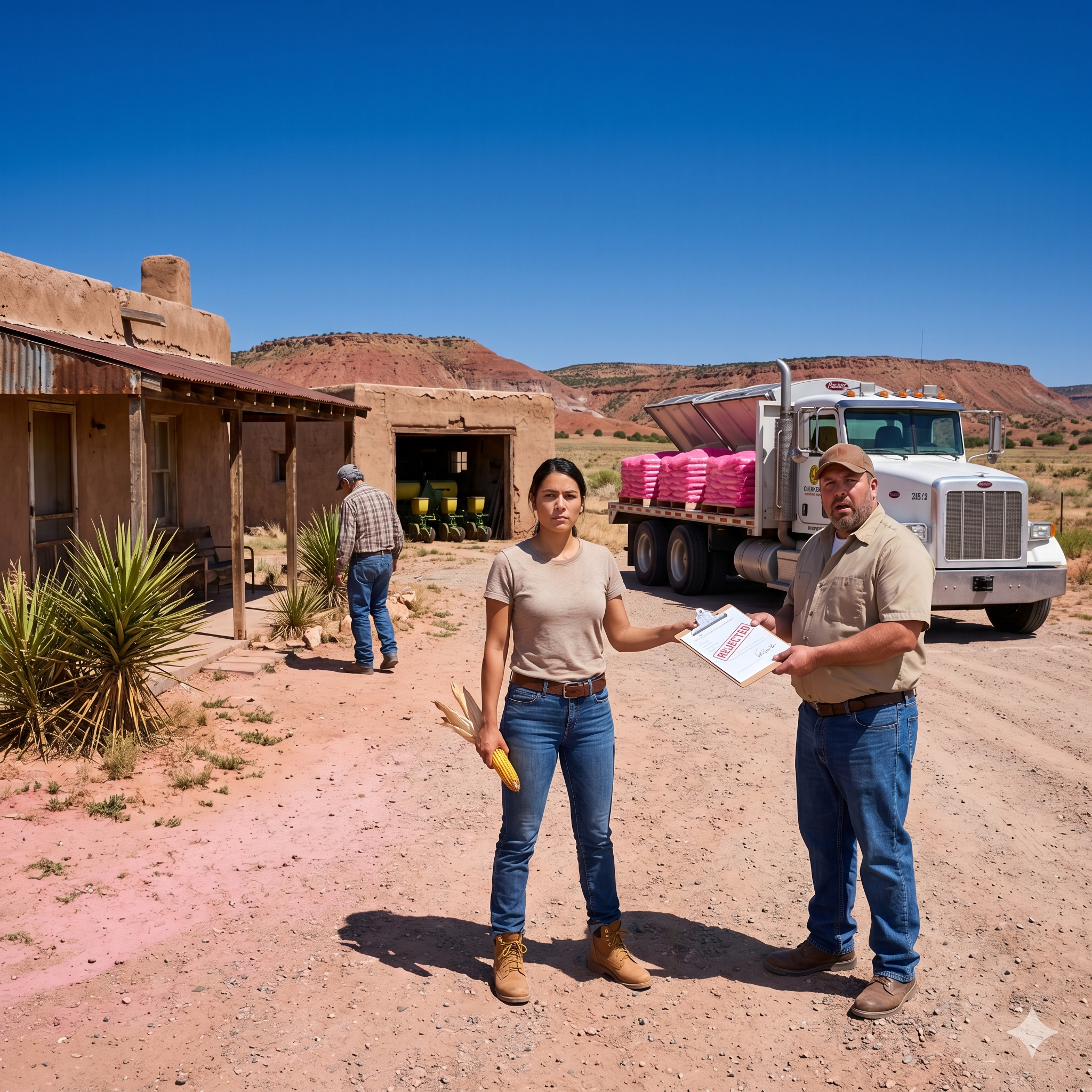
The wind off the red mesas of Valencia County, New Mexico, didn’t blow; it scraped. It carried the fine, alkaline silt of the high desert, a pale pink dust that tasted like copper and old salt. It settled into the deep creases around Carlos Ortiz’s eyes, turning his dark skin the color of cracked leather, and coated the pristine, white-hooded Peterbilt seed truck idling in the driveway of the Ortiz family farm.
At twenty-six, Lena Ortiz had her grandmother’s quiet, observant eyes and her father’s stubborn, straight-backed posture. She stood on the rusted metal porch of the old adobe farmhouse, a thick, yellow carbon-copy invoice clutched in her fist. Her knuckles were white.
“Seventeen thousand dollars, Dad,” Lena said, her voice dropping into the dry air like a stone into a deep well. “That’s just the first installment for the AgriCorp Zeus-3 Hybrids. If we don’t hit ninety bushels an acre in this sand, the interest alone will swallow the south pasture by October.”
Carlos didn’t look at her. He was sixty-two, his spine slightly curved from forty years of hauling irrigation pipes through the mud, but his hands were still thick and heavy as cedar blocks. He stood by the back of the corporate delivery truck, watching the driver slice open a sample bag of the commercial seed. The kernels inside were a uniform, unnatural neon pink—coated in a systemic cocktail of fungicides, neonicotinoid pesticides, and polymer lubricants.
“The Zeus-3 is engineered for the desert, Lena,” Carlos muttered, his voice a low, defensive rumble. He rubbed a handful of the pink kernels between his calloused palms. “Brody Vance down at the co-op said these seeds can pull water out of bare stone. Everyone in the valley is planting them this spring. If we stick to the old ways, the bank won’t even look at our operating line.”
“Brody Vance is a salesman, Dad,” Lena said, stepping down from the porch. Her scuffed leather boots kicked up small puffs of sandy clay. “He doesn’t care that AgriCorp owns the patent on every single one of those pink kernels. You can’t save the seed from this harvest. You can’t even replant it without violating a federal contract. If we buy into this, we are renting our own land from a corporate office in Delaware.”
“We owe the co-op nine thousand for last year’s fertilizer, Lena!” Carlos turned on her, his eyes flashing with the sudden, raw panic of a man who saw the end of his family’s three-generation legacy looming in the dust. “The river is low. The allocation from the ditch is down thirty percent this year. We need a miracle, not a lecture from someone who spent the last four years studying ecology in Albuquerque. University books don’t pay the mortgage.”
“No,” Lena shot back, her jaw locking into that stubborn Ortiz line. “But looking at the bank ledger does. We’re forty-two thousand dollars in debt to First National. This seed order isn’t a miracle, Dad. It’s a gold-plated noose.”
The truck driver, a burly man with an AgriCorp logo embroidered over his pocket, looked between the two of them, a clipboard held out like a shield. “Look, folks, I just need a signature on the delivery authorization. If you’re refusing the shipment, I’ve got three other farms on the mesa waiting for these pallets.”
Lena stepped between her father and the truck. She snatched the clipboard from the driver’s hand, drew a sharp, black line across the signature box, and wrote one word in clear, bold letters: REJECTED.
Carlos let out a ragged, choking breath. “Lena! What have you done?”
“I’m saving our lives, Dad,” she said, handing the clipboard back to the stunned driver. “Drive it back to the warehouse. The Ortiz farm is off the corporate registry.”
Chapter 2: The Sealed Urn
The silence that followed the departure of the AgriCorp truck was heavy, broken only by the dry rattle of the wind through the yucca stalks at the edge of the yard. Carlos didn’t yell. That was the most terrifying part. He simply turned his back on his daughter, walked into the old equipment shed, and began greasing the fittings on an ancient, four-row John Deere planter that had belonged to his own father.
Lena watched him go, a lump of ice sitting in her throat. She loved her father, but his fear had made him blind.
Since her grandmother, Abuela Sofia, had passed away six months ago, the farm had felt like a ghost town. Sofia had been the anchor of the valley—a curandera and a seed-saver who could look at a cloudless morning sky and tell you exactly what time the rain would hit the valley floor. When she died, the old ways seemed to die with her. Carlos had immediately cleared out her small drying racks, replaced her hand-carved wooden tools with modern steel, and placed his faith in the corporate promises of the AgriCorp catalog.
Later that afternoon, when the sun had dropped low enough to turn the sandstone mesas into glowing towers of purple and crimson, Lena walked across the arroyo to her grandmother’s old adobe seed-storage room. It was a small, windowless structure built half-into the earth, its thick clay walls keeping the interior cool even during the brutal one-hundred-degree days of July.
Carlos had left this building alone, mostly out of a superstitious respect for his mother’s memory.
Lena pushed the heavy cedar door open. The air inside smelled of dried sage, parched earth, and something deep, dark, and ancient. Along the back wall stood a row of large, unglazed earthenware jars—tinajas—sealed with thick plugs of grey beeswax.
She walked to the largest jar at the end of the row. Scratched into the clay with a fingernail before it had been fired decades ago was a single word: Maíz.
Lena used her pocketknife to pry away the brittle beeswax seal. She pulled the cedar plug and shone her flashlight into the dark interior of the jar.
A low gasp escaped her lips.
Inside lay thousands of large, heavy kernels. They didn’t look like any corn seed sold in America today. They weren’t the pale, uniform yellow of commercial flint corn, nor were they the artificial neon pink of the AgriCorp hybrids. These kernels were deep, midnight blue, speckled with streaks of blood-red, orange, and a pale, pearlescent white. They looked almost prehistoric, like a collection of polished river stones or something illicitly excavated from a prehistoric Pueblo ruin.
Tucked into the mouth of the jar was a small, square notebook bound in cracked pigskin. Lena pulled it out, her fingers tracking the delicate, elegant Spanish script written by her grandmother’s hand forty years ago.
Blue Flint — Sacred Seed of the High Mesa. Collected from the old people at Oku Pin. It does not ask for the river. It does not ask for the bag of chemicals from the white man. It searches for the deep moisture in the sand. It knows the wind. Plant it when the cicadas cry, and do not fear the sun.
Lena held a handful of the multicolored kernels against her cheek. They felt cool, heavy, and completely alive. This wasn’t just food; it was an inheritance. And it was exactly what the high desert had been waiting for.
Chapter 3: The Shame of the Valley
The next morning at 5:00 AM, the kitchen smelled of black coffee and unexpressed fury. Carlos sat at the formica table, his hands wrapped around a mug, staring at the floorboards.
“People are talking, Lena,” he said, his voice flat, devoid of its usual warmth. “Brody Vance called me from the co-op. He said you walked into the warehouse yesterday afternoon and canceled our fertilizer account too.”
“We don’t need forty bags of synthetic ammonium nitrate if we aren’t planting the Zeus hybrids, Dad,” Lena said, setting a plate of warm tortillas on the table. “Abuela’s blue corn fixes its own nitrogen through the old soil microbes. The deep roots don’t want the salt from commercial fertilizer.”
“Abuela’s corn?” Carlos stood up so fast his chair screeched against the linoleum. His face was dark with a mixture of anger and deep, cultural shame. “That old Indian corn? That’s what you want to put in our fields? Lena, people will think we’re poor! They’ll think we’re so broke we can’t even afford real seed from the dealer!”
Lena stepped close to him, her eyes burning with a sudden, sharp clarity. She reached out and grabbed his thick, calloused forearm.
“We are poor, Dad,” she said, her voice dropping to a fierce, quiet whisper. “Look at the books. We have two hundred dollars in the checking account. We are poor. We just keep buying expensive ways to hide it from the neighbors.”
Carlos flinched as if she had struck him across the face. He looked out the small kitchen window at the north pasture—four hundred and fifty acres of empty, sandy loam that had been turned over by the plow, waiting for a crop that might never come.
“Your grandfather worked five years at the copper mine in Silver City just to buy the water rights for this land,” Carlos said, his voice trembling. “He wanted us to be modern. He wanted us to be like the white farmers up in Clovis. If we plant that colored corn, the inspectors from the grain pool won’t even grade it. They call it ‘specimen crop.’ They buy it for pennies as livestock feed or decoration for tourist shops in Santa Fe.”
“We aren’t selling it to the commercial grain pool,” Lena said, pulling the pigskin notebook from her jacket pocket and laying it on the table between them. “We’re going to grow it, we’re going to save the seed, and we’re going to sell the flour directly to the native bakeries and the artisan mills. But first, we have to keep the farm from going under. Let me plant half the farm with Abuela’s seed. You take the south half and buy whatever hybrid bags Brody Vance will give you on credit. Let the land decide who’s right.”
Carlos looked at the multicolored kernels Lena had placed on the table. To him, they looked like a regression—a return to the hard, hand-to-mouth existence his family had fought for half a century to escape. But he also looked at his daughter’s face and saw the ghost of his mother, Sofia, staring back through those unyielding gray-black eyes.
“Half,” Carlos whispered, his hand shaking as he picked up his hat. “But if those fields are bare by July, Lena… you’re going back to Albuquerque to find a real job. And I’m selling the water rights to Marcus Vance.”
Chapter 4: The Museum Corn
By noon, word of the Ortiz family split had traveled through the valley like a brushfire along the irrigation ditches. The local general store and diner, The Red Mesa Outpost, was filled with the low rumble of local ranchers and corporate-contracted farmers discussing the madness of the Ortiz girl.
Lena walked into the store to buy a replacement fan belt for the old John Deere tractor. The moment the screen door banged shut behind her, the clinking of porcelain coffee mugs died away.
Over by the gun rack stood Brody Vance, the regional AgriCorp representative. He was thirty-two, wore a polished leather vest over a clean western shirt, and carried himself with the supreme confidence of a man whose company owned seventy percent of the mortgages in the county.
“Well, look who it is,” Brody chuckled, leaning against the counter and looking down at Lena with a patronizing grin. “The ecologist. Hear you’re turning the Ortiz place into a living history museum, Lena. Your dad told me you’re planting that old Pueblo flint corn from before the Spaniards arrived.”
A few of the older farmers at the counter snickered into their hats.
“It’s called Maíz Azul, Brody,” Lena said, her voice cool and steady as she handed her part number to the clerk behind the counter. “It’s been growing in this valley for twelve hundred years. Long before AgriCorp started selling seeds that die if the power grid goes down for a week.”
“Twelve hundred years ago, the people in this valley were eating grass and dying of tooth decay at thirty, Lena,” Brody said, his smile turning sharp and professional. “Modern agriculture is about yield. The Zeus-3 hybrid is designed to withstand up to five days of zero-inch moisture during the silk stage. Your grandmother’s corn hasn’t been performance-tested by a real lab since the Hoover administration. It’s too short, the ears are too small, and the stalks will lodge the first time a forty-mile-per-hour spring wind comes off the mesa.”
He stepped closer, his voice dropping so the rest of the diner couldn’t hear. “I like your dad, Lena. He’s a good man. But if you ruin his spring planting with this stunt, First National isn’t going to wait until October. My uncle sits on the loan board. They’ll call the principal on the equipment loan by July first. You’re playing with fire.”
“Then it’s a good thing Abuela’s corn knows how to handle the heat,” Lena said, snatching her fan belt from the clerk and turning her back on him.
As she walked out to her truck, she could hear the laughter starting up again behind her. They called it “museum corn.” They called her the “hippie girl from the city.” But as she looked up at the sun—a fierce, blinding white disc in a sky that hadn’t seen a drop of moisture since February—she felt a strange, cold certainty in her bones.
The high desert was changing. The old rules were breaking. And the modern world had forgotten what a real drought felt like.
Chapter 5: The Dividing Line
The planting began on the third week of May.
The Ortiz farm was split down the middle by a gravel access road. To the south lay Carlos’s four hundred and fifty acres—planted with the AgriCorp Zeus-3 hybrids, which he had managed to secure through a high-interest emergency credit line from Brody Vance’s uncle at the bank. The soil on the south side was treated with three hundred pounds of synthetic nitrogen per acre, laid down with precision GPS-guided tractors that sliced through the earth like scalpels.
To the north lay Lena’s four hundred and fifty acres.
She didn’t use GPS. She used the old four-row planter, setting the seed shoes deep—nearly six inches down into the dry, sandy subsoil where the last remnants of the winter moisture lingered. She didn’t add a single drop of commercial fertilizer. She simply dropped the multicolored, “illegal-looking” kernels into the red sand and waited.
By mid-June, the contrast between the two fields was the talk of the highway.
Carlos’s south field was a beautiful, uniform emerald green. The Zeus-3 hybrids grew like soldiers—tall, thick-stalked, and perfectly spaced. They looked like a picture from a corporate agricultural magazine. Carlos began to walk with his head up again, his chest out, avoiding his daughter’s eyes but smiling whenever Brody Vance drove past in his shiny company truck.
Lena’s north field, however, looked like a disaster.
The heirloom corn didn’t grow straight or tall. It emerged from the sand in small, bushy clumps—three or four stalks rising from a single root cluster. The leaves weren’t emerald green; they were a dull, dusty blue-gray, covered in a fine, velvety fuzz that looked like sagebrush. The stalks were short, barely reaching a man’s waist when the south field was already at shoulder height.
“It looks like a weed patch, Lena,” Carlos said one evening as they stood on the porch, looking across the road. The air was dead, hot enough to make the sandstone mesas shimmer in the distance. “The ears are barely forming, and the stalks are half the size of the hybrids. Vance says the AgriCorp field cameras are showing our north side is a write-off.”
“Look at the leaves, Dad,” Lena said, pointing her flashlight across the road toward his pristine green field. “The sun’s been down for two hours. Why are your leaves still curled up like soda straws?”
Carlos shifted his weight, his eyes narrowing. He hadn’t wanted to notice it, but the signs were there. The Zeus-3 hybrids were tall, but their leaves were tightly rolled, a classic defense mechanism against extreme moisture stress. They looked like a row of green spears, desperate for water.
Lena’s blue-gray plants, however, were wide open. Their dusty, low-slung leaves were spread flat against the night air, catching the faint, ephemeral dew that drifted off the high mesas before midnight. They weren’t fighting the desert; they were living in it.
And then, the sky turned white.
It wasn’t a cloud. It was the onset of the Great Heat Dome of 2026—a monstrous, high-pressure atmospheric block that settled over New Mexico and Arizona like a solid glass lid. The temperature on the thermometer outside the kitchen window hit one hundred and eight degrees on Monday. One hundred and eleven on Tuesday. One hundred and fourteen by Thursday.
The Rio Grande irrigation ditch, their only lifeline, went dry on Friday morning. The water allocation for the entire valley was slashed to zero.
The true battle for the Ortiz farm had begun.
[End of Part 1]
Part 2: The Fire from the Sky
Chapter 6: The Furnace of July
The air in Valencia County didn’t feel like air anymore; it felt like a physical weight, a dry, invisible flame that scorched the lining of your lungs with every breath. By the first week of July, the high desert was a furnace. The yucca plants along the road were turning black, their spiked leaves shriveling into charcoal-like tinder, and the mud at the bottom of the irrigation ditches had dried into deep, hexagonal plates of hard gray clay.
Every morning at 4:00 AM, Lena and Carlos walked the dividing line of the farm in absolute silence. The heat was already ninety-two degrees before the sun even cleared the eastern peaks.
The south field—the pride of the AgriCorp catalog—was dying.
The change had been fast, brutal, and systematic. The Zeus-3 hybrids, engineered for maximum yield under managed conditions, couldn’t handle the absolute failure of the irrigation system. Without the constant, artificial deluge of river water from the ditches, the shallow, fibrous root systems of the modern corn couldn’t penetrate the hard clay pan beneath the topsoil.
The leaves had turned from emerald green to a pale, sickly yellow, then to the color of old paper. The ears, which had promised to be massive, were stunted, their silks drying into brittle black thread before they could even be pollinated.
“They’re burning up, Lena,” Carlos whispered, his voice trembling as he broke open a stalk from his field. The inside of the stem was dry, pithy, and filled with a fine, white powder instead of the sweet, moist juice of a healthy plant. “The whole four hundred and fifty acres. It’s tinder. One spark from a tractor exhaust and the whole south half will go up like a box of matches.”
He looked across the gravel access road at the north field.
The heirloom blue corn looked exactly the same as it had three weeks ago. It hadn’t grown an inch taller—it was still short, squat, and bushy, barely reaching Lena’s hip. But it wasn’t yellow. The dusty, blue-gray leaves were still spread wide, their velvety surface covered in a microscopic layer of wax that held the plant’s internal moisture like a vault.
“How is it doing that?” Carlos asked, his voice filled with a mixture of awe and fear. “It hasn’t had a drop of water since May. The ground is cracked wide enough to drop a crescent wrench down the fissures, but those plants aren’t curling.”
“Abuela’s corn doesn’t put its energy into the stalk, Dad,” Lena said, kneeling in the sand and digging with her bare fingers until she reached a thick, fleshy root system that shot straight down into the earth like a taproot. “Modern hybrids are bred to grow fast and high so they can beat the weeds, but they need a constant bottle-feed of nitrogen and water to do it. This old seed… it spends its first two months growing down. It’s got roots ten feet deep into the ancient water table. It doesn’t care about the ditch. It’s drinking from the mountain runoff beneath the sand.”
Before Carlos could answer, the roar of a heavy diesel engine cut through the dry air. A white Ford F-250 with the blue-and-silver AgriCorp logo emblazoned on the door slammed its brakes shut in the gravel driveway.
Out stepped Brody Vance, his face red from the heat, his silk western shirt soaked with sweat. He didn’t have his usual smirk. He looked like a man whose stock portfolio was melting in his hands.
“Carlos!” Brody shouted, running toward them. “Carlos, thank God you’re out here. I’ve been driving the mesa since dawn. The Vance fields are gone. The Miller fields are gone. The whole valley is hitting a one-hundred-percent crop failure on the Zeus hybrids. The regional office is declaring a seed-emergency.”
He looked past Carlos at the north field, his mouth falling open as his eyes locked onto the solid, unyielding wall of blue-gray heirloom stalks.
“What… what is that?” Brody stammered, pointing a shaking finger at Lena’s crop. “Why is that field still alive?”
Chapter 7: The Contract of the Ghost
“It’s the museum corn, Brody,” Lena said, her voice dropping like a cool shadow into the heat of the driveway. “The one you said would lodge in the wind. The one your uncle at the bank said was a write-off.”
Brody walked to the edge of the north field, his polished boots sinking into the dry sand. He reached out and touched a thick, low ear of corn forming on the closest bush. He stripped back the husk with his thumb, revealing the neat, spiraling rows of multi-colored kernels—deep sapphire, crimson, and gold—already hardening under the fierce sun. They were fully pollinated, fully formed, and perfectly healthy.
“This is impossible,” Brody muttered, his voice cracking. “The moisture index in this county is at zero point zero two. Nothing can produce grain under these numbers without a center-pivot system.”
“This seed was performance-tested by the desert for twelve hundred years, Brody,” Lena said, walking up beside him. “It doesn’t need an AgriCorp technician to clear its error codes.”
Brody turned around, his face suddenly tightening into a desperate, corporate calculation. He looked at Carlos, ignoring Lena completely. “Carlos… listen to me. The company needs this grain. AgriCorp is looking for native genetic traits to cross-breed into the next generation of the Zeus line. We’ll buy this entire north field from you right now. Cash. We’ll pay you three times the current Chicago board price for flint corn. We’ll wipe out your fertilizer debt from last year, and I’ll personally guarantee the bank extends your equipment loan for another five years.”
Carlos looked at Brody. He looked at the contract clipboard the younger man was pulling from the front seat of his truck. For forty years, Carlos had lived in fear of the men in those white trucks—the men who held the keys to the seed, the chemicals, and the land.
Then, Carlos looked at his daughter. He saw her grease-stained canvas pants, her dirt-caked fingers, and the small, pigskin notebook peeking out of her shirt pocket. He remembered the look on his mother Sofia’s face when she used to hold those same multicolored kernels in her kitchen, her voice telling him that the land belonged to the people who remembered its name.
Carlos took off his hat, wiped the sweat from his silver hair, and stepped between Brody Vance and his daughter.
“The seed isn’t mine to sell, Brody,” Carlos said, his voice dropping into a deep, steady register that sounded like the low rumble of thunder over the mountains.
“What are you talking about, Carlos?” Brody snapped, his professional veneer cracking. “You’re the head of the Ortiz LLC. You sign the papers, the debt goes away. If you don’t sell this crop to us, the bank will foreclose on this whole place by the first of the month anyway!”
“No, they won’t,” Lena said, stepping forward and holding up a document she had pulled from her pocket. “I spent yesterday afternoon in Santa Fe with the State Agricultural Extension Office and the Native Seed Alliance. Abuela’s blue flint has just been registered as a certified historic heirloom landrace crop. The Alliance has already issued us a pre-harvest grant of forty-five thousand dollars to secure the seed stock for next year’s planting across the entire pueblo district. The check cleared this morning, Brody. The bank can’t touch us.”
Brody stared at the document, his face turning from red to a pale, chalky gray. He looked out at the living blue-green ocean of the north field, then back at the two farmers standing before him in the red dust.
“You’re crazy,” Brody whispered, backing toward his truck. “You can’t fight a company like AgriCorp with old stories and colored corn.”
“We aren’t fighting you, Brody,” Carlos said, turning his back on the white truck and looking out at his daughter’s field. “The desert already did that for us.”
Chapter 8: The Crimson Harvest
The harvest began on the third week of August.
It didn’t look like any harvest the valley had seen in fifty years. Usually, the Ortiz farm was a mechanical operation—a massive, rented John Deere combine roaring through the field, swallowing rows of uniform yellow stalks and spitting out clean, identical yellow kernels into a waiting semi-truck destined for the industrial elevators in Clovis.
But the old combine couldn’t handle the low, multi-stalked bushes of the heirloom blue corn.
Instead, the access road was lined with trucks from every small farm in the valley. There were old ranchers from the high mesas, young native agricultural workers from the nearby Isleta and Laguna pueblos, and independent Hispanic farmers who hadn’t planted a crop since the water tables started dropping in the nineties. They came with hand-sacks, wooden baskets, and old leather gloves.
They formed a harvest line—fifty people moving in a slow, rhythmic V-formation through the four hundred and fifty acres of blue-gray stalks.
“Look at the weight of it, Carlos,” Tom Miller said, holding up a massive, heavy ear of corn that looked like a cluster of polished jewels in the morning light. Miller was seventy, his own modern hybrid farm three miles down the road had been completely wiped out by the heat dome, leaving him with nothing but dry stalks and a mountain of chemical debt. “It’s dense as stone. This stuff will grind into the best blue meal this state has ever seen. The mills in Albuquerque are offering eighty dollars a bushel for this quality.”
Carlos worked alongside him, his old hands moving with a fluid, natural memory he hadn’t used since he was a boy helping his mother Sofia. He would grab the low ear, give it a sharp, downward twist until the stem snapped with a clean, satisfying crack, and drop it into the canvas sack slung across his shoulder.
“We were wrong, Tom,” Carlos said quietly, his eyes fixed on his daughter, who was leading the line further down the ridge. She was laughing, her face covered in red dust and sweat, a massive ear of deep purple-blue corn held high above her head like a trophy. “We spent thirty years trying to turn this desert into Illinois. We bought their seeds, we bought their chemicals, we drowned the land in river water until the soil turned to salt. And all the time, the answer was sitting right there in my mother’s cellar, waiting for us to forget how to be arrogant.”
By noon, the north field was clear. The south field—the dead, brown tinder of the AgriCorp hybrids—had been disked under, turned back into the red sand to rot and provide what little organic matter it could to the earth. It was a loss, but it was a loss they could afford now.
The storage barn at the Ortiz place was filled to the rafters with thousands of bushels of multicolored, ancient flint corn. The air inside smelled sweet, rich, and dry—the smell of survival.
Chapter 9: The Ghost in the Ledger
That evening, the heat dome finally broke.
A massive, violent thunderstorm rolled off the San Mateo mountains, bringing a cool, rushing wind that smelled of wet cedar and ozone. The rain hit the tin roof of the old adobe farmhouse with a sound like a thousand silver coins falling from the sky.
Lena sat at the formica kitchen table, the pigskin notebook open before her. Next to it lay the farm’s new ledger book. For the first time in ten years, the columns on the right side of the page were written in black ink instead of red.
-
Seed Cost: $0 (Saved from Abuela’s jar)
-
Fertilizer/Chemical Cost: $0
-
Water Allocation Fees: $0 (Dryland survival)
-
Native Seed Alliance Pre-Purchase: +$45,000
-
Artisan Mill Contracts (Albuquerque/Santa Fe): +$38,000
-
Net Operating Balance: +$83,000
The screen door opened, and Carlos walked into the kitchen, carrying two mugs of hot pinon tea. He set one down in front of his daughter, then sat down across from her, his old gray eyes tracking the clean, black columns of figures in the ledger.
“Brody Vance’s uncle resigned from the bank board this afternoon,” Carlos said quietly, a faint, amused smile touching the corners of his mouth. “The co-op is restructuring its credit lines for the whole valley. They’re saying forty farms are switching to dryland heirloom varieties next spring. They want us to provide the seed stock, Lena.”
Lena took a sip of her tea, the warmth spreading through her tired muscles. “We have enough in the storage barn to seed five thousand acres, Dad. But we don’t sell it to anyone who signs an AgriCorp registry. The seed stays with the people who work the dirt.”
Carlos reached across the table, his thick, calloused thumb gently tracing the edge of his mother’s old pigskin notebook. “I spent twenty years being ashamed of that book, Lena. I thought it was the reason we were stuck in the old world while the rest of the country was moving forward.”
“The old world didn’t die, Dad,” Lena said, leaning forward and placing her hand over his. “It was just waiting for the modern one to run out of water.”
Chapter 10: The Lesson of the High Mesa
The next morning, a white sedan with the logo of the New Mexico Agricultural Review rolled into the driveway.
Out stepped a young reporter from Albuquerque, carrying a digital recorder and a camera with a massive telephoto lens. She looked around the yard, her eyes lingering on the empty, disked-under south field, then shifting to the storage barn where the multicolored ears of corn were being sorted into clean burlap sacks.
“Ms. Ortiz?” the reporter asked, walking up to the porch where Lena was cleaning a set of old hand-sieves. “I’m Sarah Martinez from the Review. We’re doing a statewide feature on the Heat Dome crisis. Every commercial corn farm in this district hit zero percent yield this month—except this one. The state extension office says you pulled eighty-five bushels an acre out of dry sand without a drop of irrigation water.”
Lena stood up, wiping her hands on her apron. “That’s right, Sarah.”
The reporter clicked her recorder on, her eyes bright with curiosity. “The analysts in Las Cruces are calling this a biological miracle. They want to know what kind of advanced genetic manipulation or micro-irrigation techniques you used to get these results. Where did you learn to farm like this?”
Lena looked at her father, who was standing by the door of the storage barn, a large burlap sack of blue flint seed held securely in his arms. He nodded to her, a slow, proud smile wrinkling his weather-beaten face.
Lena reached into her pocket, pulled out the small, cracked pigskin notebook that had belonged to Abuela Sofia, and held it out toward the reporter.
“I didn’t learn it from a lab, Sarah,” Lena said, her voice carrying clearly across the red sand of the yard, matching the steady, cool wind coming off the mesas. “I learned it from someone who remembered what the land looked like before the machines arrived.”
She opened the notebook to the first page, where the elegant, faded Spanish script was written in dark ink that had survived forty years of desert sun. She pointed to a single sentence written at the very top of the parchment—the simple, unyielding truth that had saved the Ortiz name from the dust.
The reporter leaned closer, reading the words aloud into her microphone:
“El futuro cósmico puede necesitar lo que el pasado sobrevivió.” “The future may need what the past survived.”
Lena closed the book, her fingers locking around the leather spine like a key. “Next spring, we’re planting the whole nine hundred acres,” she said, looking out toward the high, red horizon where the clouds were finally breaking, revealing a sky that was clean, bright, and completely free. “And we aren’t buying any pink seeds.”
[The End]
News
🤯 THE LOCKET, THE TAPE, & THE DETECTIVE: The Final Twist in the Kruger Investigation.
THE GRAVE SPEAKS: A Hidden Locket, a Smuggled SD Card, and the Final Trap That Broke the Kruger Syndicate PRETORIA — Just when the corrupt political elites of South Africa thought they could manage the fallout of the Kruger National…

“MY SON WAS TREATED LIKE AN ANIMAL.” THE FATHER’S UNTOLD STORY.
SOUTHAMPTON — The click of metal handcuffs is a sound meant to signify the capture of a dangerous criminal. But on a freezing December night in 2025, that sharp, metallic snap became the soundtrack to one of the most profound…
💔 5 WORDS THAT SHAMED A NATION: “DON’T THINK YOU HAVE, MATE.”
SOUTHAMPTON — The click of metal handcuffs is a sound meant to signify the capture of a dangerous criminal. But on a freezing December night in 2025, that sharp, metallic snap became the soundtrack to one of the most profound…

THE 2037 DREAM IS DEAD: How A Single “Hot Mic” Recording Just Guaranteed Mackenzie Will Never Walk Free
THE “HOT MIC” BOMBSHELL: Leaked Audio And Prison Secrets Just Destroyed Mackenzie Shirilla’s Netflix Lie For Good 🎙️🛑 “I am not a monster. I am a driver in a tragedy.” Millions of viewers watched the tear-streaked face of 21-year-old Mackenzie…

THE WHISTLEBLOWER SPEAKS: Why A Netflix Editor Risked Everything To Expose Mackenzie Shirilla’s Sickening Act
THE “HOT MIC” BOMBSHELL: Leaked Audio And Prison Secrets Just Destroyed Mackenzie Shirilla’s Netflix Lie For Good 🎙️🛑 “I am not a monster. I am a driver in a tragedy.” Millions of viewers watched the tear-streaked face of 21-year-old Mackenzie…
💔 THE PLOT TWIST NO ONE SAW COMING: We Finally Know Where The Mother Is.
🚨 SHOCKING DISCOVERY: Police Breached A “Fake Wall” Inside The Temple Home. The True Source of the “Odor” Finally Revealed. By Senior Investigative Desk Dateline: Temple, Texas — June 2, 2026 When Temple Police Department tactical teams first breached the…
End of content
No more pages to load