Part 1: The Wild Acreage
Chapter 1: The Chemical Ink
The scent of the Siskiyou foothills in late May was usually a crisp blend of cedar needle and thawing high-desert clay. But inside the cramped office of the Bennett Homestead, the air tasted entirely of copper, stale coffee, and the sharp, vinegar-like sting of industrial carbon paper.
Mara Bennett kept her hands buried deep in the pockets of her canvas work jacket. Her thumbs traced the rough, calloused ridges of her palms—hands that had spent the last ten years kneading wild sourdough, crushing dried elderberries, and mixing small-batch tinctures in Eugene. Now, those same hands were expected to sign away the very soul of the land she had inherited.
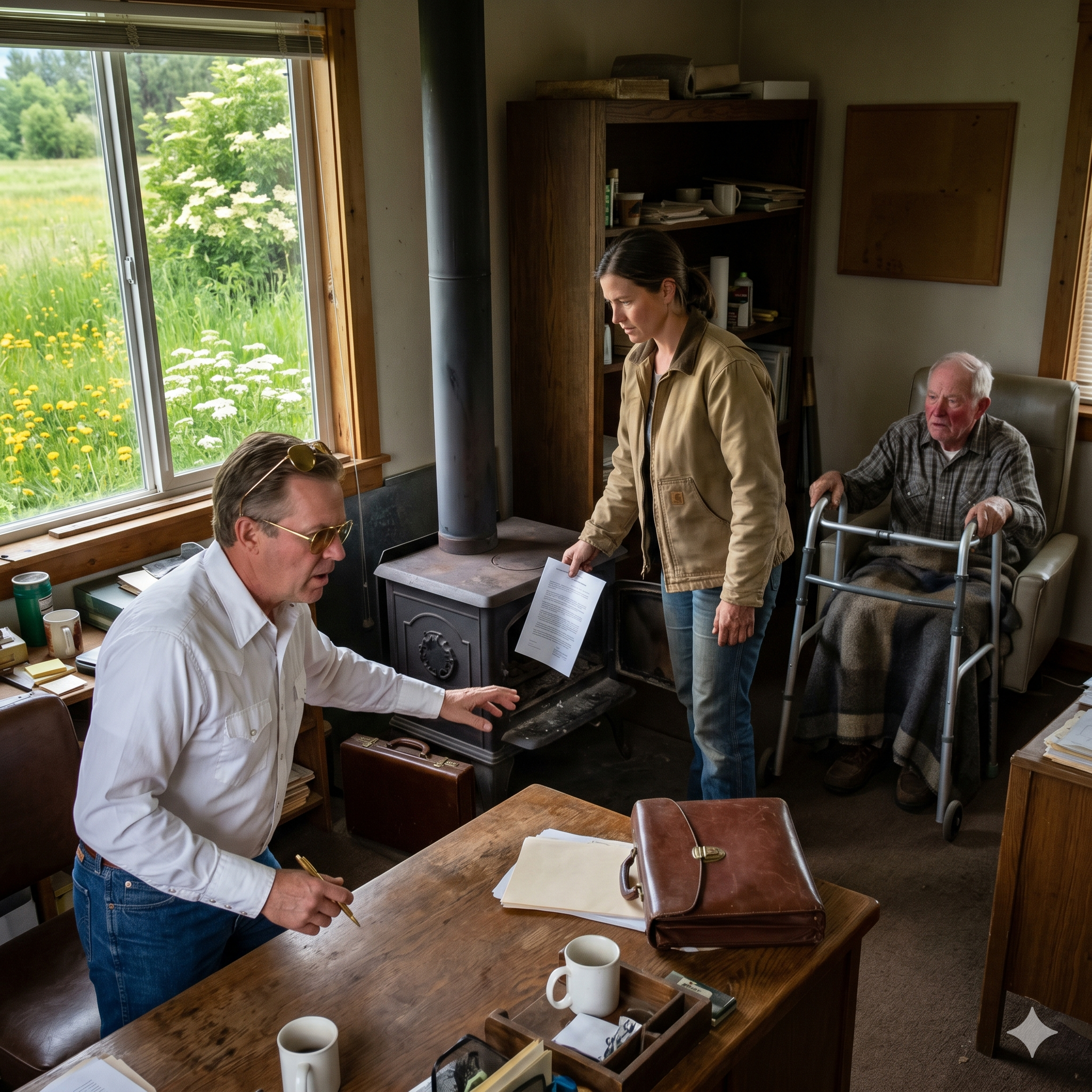
Across the scarred oak desk sat Chet Vance, the regional representative for Tri-County Ag Solutions. He wore a crisp, white western shirt with pearl snaps that had never seen a speck of real pasture mud, and his gold-rimmed aviators rested right next to a thick, glossy contract.
“Forty thousand dollars flat, Mara,” Vance said, his voice dropping into that smooth, practiced cadence used by men who sold poison for a living. “That covers the aerial application of Defiance-IV across all four hundred acres, plus the ground-rig follow-up in July. By August, I guarantee this ground will be as clean as a billiard table. Not a speck of green showing except the cash-crop rows.”
From the faded vinyl armchair in the corner, a ragged, wheezing breath cut through the room.
Thomas Bennett sat with a heavy wool blanket draped over his knees despite the spring heat. His fingers, twisted by severe osteoarthritis until they resembled old sagebrush roots, clutched the handles of a silver walker. His eyes, clouded by cataracts and years of watching the commodity markets slide into the red, were fixed entirely on his daughter.
“Sign it, Mara,” Thomas rasped, his voice sounding like two pieces of coarse sandpaper rubbing together in the dark. “The thistle… it’s knee-high in the north pasture. The stinging nettle is choking out the irrigation ditches. If we don’t clear the ground now, the co-op won’t even look at our alfalfa contract this winter. We’ll be default by November.”
“We’re already sixty thousand in debt to the co-op, Dad,” Mara said gently, keeping her eyes on the contract. “Adding another forty thousand for a chemical cocktail that washes straight into the Klamath watershed isn’t a solution. It’s just a more expensive way to go bankrupt.”
“It’s the only way to farm, girl!” Thomas snapped, a sudden, dangerous crimson flushing his weathered cheeks. He tried to lean forward, his knuckles turning white on his walker. “Your grandfather didn’t clear these rocks and fight the timber companies just so we could let the weeds take the valley. You’ve been back from the city for three months, and all you’ve done is look at the ground and talk about ‘soil biology.’ Dirt doesn’t care about biology, Mara. It cares about iron, nitrogen, and a clean slate.”
Chet Vance smiled, a slow, patronizing lift of his lips as he tapped his gold cross pen against the signature line. “Your dad’s right, Mara. Look at Boyd Miller’s place next door. Five hundred acres of pure, uniform orchard grass. Not a weed in sight. He just bought a brand-new diesel dually because his margins are locked in. You can’t run a commercial operation on sentiment. You need to kill the wild if you want to grow the green.”
Mara looked out the window. Across the gravel driveway, the Bennett farm didn’t look like Boyd Miller’s sterilized paradise. It looked like an explosion of feral energy. The winter rains had unleashed a green fury across the uncultivated fields. Massive stands of stinging nettle choked the fence lines; yellow carpets of common dandelion covered the low flats; white, umbrella-like clusters of wild yarrow danced in the constant canyon wind; and along the old creek bed, the elderflowers were beginning to heavy the air with their thick, sweet cream scent.
To her father, it was a declaration of defeat. To Mara, it looked like a goldmine.
She stepped forward, reached out, and picked up the contract. Chet Vance’s smile widened, his hand already reaching for his leather briefcase.
Then, with a clean, deliberate motion, Mara folded the forty-thousand-dollar contract in half, then in half again, and dropped it squarely into the cast-iron belly of the dead woodstove in the corner.
“The meeting’s over, Chet,” Mara said, her voice dropping into a hard, quiet register that made the salesman’s smile vanish instantly. “The Bennett farm is off the Tri-County registry. We aren’t spraying a single drop.”
Chapter 2: The Herbalist’s Eye
Thomas Bennett didn’t speak to his daughter for three days. He remained in his bedroom, the door closed, the old television set buzzing with the low, distorted drone of old Western re-runs.
Mara didn’t mind the silence; she needed the time to work.
At thirty-four, she had spent a decade away from the valley, working in the specialized boutique markets of the Pacific Northwest. She had studied under old-school herbalists in the Cascades, managed a community seed-bank, and learned how the high-end natural product manufacturers in Portland and Seattle sourced their raw ingredients. When her father’s health failed, she had returned to find a farm that was culturally dead but biologically vibrating.
“You really done it now, Mara,” a voice called out from the shade of the tractor shed.
Hank “Stubbs” Jackson was adjusting the fuel line on their ancient Massey Ferguson 135. Hank had been the Bennett family’s part-time ranch hand since the seventies—a true high-desert cowboy who had transitioned from breaking colts to fixing old iron when his hips gave out. He had a permanent chew of tobacco in his cheek and a face that looked like it had been carved out of a dry pine log.
“Done what, Hank?” Mara asked, setting her heavy canvas harvest basket down on the bumper of her truck.
Hank spat a dark stream of juice into the dust. “Boyd Miller was down at the feed store this morning telling the whole county you’ve lost your mind. Said you burned a Tri-County contract because you wanted to grow a crop of prickles. He’s calling this place ‘The Weed Patch’ now. Folks are laughing, Mara. Your dad’s pride is about the only thing he’s got left that works, and you took a hammer to it.”
“They can laugh all they want, Hank,” Mara said, pulling a long, thick leather glove onto her right hand. “Come look at this.”
She led the old cowboy down to the north pasture, where the stinging nettle (Urtica dioica) had grown into dense, vibrant walls nearly four feet high. The stalks were heavy with serrated, dark green leaves, each one armed with thousands of microscopic, hollow silica hairs filled with formic acid. To any conventional farmer, it was an agonizing nuisance that ruined the quality of hay and blistered the legs of livestock.
Mara reached into the cluster, her gloved hand deftly snipping the top four inches of a vibrant stalk—the prime, nutrient-dense growth.
“You know what the artisan tea blenders in Portland pay for certified organic, wild-harvested nettle leaf right now, Hank?” Mara asked, holding up the vibrant green cutting. “Ten dollars a pound dry. And they can’t get enough of it. The nutraceutical companies are buying dandelion root by the ton for liver-detox supplements. The cosmetic houses in California are paying top dollar for wild-harvested yarrow extract to put in high-end skin serums.”
Hank stared at the nettle leaf, his wrinkled brow furrowing until his eyes were almost hidden. “Ten dollars a pound for nettles? Hell, Mara, we got about twenty tons of it sitting in the irrigation ditches alone. It grows back every time you cut it.”
“Exactly,” Mara said, her eyes bright with a sharp, calculating focus. “Boyd Miller spends twelve thousand dollars a year on diesel and herbicide just to keep his ground dead so he can grow alfalfa that sells for two hundred dollars a ton. I don’t have to plant this, Hank. I don’t have to fertilizer it. I don’t have to spray it. The earth is giving it to us for free. We just have to be smart enough to harvest it.”
Hank looked from the wild field back to Mara. A slow, tentative grin broke through his leathery face, revealing a missing molar. “Well, I’ll be damned. The old man always said you were too smart for your own good, Mara. Looks like you might just be smart enough for ours.”
Chapter 3: The Scorn of the Valley
The true test of Mara’s resolve didn’t happen in the fields; it happened at The Rusty Spur, the only diner and feed-supply stop within forty miles of the farm.
Mara walked into the diner on a Friday afternoon to pick up a box of mechanical staples for their drying racks. The moment the screen door slapped shut, the constant clinking of heavy ceramic coffee mugs ceased. The air inside smelled of grease, white gravy, and the distinct, cold judgment of men who measured a person’s worth by the straightness of their furrows.
Over in the corner booth sat Boyd Miller. He was flanked by two younger ranch hands from his potato operation, his heavy, silver-buckled belt straining against his denim shirt.
“Well, look who it is,” Boyd called out, his voice loud enough to carry over the low hum of the kitchen exhaust fan. “The Wild Harvest Queen. Tell me, Mara, you need me to loan you a couple of goats to help clean up that front yard? Or are you just planning on letting the wild mustard grow high enough to hide the house completely?”
The ranch hands chuckled, dipping their biscuits into their gravy without looking at her.
Mara didn’t pause. She walked straight to the counter, took her receipt from the clerk, and then turned around to face Boyd’s booth. Her posture was relaxed, but her eyes were cold.
“My yard is doing just fine, Boyd,” Mara said, her voice clear and carrying through the quiet room. “How’s your input ledger looking this month? I noticed the price of synthetic phosphate went up another fifteen percent at the co-op. Must be hard spending half your harvest check before the seed even breaks the dirt.”
Boyd’s face darkened, the color of raw beef. He slammed his coffee mug onto the table, splashing dark liquid onto the Formica. “My ledger is solid, girl. I grow real food for real markets. I’ve got five hundred acres of premium certified grass that’s uniform from fence line to fence line. That’s what keeps this valley alive. Your dad spent his whole life trying to keep that farm clean, and you’re turning it into a sanctuary for every noxious weed in the state. It’s an eyesore, Mara. It’s a breeding ground for pests, and it’s dragging down the property values for the rest of us.”
“The ‘weeds’ on my property have deeper roots than your grass ever will, Boyd,” Mara said, picking up her box of staples. “And come August, we’ll see whose crop is actually worth the ground it’s sitting on.”
“Farming weeds because you can’t grow crops,” Boyd sneered as she walked toward the door. “That’s what it is. You’re lazy, Mara. Just like those hippies you lived with in the city. You’re going to lose that land by winter, and when you do, I’ll buy that north pasture from the bank for pennies—and the first thing I’m going to do is run a D9 cat through every square inch of it.”
Mara didn’t answer. She let the screen door slam behind her, the cool mountain air clearing the greasy smell of the diner from her clothes. But inside her chest, a fierce, protective anger had taken root. She didn’t just want to save the farm anymore; she wanted to break the conventional illusion that was killing the valley.
Chapter 4: The Apothecary’s Engine
For the next six weeks, the Bennett homestead transformed into a rustic, high-efficiency processing facility.
Mara didn’t buy expensive modern machinery. Instead, she and Hank cleaned out the old timber-frame hay barn—a massive, vaulted structure that had sat empty for five years. They ran long lines of aircraft wire between the cedar posts, creating thousands of square feet of vertical hanging space. They built stacked screen racks out of scrap pine and window mesh, setting them up near the south-facing windows where the dry canyon wind could circulate naturally.
The work was brutal, manual, and constant.
Every morning at 5:00 AM, before the sun could burn the volatile essential oils out of the leaves, Mara and Hank were in the fields. They didn’t use tractors; they used hand-held German harvesting scythes with specialized wooden cradles that cut the wild herbs cleanly without crushing the delicate stems.
They harvested the stinging nettle first, handling the green walls with long leather gauntlets. Then came the common dandelion (Taraxacum officinale)—not just the leaves for salad mixes, but the long, thick taproots. Hank used an old horse-drawn subsoiler blade behind the Massey Ferguson to loosen the earth without turning it over, allowing them to pull the deep, massive roots out intact. Mara washed them in a modified potato tumbler, sliced them by hand, and laid them out on the screen racks to dry until they were hard and dark as roasted coffee beans.
By late July, the old barn smelled incredible. It was a dense, intoxicating aroma—the sweet, honey-like perfume of drying elderflower blending with the sharp, medicinal mintiness of wild yarrow and the deep, earthy richness of the dandelion root.
Mara didn’t stop at raw botanicals. She established a small, clean-certified kitchen in the back of the house, utilizing food-grade vegetable glycerin and high-proof organic alcohol to create concentrated extracts—tinctures. She launched a simple website: Bennett Wild Harvest.
To diversify her income, she organized “Wild Foraging & Soil Regeneration” workshops. On the third weekend of July, twelve people from Ashland, Bend, and as far away as Portland drove down the gravel road, paying seventy-five dollars each to spend a afternoon walking the wild pastures with Mara, learning how to identify the medicinal properties of the very plants her neighbors were trying to eradicate.
One evening, Thomas Bennett rolled his walker out onto the back porch. He stood there for a long time, his eyes tracking the rows of cars parked in his driveway, then looking toward the barn where Hank was helping an old woman from Portland pack a crate of dried yarrow tea into her station wagon.
Mara walked up beside him, handing him a warm mug of roasted dandelion and chicory root.
He took a sip, his wrinkled mouth twitching. “It tastes like coffee,” he murmured, his voice less harsh than it had been in months. “But it’s bitter. Like the dirt.”
“It’s good for your liver, Dad,” Mara said gently, leaning her elbow against the porch railing. “That’s wild root from the south ditch. We sold eighty pounds of it to an apothecary in Eugene yesterday. Paid for the electricity bill and Hank’s wages for the month.”
Thomas looked down at his twisted hands, then out at the wild, golden-brown pastures. He didn’t say she was wrong. But he didn’t say she was right, either. “The valley is dry, Mara,” he said quietly, his eyes drifting to the sky. “The water table is dropping. Boyd Miller’s running his big diesel pumps twenty-four hours a day just to keep his grass from turning to dust. A bad summer will kill everything, girl. Even the weeds.”
Chapter 5: The Humid Shadow
The weather in the second week of August didn’t follow the high-desert script.
Instead of the usual bone-dry, ninety-degree heat that turned the valley into a crisp gold, an unusual sub-tropical moisture ridge drifted up from the Gulf of California, locking itself against the Siskiyou peaks. The temperature remained at ninety-five degrees, but the humidity soared to an unprecedented eighty percent.
The valley felt like a greenhouse—stifling, heavy, and slick with moisture that didn’t evaporate.
Mara stood in the middle of her north pasture, her fingers adjusting a digital hygrometer she had hung from a wild elderberry branch. The air was thick, smelling of old mud and warm vegetation. It was the exact environmental trigger she had been dreading during her years in the research labs.
Across the fence line, in Boyd Miller’s five hundred acres of immaculate, uniform grass, a strange phenomenon was occurring. Because Miller had sprayed his ground with heavy pre-emergent herbicides for ten years, his soil possessed no organic crust, no diverse microbial community, and no cover to regulate soil temperature. The soil was essentially a sterile medium, packed with synthetic nitrogen from his constant fertilizer applications.
Under the intense, humid heat, that nitrogen-rich, dense monoculture became a giant petridish.
“Mara!” Hank called out, running down the fence line, his boots slick with wet clay. He was pointing across the wire toward Miller’s property. “Look at Boyd’s grass. Something’s wrong with the color. It ain’t turning brown from the sun—it’s turning gray.”
Mara walked to the barbed-wire fence, her eyes narrowing as she looked closely at the premium orchard grass.
A pale, velvety white-and-gray film was creeping across the base of the grass stalks, moving through the uniform rows like smoke. It was Sclerotinia—a catastrophic fungal blight commonly known as white mold or damping-off rot. In a natural, diverse ecosystem, the fungus would be kept in check by predatory soil microbes, wild mycorrhizal fungi, and the physical barriers of non-host plant species.
But Boyd Miller’s farm had no barriers. He had built a perfect, uninterrupted highway of a single host plant, gorged on nitrogen, with zero biological resistance.
“It’s a sweep,” Mara whispered, a cold dread settling in her throat despite her animosity toward Miller. “The humidity is trapped in his dense canopy. Without any wild diversity to slow it down, that fungus is going to digest his entire five hundred acres within forty-eight hours.”
She turned around and looked at her own land. The Bennett farm was an chaotic tapestry of textures—the thick, resinous stalks of yarrow, the deep, fibrous roots of dandelion, the woody stems of elderberry, and the wild, stinging walls of nettle.
The battle for the valley had begun, but it wasn’t being fought with machines or contracts. It was being fought by the microscopic world beneath their boots.
[End of Part 1]
Part 2: The Bitter Green
Chapter 6: The White Rot
By Tuesday morning, the air in the Klamath valley didn’t smell of cedar anymore. It smelled of rotting vegetation—a sweet, sickening stench of decay that rolled off the commercial farms like a low fog.
The disaster at Miller’s Premium Dairy & Alfalfa was total.
The Sclerotinia blight had moved through his five hundred acres with an unstoppable, predatory speed. The uniform orchard grass, which had been valued at seventy thousand dollars on the hoof just three days ago, had collapsed into a slimy, gray-black mat of dead fiber. The synthetic fertilizers he had used to force the grass to grow tall had made the plant tissue soft and water-logged, turning his entire acreage into a perfect feast for the mold.
Mara stood on her porch, watching three massive commercial tractors next door trying to disc the rotten crop into the dirt before the fungus could sporulate and infect the neighboring valleys. But it was too late. The soil was so choked with chemical residues that the natural decomposers couldn’t keep up; the ground had turned into a sour, anaerobic bog.
A cloud of dust erupted from the county road as a massive, high-sided commercial box truck with Portland plates rolled past the Miller gate without stopping.
The truck didn’t pull into the feed store, either. It turned sharply into the rutted gravel driveway of the Bennett Homestead, its air brakes hissing with a loud, metallic shhh right outside Mara’s barn.
Out of the passenger side stepped a woman in a tailored linen blazer, her calfskin boots stepping carefully around the patches of wild chamomile growing in the driveway. Her name was Evelyn Cole, the chief sourcing director for Biota Botanicals, the largest organic apothecary and natural wellness brand in the Pacific Northwest.
“Mara Bennett?” Evelyn asked, shielding her eyes from the glare of the morning sun.
“That’s me,” Mara said, stepping down from the porch, her hands tucked into her work apron.
Evelyn looked around the property, her eyes taking in the wild, uncultivated flats of yarrow, the towering walls of nettle, and the deep, rich green of the creek bed. A look of intense, professional relief broke across her face. “Thank God. We’ve been driving through the lower valley for two hours. Every single conventional herb supplier we had contracted in the county just reported a one-hundred-percent crop failure due to the blight. The fungal spore count in the valley air is off the charts. My testing lab in Portland said your coordinates were the only ones showing a clean biological signature.”
“The fungus doesn’t have a bridge here, Evelyn,” Mara said, leading her toward the big timber barn. “We don’t have enough of any single species to let a disease take hold. The biodiversity acts as a living shield.”
She swung the heavy cedar doors of the barn open.
Inside, the cool air was a sensory revelation. The thick, clean scent of drying yarrow, roasted dandelion root, and crisp nettle leaf hit them like a wall. Thousands of pounds of pristine, vibrant green and deep gold herbs hung in perfect, orderly rows from the aircraft wire, completely untouched by the gray rot consuming the rest of the county.
Evelyn Cole stepped inside, lifted a handful of the dried nettle leaf from a screen rack, and crushed it between her fingers. She brought it to her nose, inhaled deeply, and closed her eyes.
“This is grade-A wild-crafted quality,” Evelyn said, her voice dropping into an intense, business-like focus. “The essential oil content is twice what we get from the cultivated plots in California. Mara, I have a purchase order on my tablet right now for twelve thousand pounds of dried botanical material—nettle, yarrow, and dandelion root combined. We’re offering sixteen dollars a pound flat rate for immediate delivery. We’ll handle the freight.”
Mara did the math in her head, her breath catching in her throat. Twelve thousand pounds at sixteen dollars a pound.
One hundred and ninety-two thousand dollars. Cash.
“We can start loading the crates right now, Evelyn,” Mara said, her voice steady despite the hammer of her heart against her ribs.
Chapter 7: The Unbroken Shield
The loading of the Biota Botanicals truck was a communal event that the valley wouldn’t forget.
Mara didn’t have a high-tech automated conveyor system. She had Hank, she had herself, and she had four of the young women who had attended her wild-foraging workshop the previous month, whom she had hired at twenty-five dollars an hour to help pack the dried herbs into food-grade jute sacks.
Thomas Bennett sat in his wheelchair on the edge of the barn ramp. For the first time in a year, he didn’t have his wool blanket on his knees. He was holding an old wooden clipboard, his twisted, arthritic fingers clumsily tallying the weight of each sack as Hank swung them onto the digital floor scale.
“Sack forty-two… seventy-eight pounds, dry nettle,” Thomas called out, his slurred voice carrying a strange, long-forgotten clarity. “Mark it down, Mara. That’s pure gold from the north ditch.”
Mara smiled, writing the numbers into her ledger. The old man wasn’t looking at the weeds like an eyesore anymore. He was looking at them like an accountant looks at an unmined vein of high-grade ore.
Across the property line, the contrast was devastating.
Boyd Miller’s tractors had broken down in the muck, their air filters choked with the sticky, gray fungal dust of his ruined grass. He stood by his fence line, his hands resting heavily on a rusted cedar post, watching the pristine white box truck swallow the harvest of the farm he had called a derelict waste.
His new diesel dually sat idle in his driveway, a reminder of a forty-thousand-dollar debt to Tri-County Ag that he had no way of paying back.
Hank walked up to the fence line, a large burlap sack of yarrow tea slung over his shoulder, and spat a stream of tobacco into the dirt right at the border. “Afternoon, Boyd,” Hank called out, his voice loud enough to carry over the wind. “Nice day for a harvest, ain’t it? Air’s a little thick next door, but it’s real clean over here.”
Boyd didn’t answer. He looked at the white truck, then at Mara, who was standing by the loading ramp, her hands dark with the green chlorophyll of the wild plants, her face alive with a fierce, quiet triumph. With a sudden, jerky movement, Boyd pulled his hat down low over his eyes, turned his back on the line, and walked toward his empty house.
Chapter 8: The Brand of the Wild
By Thursday afternoon, the Biota Botanicals truck was packed to the ceiling. The heavy rear doors were swung shut, and Evelyn Cole handed Mara a certified corporate check that looked small but felt heavy enough to tilt the entire valley floor.
“We’ll want a three-year exclusivity contract on the north pasture, Mara,” Evelyn said, leaning against the cab of her truck as the driver started the massive diesel engine. “The market in Portland is shifting. People don’t want cultivated, chemical-dependent herbs anymore. They want the wild. They want the plants that had to fight the desert to survive. You’ve got the biggest unpolluted wild-harvest footprint in the state right here.”
“The contract will be on your desk by Monday, Evelyn,” Mara said, shaking her hand.
As the massive truck began to roll down the gravel driveway, its tires kicking up small plumes of dry clay, the canyon wind caught the air from the exhaust, carrying the scent of wild yarrow and mint out toward the highway.
Mara walked back to the porch, where her father was staring at the check in his hand. His thumb, rough and scarred by forty winters of hard labor, was tracing the numbers: $192,000.00.
“Mara,” the old man said softly, his voice cracking with an emotion he hadn’t let himself feel since his wife had died. “This… this pays off the co-op. It pays off the land note. It buys us three years of seed and fuel if we ever wanted to plant alfalfa again.”
“We aren’t planting alfalfa again, Dad,” Mara said, sitting down on the porch step beside his wheelchair. “The alfalfa was killing us. The weeds are what kept us alive.”
Thomas looked out at the north pasture, where the scythed nettle stalls were already putting out fresh, vibrant green shoots from their deep, unbroken roots. The common dandelions were opening their yellow faces to the afternoon sun, and the wild mint along the creek bed was thriving in the damp heat.
He let out a long, slow breath, his shoulders dropping as if a fifty-ton weight had been lifted from his spine. “Your grandfather… he was a stubborn man, Mara. He spent his whole life trying to break this valley. He thought if he didn’t master the dirt, the dirt would master him.”
He reached out, his twisted hand gently patting his daughter’s shoulder. “But he never had your eyes. He never knew that the land was already giving us everything we needed, if we just knew how to listen.”
Chapter 9: The Fence Line View
The sun was dropping low over the Siskiyou ridge, turning the sandstone peaks into pillars of liquid copper, when the sound of heavy boots on the gravel driveway broke the evening quiet.
Mara stood up from the porch.
Boyd Miller was walking slowly up the path. He had taken off his fine leather vest; his denim shirt was stained with grease and gray fungal dust from his fields, and his face looked ten years older than it had at the diner. He stopped at the bottom of the porch steps, his hands buried deep in his pockets, his eyes fixed stubbornly on the toes of his boots.
“Carlos down at the bank told me you cleared your line of credit today, Mara,” Boyd said, his voice flat, stripped of its previous arrogance.
“That’s right, Boyd,” Mara said, her arms crossed over her chest.
Boyd shifted his weight, his jaw working as he struggled with the words. He looked toward the barn, where the scent of the dried herbs still lingered in the old cedar beams. “My grass… it’s total loss. The co-op inspector said the soil is infected with the Sclerotinia sclerotia. Said I can’t plant grass or alfalfa there for at least four years without risking another outbreak. The chemical treatments to clear the spore load will run me twenty thousand dollars I don’t have.”
He looked up at her then, his eyes hollowed out by the realization of his own ruin. “The bank’s looking at my equipment line, Mara. They’re going to take the dually by the end of the month if I can’t show some kind of alternative revenue.”
Mara looked at her neighbor. She remembered his mockery at the diner; she remembered his threat to run a bulldozer through her grandmother’s pastures. But she also saw a man who had been lied to by the same corporate system that had almost swallowed her father.
“The white mold doesn’t live on native composites, Boyd,” Mara said quietly, stepping down to the bottom step until she was eye-to-eye with him. “It won’t touch wild yarrow, and it won’t touch dandelion. If you disc your dead grass under, let the wild mustard and the clover take the ground for three years, the soil microbes will digest the fungal spores naturally. You don’t need a twenty-thousand-dollar chemical to fix it. You just need to let the ground rest.”
Boyd blinked, his conventional training wrestling with the simple, logical reality of her words. “And what do I do for money while the ground is resting?”
Mara walked to the back of her truck, where a final crate of their specialized herbal products was waiting for the evening courier. She pulled a small, brown glass bottle from the box—a concentrated extract of wild yarrow and elderberry—and handed it to him.
“You can hire your boys out to help me harvest the south ditch next week, Boyd,” Mara said, a small, tough smile touching her lips. “I pay twenty-five an hour, and I don’t care if your shirts are clean. But you leave the spray rigs in the shed.”
Boyd looked at the small bottle in his thick hand, then back at the wild, beautiful fields of the Bennett farm. He gave a single, slow nod of his head—a cowboy’s agreement, signed in the dust. “Four AM, Mara. We’ll be at the gate.”
Chapter 10: The Wild Harvest
The next morning, the first true autumn breeze dropped down from the high cascades, clearing the humid heat wave from the valley floor and bringing back the crisp, clean scent of dry pine and sage.
Mara stood at the shipping table inside the barn, sealing the final crates for the Portland courier. The barn was quiet, but it was a living quiet—the sound of an ecosystem that had survived the fire and the frost because it was whole.
Hank was outside, helping Thomas Bennett into his favorite lawn chair on the porch, where the old man could watch the valley turn from summer gold to winter gray.
Mara picked up the final stencil tool, dipping the brush into thick, black oil-ink. She leaned over the heavy pine crate, her hand moving with a fluid, confident precision as she painted the master label across the clean white wood.
The courier truck was already idling at the gate, its headlights cutting through the early morning mist.
Beside the fence line, Boyd Miller and his two ranch hands were already standing with their hand-scythes, their boots wet with the morning dew, waiting for her signal to enter the wild pastures.
Mara stepped back from the table, letting the ink dry under the cool canyon breeze.
On the side of the crate, the bold, black letters stood out against the raw wood—a manifesto stenciled in ink that would never wash away into the Klamath mud:
BENNETT WILD HARVEST Grown Where Others Saw Weeds.
She picked up her leather gloves, swung the basket over her shoulder, and walked out into the green fury of the morning sun.
[The End]
News
🤯 THE LOCKET, THE TAPE, & THE DETECTIVE: The Final Twist in the Kruger Investigation.
THE GRAVE SPEAKS: A Hidden Locket, a Smuggled SD Card, and the Final Trap That Broke the Kruger Syndicate PRETORIA — Just when the corrupt political elites of South Africa thought they could manage the fallout of the Kruger National…

“MY SON WAS TREATED LIKE AN ANIMAL.” THE FATHER’S UNTOLD STORY.
SOUTHAMPTON — The click of metal handcuffs is a sound meant to signify the capture of a dangerous criminal. But on a freezing December night in 2025, that sharp, metallic snap became the soundtrack to one of the most profound…
💔 5 WORDS THAT SHAMED A NATION: “DON’T THINK YOU HAVE, MATE.”
SOUTHAMPTON — The click of metal handcuffs is a sound meant to signify the capture of a dangerous criminal. But on a freezing December night in 2025, that sharp, metallic snap became the soundtrack to one of the most profound…

THE 2037 DREAM IS DEAD: How A Single “Hot Mic” Recording Just Guaranteed Mackenzie Will Never Walk Free
THE “HOT MIC” BOMBSHELL: Leaked Audio And Prison Secrets Just Destroyed Mackenzie Shirilla’s Netflix Lie For Good 🎙️🛑 “I am not a monster. I am a driver in a tragedy.” Millions of viewers watched the tear-streaked face of 21-year-old Mackenzie…

THE WHISTLEBLOWER SPEAKS: Why A Netflix Editor Risked Everything To Expose Mackenzie Shirilla’s Sickening Act
THE “HOT MIC” BOMBSHELL: Leaked Audio And Prison Secrets Just Destroyed Mackenzie Shirilla’s Netflix Lie For Good 🎙️🛑 “I am not a monster. I am a driver in a tragedy.” Millions of viewers watched the tear-streaked face of 21-year-old Mackenzie…
💔 THE PLOT TWIST NO ONE SAW COMING: We Finally Know Where The Mother Is.
🚨 SHOCKING DISCOVERY: Police Breached A “Fake Wall” Inside The Temple Home. The True Source of the “Odor” Finally Revealed. By Senior Investigative Desk Dateline: Temple, Texas — June 2, 2026 When Temple Police Department tactical teams first breached the…
End of content
No more pages to load