PART 1: The Heat of the Underground
The phone call came at 2:14 PM on a blistering Tuesday, right in the middle of a chaotic double shift at the Brazos County Memorial Hospital.
Laura Valdez, a first-generation Mexican-American ER nurse, was elbow-deep in a trauma case involving a ranch hand who had a run-in with a combine harvester. Her scrubs were stained, her feet ached with a familiar, dull throb, and her mind was running on three hours of sleep and stale black coffee.
When the nurse’s station signaled that she had a personal call from Red Dirt High School, Laura’s stomach immediately dropped. She scrubbed out, her heart hammering against her ribs. The last time the school called, it was the principal, complaining about her fourteen-year-old daughter, Emily.
Laura pressed the receiver to her ear, expecting the cold, bureaucratic tone of the school secretary. Instead, a low, gravelly voice spoke—a voice thick with age and a deep Southern drawl.
“Ms. Valdez? This here is Elias. Elias Hargreaves. I’m the head custodian over at the high school.”
Laura frowned, wiping sweat from her forehead with the back of her wrist. “Mr. Hargreaves? Is Emily hurt? Did she throw up in the hallway again?”
“No, ma’am,” the old man said quietly. His voice dropped to a conspiratorial whisper, barely audible over the static of the line. “I’m calling ’cause you need to come down here. Right now. I know what the principal’s been telling you. I know what her father’s new wife is saying. But they got it all wrong.”
Laura gripped the counter. “Got what wrong?”
“Your daughter isn’t skipping school, Ms. Valdez,” Elias said, his voice heavy with a grim certainty. “She ain’t out running with bad crowds. She’s hiding here. Every single day.”
The line went dead.
Laura stood frozen as the chaotic symphony of the emergency room buzzed around her. For weeks, Emily’s grades had plummeted from straight A’s to dismal F’s. The bright, talkative girl who used to help Laura bake pan dulce on Sunday mornings had morphed into a ghost—pale, silent, and perpetually trembling.
The school administration had been entirely unhelpful. Mr. Harrison, the guidance counselor, had patronizingly told Laura that Emily was simply “struggling to assimilate” and “acting out.”
Worse was the reaction of Emily’s stepmother. Laura’s ex-husband, a foreman at one of the largest cotton plantations in the county, had left her for Sarah, the daughter of a wealthy white landowner. Just two nights ago, when Laura called to ask if Emily was behaving differently at their sprawling ranch house, Sarah had scoffed over the phone.
“Oh, please, Laura,” Sarah had sneered, her voice dripping with iced-tea hospitality and venom. “She just wants attention. It’s classic teenage rebellion. If you were around more instead of working those ridiculous night shifts, maybe she wouldn’t act like such a stray dog.”
Laura had bitten her tongue until it bled, swallowing her pride because she needed the overtime pay to keep a roof over Emily’s head. She had tried to believe it was just hormones, just the trauma of the divorce.
But Elias Hargreaves’ words shattered that illusion. She’s hiding.
Without a word to her nursing supervisor, Laura stripped off her soiled PPE, grabbed her keys, and sprinted to her beat-up Honda Civic. The West Texas sun was merciless, baking the asphalt and making the air shimmer with heat, but Laura felt entirely cold.
She arrived at Red Dirt High School in less than ten minutes. Instead of walking through the front double doors and checking in at the front desk like a compliant parent, she slipped through the side entrance near the loading docks. She knew how these small-town institutions worked; if she went to the office, they would stall her. They would protect their own ecosystem.
She navigated the linoleum hallways, relying on the directions Elias had hastily whispered before hanging up: Go to the old wing. Past the gymnasium. Take the concrete stairs down.
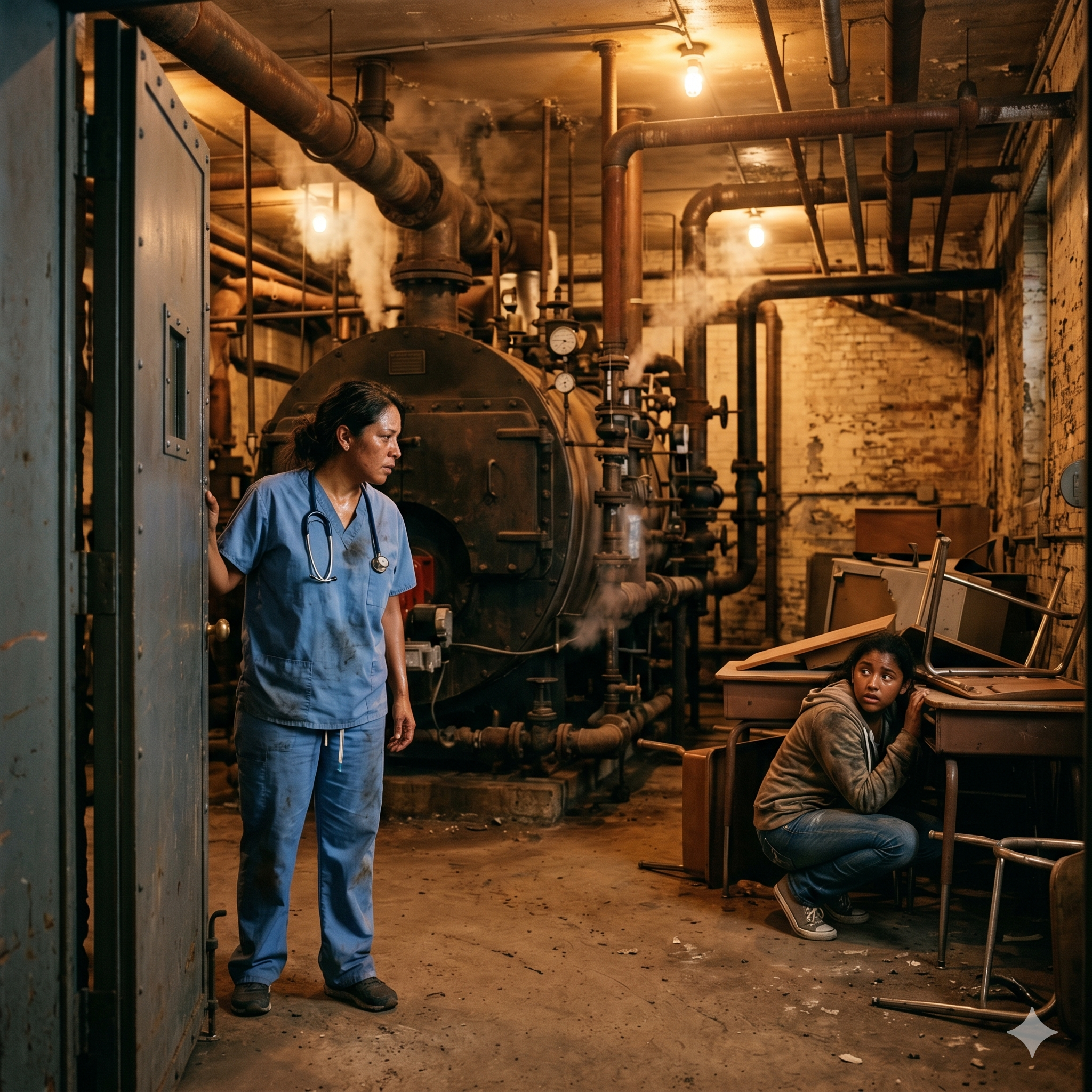
The air grew significantly hotter and thicker as Laura descended the stairwell. The sterile, fluorescent lighting of the school gave way to dim, flickering bulbs. The smell of floor wax faded, replaced by the heavy, metallic scent of rust, old dust, and sulfur.
She reached the heavy steel door of the boiler room. It was cracked open just an inch.
Laura pushed it. The hinges groaned in protest.
The room was cavernous and oppressive, dominated by the massive, churning iron lungs of the school’s archaic heating system. Pipes crisscrossed the low ceiling like a metal spiderweb, hissing and spitting steam. It was at least ninety degrees down here.
“Emily?” Laura whispered, her voice trembling.
From the far, darkest corner behind a stack of broken wooden desks, a small shadow flinched.
Laura navigated through the labyrinth of pipes, her heart shattering as her eyes adjusted to the gloom. There, wedged between the cinderblock wall and a massive water heater, sat her daughter.
Emily had her knees pulled tight to her chest, her arms wrapped around her faded denim backpack like a shield. Her dark hair was matted with sweat, sticking to her pale cheeks. Her eyes, usually a vibrant, defiant brown, were wide, bloodshot, and feral with pure terror.
“Em?” Laura dropped to her knees, not caring about the grease staining her scrubs. “Oh, mi amor, what are you doing down here? Why are you in the dark?”
Emily flinched violently when Laura reached out to touch her shoulder. She scrambled back, hitting her head against the cinderblocks.
“You shouldn’t be here,” Emily choked out, her voice raspy from disuse and crying. “Mom, you have to leave. If they see you…”
“If who sees me?” Laura demanded, panic rising in her throat. She grabbed Emily’s hands. They were ice cold despite the suffocating heat of the boiler room. “Who is doing this to you? The school thinks you’re skipping. Sarah thinks you’re just trying to get attention. Why are you hiding in the basement?”
Emily began to sob, a deep, wretched sound that tore at Laura’s soul. With trembling, hesitant fingers, the fourteen-year-old unzipped the front pocket of her backpack. She reached inside and pulled out a fistful of crumpled, grease-stained pieces of notebook paper.
She shoved them into Laura’s hands.
“They leave them in my locker,” Emily whispered, tears carving tracks through the dust on her face. “Every morning. Between passing periods. If I go to class, they whisper it. If I go to the cafeteria, they slide them onto my tray. I can’t breathe up there, Mom. I can’t breathe.”
Laura smoothed out the first crumpled paper. The handwriting was jagged, written in thick, aggressive black marker.
WE KNOW WHAT YOUR MOTHER DID.
Laura’s breath hitched. She quickly unfolded the second note.
DIRTY LIAR. YOU BOTH DON’T BELONG HERE.
She opened a third, this one stained with what looked like red ink—or blood.
SHE RUINED OUR FAMILY. NOW WE RUIN HERS. WATCH YOUR BACK, HALF-BREED.
The oppressive heat of the boiler room vanished, replaced by a sudden, freezing dread that paralyzed Laura’s lungs. The notes weren’t about teenage drama. They weren’t about a boy, or a bad grade, or a petty high school rivalry.
They were about her.
They were about the secret Laura had buried deep in the arid Texas dirt ten years ago.
“Mom?” Emily’s voice was a fragile thread. “Mom, what did you do?”
Before Laura could form a word to answer her terrified daughter, a heavy footstep echoed behind them.
Laura spun around, her maternal instincts flaring, ready to fight.
Standing in the shadows of the doorway, leaning heavily on a push-broom, was an old man in a dark blue custodial jumpsuit. His skin was the color of rich, dark soil, deeply lined with years of hard labor, and his eyes carried a heavy, sorrowful weight.
“She ain’t the one they’re after, Ms. Valdez,” Elias Hargreaves said softly, stepping into the dim light. “They’re hunting you. Using the girl as bait.”
PART 2: Sins of the Soil
Laura scrambled to her feet, instinctively pushing Emily behind her. She recognized Elias now. He wasn’t always a high school janitor. Ten years ago, he wore a different uniform. He wore the pale green scrubs of a hospital orderly at the prestigious, privately-owned Callahan Medical Clinic.
“Elias,” Laura breathed, her eyes darting between the old man and the threatening notes in her hand. “It’s them, isn’t it? The Callahans.”
Elias nodded slowly, his broad shoulders slumping as if carrying the weight of the entire town. “It’s the boy. Cole Callahan. He’s a senior here now. Drives a big black truck, runs with the football crowd. The teachers look the other way ’cause his family basically built the stadium.”
Emily tugged at the hem of Laura’s shirt. “Mom, who are the Callahans? What does this mean?”
Laura closed her eyes, the memories crashing over her with the violence of a flash flood. She looked at her daughter, realizing the time for protecting her with silence was over.
“Ten years ago,” Laura began, her voice shaking but resolute, “before I worked at the County Hospital, I was a scrub nurse at a private clinic across town. It was run by Dr. Vance Callahan. He was a very powerful man. His family owns half the cotton fields in this county, the same fields your father manages.”
Elias leaned on his broom, his gaze fixed on the concrete floor. “He was a powerful man, and a cruel one.”
“Dr. Callahan had a lucrative side business,” Laura continued, turning back to Emily. “He treated undocumented migrant workers who got hurt in the fields. But he didn’t treat them out of the goodness of his heart. He did it under the table, charging the plantation owners exorbitant fees to keep the injuries off the official record, so OSHA and the government wouldn’t investigate the unsafe working conditions. He treated human beings like livestock.”
“One night,” Elias chimed in, his voice thick with regret, “a young girl was brought in from the fields. A migrant worker. Couldn’t have been more than seventeen. She was pregnant, in premature labor, and hemorrhaging bad. Dr. Callahan was drunk. He told the foreman to put her in the back room and wait until morning, so it wouldn’t ruin his dinner party.”
Tears welled in Laura’s eyes. “I pleaded with him to let me call an ambulance, to transfer her to the ER. He threatened to have me deported, even though I was born in El Paso. He threatened my nursing license. He locked the clinic doors.”
“And the girl?” Emily asked, her voice a terrified whisper.
“She died,” Laura said, a single tear slipping down her cheek. “Right there on the floor of the back room. I couldn’t save her. But the next morning, I didn’t stay quiet. I went straight to the State Medical Board. I went to the police. I testified against Dr. Vance Callahan.”
“It tore this town apart,” Elias said. “The rich folks hated your momma for it. Called her a traitor. But she sent Vance Callahan to federal prison for involuntary manslaughter and medical malpractice. His wife divorced him, took half the money. The clinic was shut down. But…” Elias paused, looking at Laura with profound guilt. “I was there that night, Ms. Valdez. I was mopping the hallway when he locked the door.”
“Why didn’t you say anything?” Laura asked, her voice cracking, not with anger, but with the exhaustion of a marginalized woman who understood the harsh rules of survival.
Elias looked up, his eyes shining with unshed tears. “I’m an old Black man in a town that still flies the Confederate flag on porches, Ms. Valdez. I was two years away from my pension. If I spoke up against a Callahan, I wouldn’t have just lost my job. I might have lost my life. So, I lied. I told the police I didn’t see nothing. They fired me anyway, sent me to scrub toilets in the basement of this high school. I’ve lived with that cowardice every day for ten years.”
He gestured toward Emily. “When I saw the Callahan boy backing your girl into lockers, slipping papers into her bag… I couldn’t look away again. I couldn’t let another innocent girl get hurt.”
Laura looked at the notes in her hand. The pieces of the puzzle clicked together with terrifying clarity. Vance Callahan had recently been released from prison. And his son, Cole, had been marinading in a decade of hatred, fueled by the narrative that a “dirty immigrant nurse” had ruined his affluent family.
And now, Cole was using his power in the high school to psychologically torture Laura’s daughter. He was breaking Emily down, ensuring that Laura felt the exact same helpless agony the Callahans felt when their empire crumbled.
“We’re going to the police,” Laura stated firmly, grabbing Emily’s hand. “We have the notes. We have proof of harassment. We’ll get a restraining order against the boy.”
“Mom, you don’t understand,” Emily cried out, pulling her hand back. “Cole isn’t just trying to scare me. He knows things. Things that don’t make sense.”
Laura frowned. “What do you mean?”
Emily reached into her back pocket. Her hand was trembling so violently she could barely hold the paper.
“I didn’t show you all of them,” Emily whispered. “He slipped this one under the bathroom stall door this morning. Right before I ran down here. This is why I can’t leave the basement. This is why I’m so scared.”
Laura took the folded piece of paper. Unlike the others, which were written in angry, rushed marker, this one was typed out neatly on thick, expensive cardstock. It looked formal. Cold. Calculated.
Laura unfolded it. The dim light of the boiler room seemed to flicker as she read the single line of text printed in the center of the page.
Her blood turned to ice. The breath vanished from her lungs, and a ringing sound filled her ears, drowning out the hiss of the steam pipes.
Tell your mother the baby didn’t die.
News
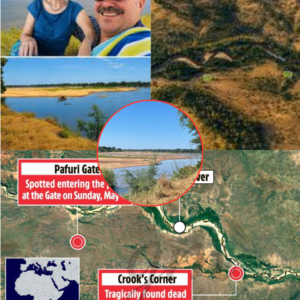
🤯 THE LOCKET, THE TAPE, & THE DETECTIVE: The Final Twist in the Kruger Investigation.
THE GRAVE SPEAKS: A Hidden Locket, a Smuggled SD Card, and the Final Trap That Broke the Kruger Syndicate PRETORIA — Just when the corrupt political elites of South Africa thought they could manage the fallout of the Kruger National…
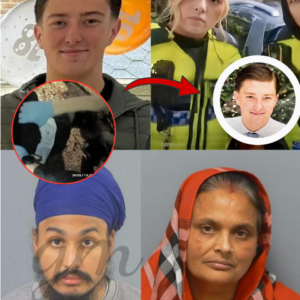
“MY SON WAS TREATED LIKE AN ANIMAL.” THE FATHER’S UNTOLD STORY.
SOUTHAMPTON — The click of metal handcuffs is a sound meant to signify the capture of a dangerous criminal. But on a freezing December night in 2025, that sharp, metallic snap became the soundtrack to one of the most profound…
💔 5 WORDS THAT SHAMED A NATION: “DON’T THINK YOU HAVE, MATE.”
SOUTHAMPTON — The click of metal handcuffs is a sound meant to signify the capture of a dangerous criminal. But on a freezing December night in 2025, that sharp, metallic snap became the soundtrack to one of the most profound…

THE 2037 DREAM IS DEAD: How A Single “Hot Mic” Recording Just Guaranteed Mackenzie Will Never Walk Free
THE “HOT MIC” BOMBSHELL: Leaked Audio And Prison Secrets Just Destroyed Mackenzie Shirilla’s Netflix Lie For Good 🎙️🛑 “I am not a monster. I am a driver in a tragedy.” Millions of viewers watched the tear-streaked face of 21-year-old Mackenzie…

THE WHISTLEBLOWER SPEAKS: Why A Netflix Editor Risked Everything To Expose Mackenzie Shirilla’s Sickening Act
THE “HOT MIC” BOMBSHELL: Leaked Audio And Prison Secrets Just Destroyed Mackenzie Shirilla’s Netflix Lie For Good 🎙️🛑 “I am not a monster. I am a driver in a tragedy.” Millions of viewers watched the tear-streaked face of 21-year-old Mackenzie…
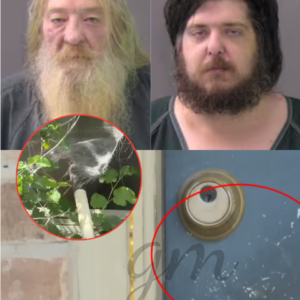
💔 THE PLOT TWIST NO ONE SAW COMING: We Finally Know Where The Mother Is.
🚨 SHOCKING DISCOVERY: Police Breached A “Fake Wall” Inside The Temple Home. The True Source of the “Odor” Finally Revealed. By Senior Investigative Desk Dateline: Temple, Texas — June 2, 2026 When Temple Police Department tactical teams first breached the…
End of content
No more pages to load