Part 1: The Midday Ghost
The biting frost of rural Vermont did not care that Claire Whitmore was grieving. It crept through the poorly insulated windowpanes of the sprawling, century-old farmhouse, sinking into her bones. Claire, a first-generation Dominican woman who had traded the bustling, crowded streets of the Bronx for the isolating pine forests of New England, had always felt the cold more than her late husband, Ben. Ben was built for this unforgiving landscape—a broad-shouldered dairy farmer with hands like cured leather. But Ben had been dead for eleven months, the victim of a catastrophic logging truck failure on the icy mountain roads last spring.
Now, Claire was entirely alone, a woman of color managing a crumbling dairy farm in a valley where her neighbors viewed her with a mixture of pity and quiet suspicion.
It was a Tuesday morning when the isolation finally began to crack. Claire was on the frozen front porch, wrestling with a split cord of firewood, when the crunch of tires on gravel announced a visitor. It was Mrs. Avery, the octogenarian widow from the neighboring property. Mrs. Avery was a relic of the old valley—a former farmhand with knuckles swollen from arthritis and eyes as sharp as knapped flint.
She rolled down the window of her battered Subaru, the heater blasting.
“Mornin’, Claire,” Mrs. Avery rasped, her breath pluming in the frigid air. “You’re splitting that maple all wrong. Gotta hit the grain, not the knot.”
“Good morning, Mrs. Avery,” Claire said, wiping a line of sweat from her forehead despite the chill. She forced a polite smile. “Just trying to keep the woodstove fed. Can I get you a coffee?”
“No time,” the old woman said flatly. She leaned closer to the window, her pale blue eyes locking onto Claire’s dark ones. The casual neighborly tone vanished, replaced by something urgent and intensely unsettling. “I’m just here to tell you that you need to start locking your back door, girl. Because your husband still comes home at noon.”
Claire’s axe slipped from her grip, the heavy iron head thudding into the snow. The silence that followed was deafening, broken only by the whistling wind through the pines.
“Excuse me?” Claire breathed, her heart seizing.
“Every day,” Mrs. Avery continued, her voice devoid of any hesitation. “Right around noon, when the sun hits the top of the silo. I see him walking up the tree line from the lower pasture. Wearing that heavy Carhartt jacket with the grease stain on the left shoulder. He walks right up the porch steps and goes through your kitchen door.”
A sickening knot formed in Claire’s stomach. Ben had been buried in the frozen earth of the local cemetery almost a year ago. She had picked out the casket. She had watched it go into the ground.
“Mrs. Avery,” Claire said gently, trying to mask the tremor in her voice. She had heard whispers in town that the old woman’s mind was slipping, that the isolation of the valley was finally claiming her sanity. “Ben is gone. It’s been almost a year.”
“I know when a man is dead, Claire,” Mrs. Avery snapped, a sudden fierceness in her tone. “I buried two of my own. I’m telling you what I see. Twelve o’clock. Every day. You’d do well to pay attention to your own house.”
Before Claire could respond, Mrs. Avery rolled the window up and reversed down the driveway, the Subaru’s taillights disappearing into the gray morning mist.
Claire stood frozen. The rational part of her brain—the part that had managed the farm’s chaotic ledgers and kept the bank at bay—told her the old woman was suffering from dementia. But another, more primal part of her remembered the heavy, suffocating feeling of being watched that had plagued her for weeks.
Two hours later, the rumble of a heavy diesel engine broke her train of thought. It was Luke, Ben’s older brother.
Luke was a jagged, meaner version of Ben. While Ben had poured his soul into saving the family farm, Luke had spent his twenties racking up gambling debts in Montreal and burning bridges. He had always resented Claire. To Luke, she wasn’t family; she was an outsider, an immigrant who had somehow bewitched his brother out of the family legacy.
Luke kicked the snow off his boots and let himself into the kitchen without knocking, a habit that always made Claire’s skin crawl.
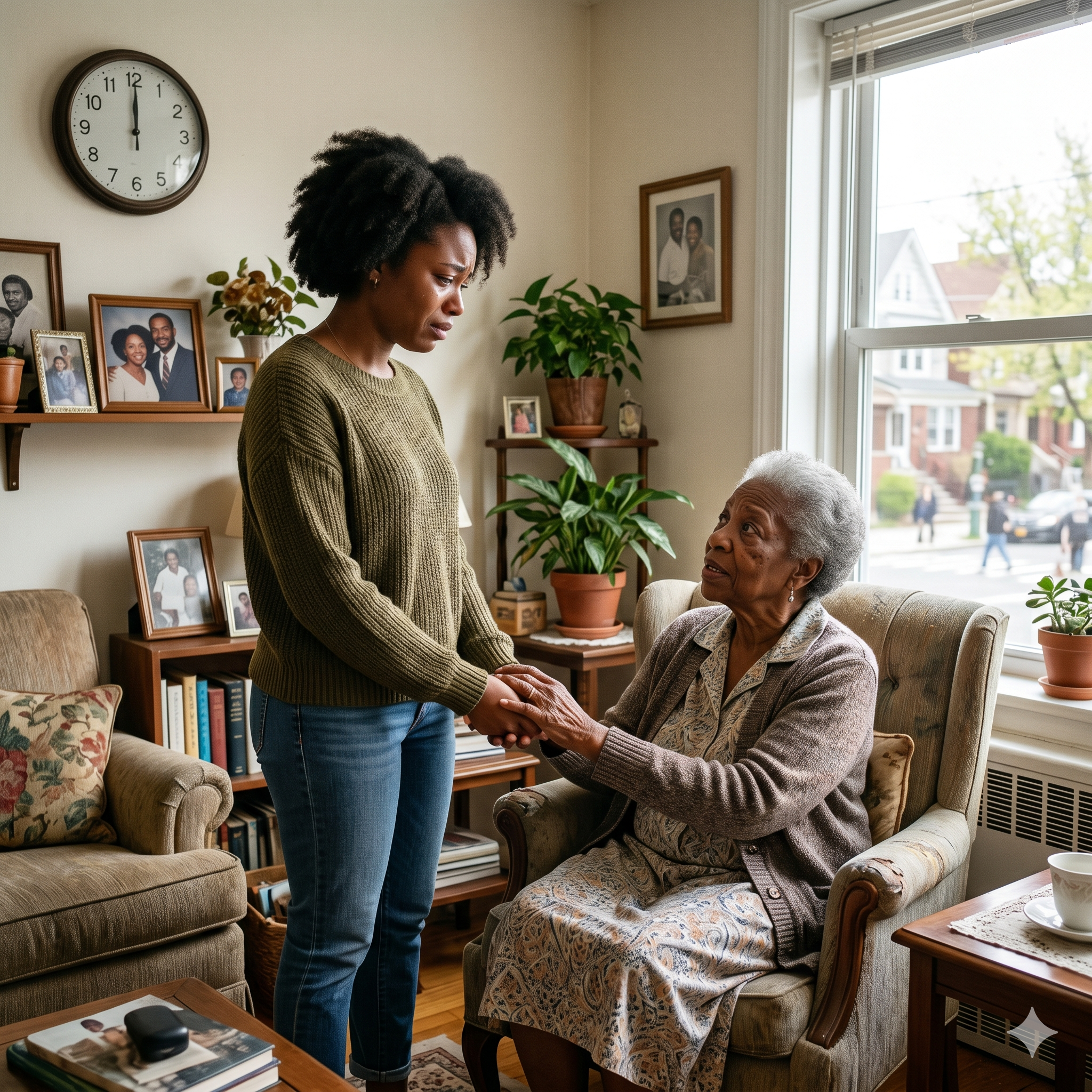
“Freezing in here, Claire,” Luke muttered, heading straight for the coffee pot. He poured himself a mug without asking. “You’re burning through wood too fast. At this rate, you’ll freeze to death before February.”
“I’m managing fine, Luke,” Claire said, keeping her distance, her arms crossed defensively over her chest.
Luke leaned against the counter, his eyes scanning the worn linoleum, the peeling wallpaper, and finally, Claire. “Look, I’m just gonna say it. You look exhausted. The bank is breathing down your neck. This farm is a money pit, and it killed my brother. You need to sell.”
“We’ve had this conversation,” Claire said firmly, lifting her chin. “Ben wanted me to keep this land. We had a plan.”
“Ben was a romantic, and now he’s dead,” Luke retorted, his voice hardening. “I have a buyer. A corporate dairy outfit from upstate. They’ll pay a premium for the acreage. You take the cash, move back to the city where you belong, and I get my cut of the inheritance. It’s clean.”
“I am not selling my home,” Claire said, her voice dropping to a dangerous register.
Luke stared at her for a long, calculating moment. He set the mug down with a sharp clack. “You’re losing your grip, Claire. The guys down at the feed store say you’ve been acting paranoid. Jumping at shadows. It ain’t healthy for a woman out here alone. Mind plays tricks on you.”
He walked toward the door, pausing with his hand on the knob. “Think about the offer. Before this place buries you, too.”
When he left, the house felt even emptier. But Luke’s words echoed in her mind, overlapping with Mrs. Avery’s bizarre warning. You’re losing your grip… Mind plays tricks on you.
Claire looked up at the antique clock on the wall. It was 11:30 AM.
She wasn’t going to wait around to be called crazy. She was going to find out exactly what was haunting her farm.
Part 2: The Ghost in the Carhartt
The next morning, Claire meticulously staged her departure. She made sure her truck was visible as she packed a duffel bag, deliberately making a show of throwing it into the passenger seat. If someone was watching the property, she wanted them to believe she was heading into town for the day.
She drove exactly two miles down the county road, pulled into a densely wooded logging trail, and parked the truck out of sight. Grabbing a heavy iron tire iron from the trunk, she hiked back through the biting cold, navigating the dense pine forest that bordered the rear of her property.
By 11:45 AM, she was huddled in the shadowy loft of the dilapidated tractor shed, a position that offered a perfect, unobstructed view of the farmhouse’s back door. The cold was agonizing, seeping through her boots, but the adrenaline pumping through her veins kept her painfully alert.
She waited.
At exactly 11:58 AM, a figure emerged from the tree line.
Claire slapped a gloved hand over her mouth to stifle a gasp.
It was a man, broad-shouldered and walking with a heavy, purposeful stride. He was wearing Ben’s insulated, tan Carhartt jacket—the one with the distinct black grease stain on the left shoulder. He even wore Ben’s frayed Boston Red Sox cap, pulled low over his face. From a distance, the silhouette was so perfectly Ben that Claire felt the wind knocked out of her.
But as the man stepped out of the shadows and onto the porch steps, the midday sun caught his profile.
It wasn’t a ghost. It wasn’t Ben.
It was Luke.
Rage, hot and blinding, instantly burned away the cold in Claire’s limbs. Luke had a spare key. He had kept Ben’s old jacket. He was deliberately dressing like his dead brother and breaking into her house.
He’s trying to make me think I’m insane, Claire realized with sickening clarity. If she had gone to the police and claimed she saw her dead husband wandering the property, or if Mrs. Avery reported it, Luke would use it as proof that the grieving widow was mentally unstable. He could have her declared unfit, contest the deed to the farm, and force the sale. It was psychological warfare against an isolated woman he believed was powerless.
Claire gripped the tire iron, her knuckles turning white, and climbed quietly down the ladder.
She crossed the frozen yard, her footsteps masked by the howling wind, and slipped through the back door. She moved through the kitchen, silent as a shadow. She didn’t hear him in the living room. She didn’t hear him upstairs.
A faint scraping sound echoed from the end of the hallway. Ben’s old home office.
Claire crept down the hall and peered around the doorframe. Luke was on his hands and knees. He had pushed Ben’s heavy oak desk to the side and was prying at the wide-plank hardwood floorboards with a crowbar. He was sweating profusely, cursing under his breath as the old nails shrieked against the wood.
He wasn’t just here to play dress-up. He was looking for something.
“What the hell are you doing?” Claire’s voice cut through the room like a whip.
Luke violently flinched, dropping the crowbar. He spun around, his eyes wide with genuine panic, looking completely ridiculous in the oversized coat of the brother he despised.
“Claire!” he stammered, scrambling to his feet, his hands raised in a placating gesture. “I… I thought you were in town. I was just coming to fix that drafty floorboard for you.”
“Save it,” Claire spat, stepping fully into the room, the heavy iron bar resting menacingly against her leg. “Take off his jacket, Luke. Right now.”
Luke hesitated, then slowly unzipped the coat, letting it fall to the floor. The false bravado was gone, replaced by a cornered, feral energy. “Listen, Claire, you don’t understand.”
“I understand perfectly,” she said, her voice shaking with adrenaline. “You’re gaslighting me. You dress up like my dead husband so the neighbors think I’m crazy, so you can steal the land. But that doesn’t explain why you’re tearing up my floor. What are you looking for?”
Luke’s eyes darted toward the partially pried floorboard. “Nothing. Just old tax documents. Ben owed me money.”
Claire didn’t blink. She leveled the tire iron at him. “Get out. If you ever set foot on my property again, I won’t call the sheriff. I have a shotgun in the closet, and I know how to use it. Get out!”
Luke sneered, his true nature finally surfacing. “You think you can hold onto this place, you stupid girl? You don’t belong here. You never did. This is Whitmore land.”
“It’s my land now,” Claire snarled. “Get out.”
Luke backed out of the room, his eyes filled with venom, and stormed down the hall. A moment later, the front door slammed hard enough to rattle the windows.
Claire stood in the empty room, her chest heaving. When the adrenaline faded, leaving her trembling, she turned her attention to the floor.
Luke had managed to lift one of the wide oak planks. Claire dropped to her knees, shoved the crowbar under the adjacent plank, and threw her weight into it. With a loud crack, the wood splintered and gave way.
Beneath the floorboards, nestled in the dusty cavity between the joists, was a thick, waterproof lockbox.
Claire pulled it out. Her hands shook as she flipped the heavy latches.
Inside was a stack of papers, bank statements, and a meticulously kept journal in Ben’s familiar, messy handwriting. She pulled out a mechanic’s invoice—it was for the logging truck Ben had died in. But attached to the invoice was a private investigator’s report, dated three days before Ben’s death.
The report detailed Luke’s massive, crippling debts to a violent syndicate in Montreal. It also contained photographs of Luke at the local mechanic’s yard, standing next to the very truck Ben had been driving the day the brakes mysteriously failed on the mountain pass.
Suddenly, a terrifying realization washed over her. Mrs. Avery hadn’t been suffering from dementia. She hadn’t been confused. She knew exactly what Luke was doing, but in a town run by old blood and good ol’ boy networks, a working-class immigrant widow accusing a local man of murder without proof would be dismissed in a heartbeat. The old woman had deliberately pushed Claire to investigate her own house to find the proof she needed.
Claire’s hands trembled as she opened the leather-bound journal resting at the bottom of the lockbox. She turned to the very last page, written in rushed, frantic ink.
The blood drained from her face as she read the final entry.
If Luke is reading this, Claire is already in danger.
News
🤯 THE LOCKET, THE TAPE, & THE DETECTIVE: The Final Twist in the Kruger Investigation.
THE GRAVE SPEAKS: A Hidden Locket, a Smuggled SD Card, and the Final Trap That Broke the Kruger Syndicate PRETORIA — Just when the corrupt political elites of South Africa thought they could manage the fallout of the Kruger National…

“MY SON WAS TREATED LIKE AN ANIMAL.” THE FATHER’S UNTOLD STORY.
SOUTHAMPTON — The click of metal handcuffs is a sound meant to signify the capture of a dangerous criminal. But on a freezing December night in 2025, that sharp, metallic snap became the soundtrack to one of the most profound…
💔 5 WORDS THAT SHAMED A NATION: “DON’T THINK YOU HAVE, MATE.”
SOUTHAMPTON — The click of metal handcuffs is a sound meant to signify the capture of a dangerous criminal. But on a freezing December night in 2025, that sharp, metallic snap became the soundtrack to one of the most profound…

THE 2037 DREAM IS DEAD: How A Single “Hot Mic” Recording Just Guaranteed Mackenzie Will Never Walk Free
THE “HOT MIC” BOMBSHELL: Leaked Audio And Prison Secrets Just Destroyed Mackenzie Shirilla’s Netflix Lie For Good 🎙️🛑 “I am not a monster. I am a driver in a tragedy.” Millions of viewers watched the tear-streaked face of 21-year-old Mackenzie…

THE WHISTLEBLOWER SPEAKS: Why A Netflix Editor Risked Everything To Expose Mackenzie Shirilla’s Sickening Act
THE “HOT MIC” BOMBSHELL: Leaked Audio And Prison Secrets Just Destroyed Mackenzie Shirilla’s Netflix Lie For Good 🎙️🛑 “I am not a monster. I am a driver in a tragedy.” Millions of viewers watched the tear-streaked face of 21-year-old Mackenzie…
💔 THE PLOT TWIST NO ONE SAW COMING: We Finally Know Where The Mother Is.
🚨 SHOCKING DISCOVERY: Police Breached A “Fake Wall” Inside The Temple Home. The True Source of the “Odor” Finally Revealed. By Senior Investigative Desk Dateline: Temple, Texas — June 2, 2026 When Temple Police Department tactical teams first breached the…
End of content
No more pages to load