Part 1: The Whispers in the Pines
The Oregon rain didn’t fall so much as it materialized from the heavy, suffocating fog that blanketed the Willamette Valley. It clung to the towering Douglas firs and turned the soil of Tom Bennett’s struggling ten-acre farm into a thick, sucking mud. Tom, a man whose Klamath heritage showed in his high, sharp cheekbones and dark, perpetually exhausted eyes, leaned heavily against the rusted hood of his 1980 Chevy pickup. He wiped a mixture of rainwater and grease from his brow, his calloused, splinter-scarred hands aching with the deep, bone-deep chill of November.
He was a man holding onto the edge of a cliff by his fingernails. After his wife, Sarah, died suddenly of what the county coroner hastily labeled a “massive cardiac event” ten months ago, the bank had swooped in like vultures. Now, Tom worked himself to the bone—running a few head of cattle, fixing tractors for the wealthier white ranchers in the valley, and doing whatever manual labor he could find just to keep a roof over his ten-year-old daughter, Mia.
But it wasn’t the grueling work or the mounting debts that kept Tom awake at night, staring at the water stains on the bedroom ceiling. It was Mia.
Through the veil of mist, Tom watched his daughter. She was standing at the far edge of their property, where their overgrown pasture met the impenetrable, jagged wall of the old-growth pine forest. She was a small, fragile silhouette in a bright yellow raincoat. She stood perfectly still, her face pressed against the rotting wooden slats of the perimeter fence.
She was whispering.
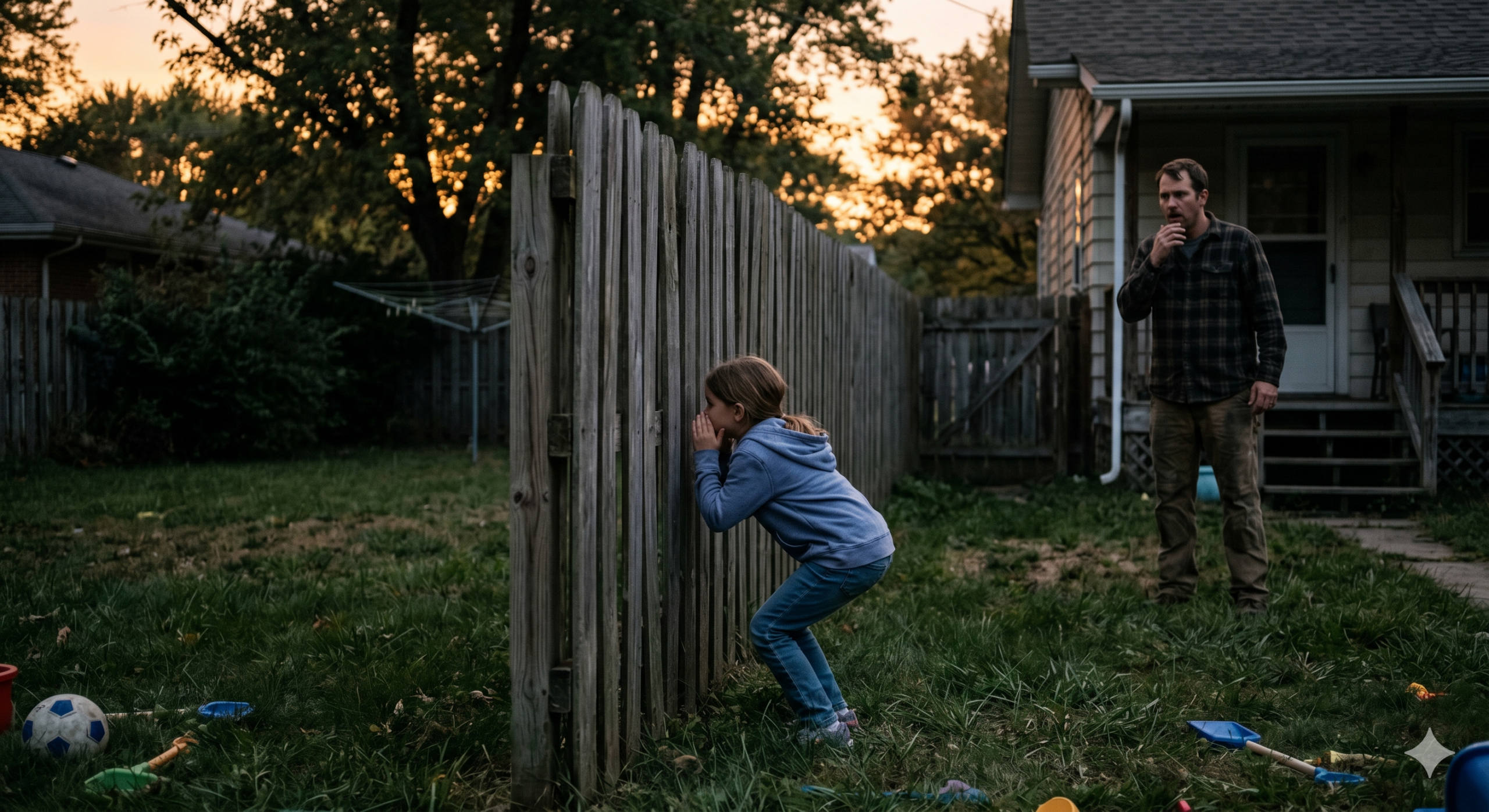
It had become a daily ritual. Every afternoon, the moment she stepped off the yellow school bus, Mia would drop her backpack on the porch, march straight through the mud to the exact same spot by the fence, and talk.
At first, Tom had asked her what she was doing. “Just telling Mom about my day,” she had replied, her voice eerily calm, devoid of the hysterical grief Tom himself was drowning in. The child psychologist the school had forced them to see told Tom it was a normal coping mechanism. “She’s a child experiencing profound trauma, Mr. Bennett. The imagination is a powerful shield. Let her speak to the wind. It helps her process the loss.”
So, Tom let her. He endured the daily heartbreak of watching his little girl hold one-sided conversations with a ghost.
“She is out there again.”
The gravelly, heavily accented voice broke Tom’s concentration. He turned to see Mrs. Keller standing on the edge of his driveway. She was an elderly Polish immigrant who lived in a dilapidated single-wide trailer on the adjacent plot of land. She was a fixture of the valley, a woman who had survived the horrors of Eastern Europe only to settle in the isolation of the Pacific Northwest. She wore a heavy babushka scarf and clutched a walking stick carved from ash wood.
“She’s just playing, Mrs. Keller,” Tom said softly, turning back to his truck. He didn’t have the energy for the old woman’s superstitious prying today. “The doctor says it’s healthy. She’s just processing.”
Mrs. Keller stepped closer, her boots squelching in the mud. Her pale, rheumy eyes locked onto Tom’s face. “A child talking to the dead is one thing, Thomas. But a conversation requires two.”
Tom froze, his hand tightening around the heavy iron wrench he was holding. “What are you talking about?”
“I sit on my porch. I drink my tea,” Mrs. Keller said, her voice dropping to a harsh whisper, blending with the sound of the falling rain. “Your property line is close to mine. I hear her talking to the woods. And Thomas… someone talks back.”
A flash of protective anger ignited in Tom’s chest. The isolation of the valley was notorious for breeding meth cooks, drifters, and squatters in the deep woods. If some vagrant was out there, hiding in the trees and talking to his little girl, Tom would kill them with his bare hands.
“Did you see someone?” Tom demanded, taking a step toward her. “A man? Is someone trespassing on the logging roads behind the fence?”
Mrs. Keller shook her head slowly, a deep sadness etching new lines into her weathered face. “Not a man. A woman. I hear the voice, Thomas. Soft. Kind. It comes from the trees. It sounds…” She hesitated, looking away.
“It sounds like what?” Tom pressed, his patience evaporating.
“It sounds like Sarah,” Mrs. Keller whispered.
The name hit Tom like a physical blow to the stomach. The anger instantly mutated into a hot, blinding fury. It was one thing to let his daughter play pretend; it was a completely different, cruel sickness for this old woman to feed into a child’s delusions.
“Don’t you ever say that,” Tom snarled, his voice vibrating with a primal, dangerous warning. He pointed a dirt-stained finger at the old woman. “My wife is dead. She is buried in the cemetery off Route 9. Do not fill my daughter’s head with ghost stories, and do not come onto my property spouting this poison, you hear me? If you’re going senile, keep it to yourself.”
Mrs. Keller did not flinch. She simply looked at him with an unbearable weight of pity. “A blind man gets angry when you tell him the sun is shining, Thomas. But it does not stop the sun from burning.”
She turned and walked slowly back toward her trailer, leaving Tom standing in the freezing rain.
He looked back toward the fence. Mia was still there, nodding her head slowly, as if listening intently to a secret the forest was sharing.
Tom felt a cold dread pooling in his gut. He didn’t believe in ghosts. As an Indigenous man who had seen his people systematically marginalized and pushed to the fringes, he knew that the real monsters in the world were made of flesh and blood. They were the logging executives who polluted the rivers, the corrupt county sheriffs who looked the other way, and the opioid epidemics that ravaged the reservations.
Sarah hadn’t been killed by a ghost. She had been a fiery, relentless bookkeeper for the county’s largest timber corporation, Vance Logging. In the weeks before she died, she had been exhausted, terrified, and constantly looking over her shoulder. She told Tom she was auditing “discrepancies” in the land acquisition accounts. Then, one morning, she was found dead on the kitchen floor. Heart failure. At thirty-two years old.
Tom had screamed at the coroner. He had demanded an autopsy. But he was just a poor, mixed-race farmer. They told him the case was closed.
Now, his daughter was talking to the trees. And his neighbor claimed the trees were speaking in his dead wife’s voice.
Tom walked into the house, his jaw set. Tomorrow, he wasn’t going to fix the truck. He was going to find out exactly who—or what—was preying on his little girl.
Part 2: The Echo in the Wood
The following afternoon, the storm had worsened, turning the sky the color of a bruised plum by 3:00 PM. The wind howled through the valley, rattling the windowpanes of the farmhouse.
Tom stood in the shadows of the old, rotting tractor shed, entirely concealed from the house and the fence line. He was soaked to the bone, rain dripping from the brim of his faded canvas hat, his breathing shallow and controlled. In his right hand, gripped tightly enough that his knuckles were white, was a heavy steel tire iron.
He waited.
At 3:15 PM, the yellow school bus groaned to a halt at the end of the road. Mia stepped off, her yellow raincoat a stark splash of color against the gray world. Just as she did every day, she didn’t head for the porch. She walked with quiet determination past the rusted farm equipment, her boots sinking into the muck, until she reached the sagging wooden fence at the edge of the property line.
Tom’s heart hammered against his ribs. He crept silently along the side of the shed, keeping out of sight, until he was within twenty feet of her, masked by the thick brush of blackberry brambles.
Mia stood on her tiptoes, leaning close to a massive, hollowed-out oak tree that sat just on the other side of the property line.
“Hi, Mommy,” Mia whispered.
Tom closed his eyes, a wave of agony washing over him. It was just a child’s imagination. He was standing in the freezing rain, holding a weapon, ready to attack thin air. He felt like a fool. He felt like a failure of a father.
“School was okay today,” Mia continued, her voice trembling slightly over the sound of the wind. “But I don’t like math. And… Daddy is still sad. He tries to hide it, but I can hear him. Daddy still cries at night.”
Tom bit his lip hard enough to taste blood. He prepared to step out of the bushes, to go to his daughter, wrap her in his arms, and finally tell her the truth—that mommy wasn’t there, and they only had each other.
Then, a sound cut through the rain.
A sharp, synthetic click.
Followed by a burst of soft, crackling static.
And then, a voice spoke from the darkness of the hollowed oak.
“I know he does, baby. Your Daddy has a big heart. The biggest I’ve ever known. It’s why I love him so much.”
Tom stopped breathing. The blood rushed to his ears in a deafening roar. The tire iron slipped from his fingers, falling silently into the thick mud.
It wasn’t a hallucination. It wasn’t the wind.
It was Sarah.
Her voice, with its familiar, gentle cadence, the slight rasp she got when it was cold—it was perfectly, impossibly her.
“You have to be strong for him, Mia,” Sarah’s voice continued from the tree, echoing slightly, laced with the hiss of audio distortion. “I know it’s hard. But you’re ten now. You are so brave. And soon, I need you to do something very important for me.”
“I will, Mommy,” Mia whispered, a tear mixing with the rain on her cheek.
Tom couldn’t take it anymore. A primal, suffocating panic erupted inside him. He exploded from the bushes, tearing through the blackberry thorns that ripped at his clothes and skin.
“Sarah!” Tom screamed, his voice tearing from his throat, a raw sound of sheer desperation.
Mia shrieked, stumbling backward in terror as her father vaulted the rotting wooden fence, crashing into the dense brush on the other side.
Tom threw himself at the hollow oak tree. “Sarah! Where are you?!” he roared, tearing at the wet bark, expecting to find her standing there, expecting to find… he didn’t know what. A ghost. A miracle.
But there was no one.
Tom fell to his knees in the mud at the base of the tree. He looked into the dark, rotted hollow of the trunk.
Resting on a small, dry ledge inside the wood was a heavy-duty, waterproof cassette player. It was an older model, the kind used by journalists for dictation. The red ‘play’ light was glowing dimly in the dark. Beside it lay a small, weather-sealed plastic box containing half a dozen meticulously labeled cassette tapes.
Tom stared at the machine, his mind violently rejecting what his eyes were seeing. He reached out with a trembling, mud-caked hand and pressed the stop button. The static died. The woods fell completely silent, save for Mia’s terrified sobbing behind him.
“Daddy, I’m sorry!” Mia cried, burying her face in her hands. “I wasn’t supposed to tell! She said it was a secret!”
Tom turned, his chest heaving, his brain completely short-circuiting. He picked up the plastic box. The tapes were labeled with dates. Mia – Week 1. Mia – Week 2. Tom – WHEN READY.
Before Tom could speak, the crunch of heavy boots on wet gravel broke the silence.
Tom whipped his head around. Stepping out from the dense pine trees, her face pale but resolute, was Mrs. Keller. She wasn’t leaning on her walking stick anymore. She held it firmly, like a guard.
“I told you, Thomas,” the old woman said, her voice steady despite the storm. “Someone talks back.”
Tom scrambled to his feet, holding the tape player like it was a live bomb. “What is this? What the hell is this?! Did you do this? Are you playing some kind of sick psychological game with my family?!”
Mrs. Keller looked at Mia, her eyes softening. “Mia, dorogaya, go inside the house. Make yourself some hot cocoa. Your father and I need to speak. Adult matters.”
Mia looked at Tom, terrified. Tom gave her a slow, numb nod. “Go inside, baby. Lock the door. I’ll be right there.”
Once Mia was safely inside the house, Tom turned his blazing eyes on the elderly woman. “Explain. Now. Or I swear to God…”
“Your wife was a very smart woman, Thomas. But she was dealing with very evil men,” Mrs. Keller began, stepping closer to the fence, ignoring the rain. “She knew they were watching her. She knew she had found something in those logging company accounts that could put powerful men in prison. Men who own the police in this county.”
Tom’s breath hitched. “She… she knew?”
“She came to my trailer three nights before she died,” Mrs. Keller said, pulling her scarf tighter against the cold. “She gave me a lockbox. She gave me this tape player. She said she was being followed. She told me that if anything happened to her, they would make it look natural. And she knew that if she left the evidence with you, they would kill you too. You are a minority in a town run by white money, Thomas. They would frame you, or they would bury you.”
Tom looked down at the plastic box in his hands. The reality of his wife’s terrifying final days crashed down on him, suffocating him.
“Why the tapes for Mia?” Tom choked out, tears finally breaking free, mixing with the rain. “Why play this game with a little girl?”
“Because Sarah knew Mia walked by this tree every single day,” Mrs. Keller explained softly. “And she knew that a grieving child coming to the woods to whisper to her dead mother would be invisible. The men who killed your wife searched your house, Thomas. They searched my trailer. They never searched the old oak tree where a little girl played pretend.”
Mrs. Keller pointed a gnarly finger at the waterproof box. “She made me promise. She recorded messages to keep the girl’s hope alive, to slowly guide her, to prepare her. She told me to wait until Mia was old enough, or until you were finally ready to see the truth. Yesterday, when you yelled at me, I saw that you were finally angry enough to fight. So, today, I let you catch us.”
Tom stood in the mud, holding the last remnants of his wife’s voice. She hadn’t abandoned them. She had fought to her dying breath, orchestrating a brilliant, desperate plan from beyond the grave to protect her family and expose her killers.
“There is one tape left in there, Thomas,” Mrs. Keller said, her eyes dark and serious. “The one labeled with your name. She said you must only listen to it when you are ready to burn this town to the ground.”
Tom looked at the tape labeled Tom – WHEN READY.
He didn’t hesitate. He popped the tape out of the waterproof box, his hands steadying with a sudden, lethal resolve. He placed it into the player and hit the heavy, mechanical play button.
There was a moment of tape hiss. Then, Sarah’s voice filled the cold, Oregon air. She sounded exhausted, terrified, but forged in steel.
“Tom. My beautiful, brave Tom. If you are hearing this, it means I’m gone. And it means Mrs. Keller kept her promise.”
Tom closed his eyes, a sob catching in his throat at the sound of her voice addressing him directly.
“I love you. I love you and Mia more than life. That’s why I had to hide this. I found the shadow ledgers, Tom. Vance Logging isn’t just stealing land. They are burying the chemicals from the mill on the reservation land upriver. It’s poisoning the water. I have the bank accounts. I have the bribe receipts for the sheriff.”
There was a pause on the tape. The sound of Sarah taking a shaky breath.
“They are coming for me tonight, Tom. I can see the headlights at the end of the road. Listen to me very carefully. You need to take the documents hidden beneath the floorboards of the woodshed, take Mia, and drive to the FBI field office in Portland. Do not stop. Do not call the local police.”
The audio crackled violently.
“Tom, if you hear this, don’t trust the death certificate.”
News
🤯 THE LOCKET, THE TAPE, & THE DETECTIVE: The Final Twist in the Kruger Investigation.
THE GRAVE SPEAKS: A Hidden Locket, a Smuggled SD Card, and the Final Trap That Broke the Kruger Syndicate PRETORIA — Just when the corrupt political elites of South Africa thought they could manage the fallout of the Kruger National…

“MY SON WAS TREATED LIKE AN ANIMAL.” THE FATHER’S UNTOLD STORY.
SOUTHAMPTON — The click of metal handcuffs is a sound meant to signify the capture of a dangerous criminal. But on a freezing December night in 2025, that sharp, metallic snap became the soundtrack to one of the most profound…
💔 5 WORDS THAT SHAMED A NATION: “DON’T THINK YOU HAVE, MATE.”
SOUTHAMPTON — The click of metal handcuffs is a sound meant to signify the capture of a dangerous criminal. But on a freezing December night in 2025, that sharp, metallic snap became the soundtrack to one of the most profound…

THE 2037 DREAM IS DEAD: How A Single “Hot Mic” Recording Just Guaranteed Mackenzie Will Never Walk Free
THE “HOT MIC” BOMBSHELL: Leaked Audio And Prison Secrets Just Destroyed Mackenzie Shirilla’s Netflix Lie For Good 🎙️🛑 “I am not a monster. I am a driver in a tragedy.” Millions of viewers watched the tear-streaked face of 21-year-old Mackenzie…

THE WHISTLEBLOWER SPEAKS: Why A Netflix Editor Risked Everything To Expose Mackenzie Shirilla’s Sickening Act
THE “HOT MIC” BOMBSHELL: Leaked Audio And Prison Secrets Just Destroyed Mackenzie Shirilla’s Netflix Lie For Good 🎙️🛑 “I am not a monster. I am a driver in a tragedy.” Millions of viewers watched the tear-streaked face of 21-year-old Mackenzie…
💔 THE PLOT TWIST NO ONE SAW COMING: We Finally Know Where The Mother Is.
🚨 SHOCKING DISCOVERY: Police Breached A “Fake Wall” Inside The Temple Home. The True Source of the “Odor” Finally Revealed. By Senior Investigative Desk Dateline: Temple, Texas — June 2, 2026 When Temple Police Department tactical teams first breached the…
End of content
No more pages to load