Part 1: The Thursday Ghost
The coastal winds of rural Maine didn’t just blow; they bit. They carried the bitter scent of salt, decaying pine needles, and impending winter, cutting through David Cole’s canvas work jacket as he loaded two-by-fours into the bed of his rusted Ford F-150. At thirty-four, David felt closer to fifty. His hands were mapped with calluses and pale scars from a decade of carpentry, but the real weight he carried wasn’t timber—it was duty.
For the past three years, his life had been a closed loop: the lumberyard, the job site, and the drafty, salt-weathered farmhouse where his mother, Eleanor, lay permanently tethered to a hospital bed in the living room. A severe stroke had reportedly stolen her mobility, leaving her frail, bedridden, and entirely dependent on David and his mother’s sister, Aunt Marcy, who came over during the days to spell him.
David slammed the tailgate shut and wiped the sawdust from his beard. Before heading home to relieve Marcy, he needed to stop at Osgood’s General Store.
Osgood’s was a relic, a dimly lit cavern smelling of kerosene heaters, stale coffee, and oiled leather. June, a woman whose face was as creased as an old map, stood behind the counter ringing up a local lobsterman. When she saw David approach with a jug of milk and a loaf of sourdough, her face broke into a familiar, sympathetic smile.
“Afternoon, David,” June rasped, the cash register chiming a tinny bell. “Cold one out there today.”
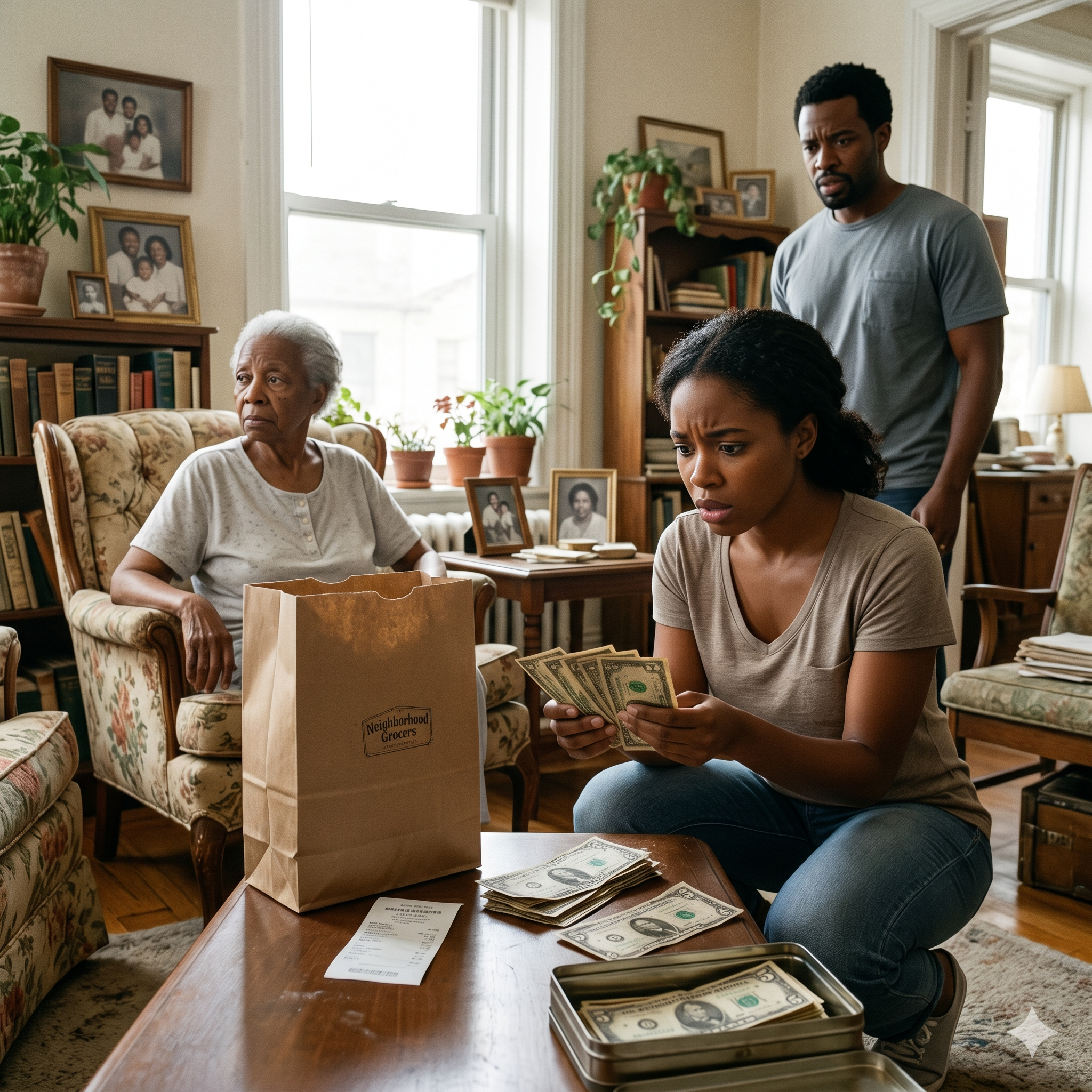
“Getting worse by the hour, June. Just need these, please,” David said, digging a crumpled twenty from his jeans.
June bagged the groceries, her eyes lingering on him with a grandmotherly warmth. “You make sure you build up that fire tonight. And tell your mother I said hello. It was good seeing her, even if she’s as stubborn as ever.”
David’s hand froze mid-reach for his change. The heater in the corner seemed to abruptly stop ticking. He looked at June, his brow furrowing in deep confusion. “I’m sorry? Tell her you said hello?”
“Well, yes,” June said, wiping down the counter with a gray rag. “She didn’t stay long. Just popped in for her usual. Bread, whole milk, and those unfiltered Pall Malls she shouldn’t be smoking at her age.”
A cold dread, entirely separate from the Maine wind, settled in David’s stomach. “June, my mother hasn’t left the house in three years. She can’t walk. You know this.”
June paused, the rag stilling on the scratched formica. She frowned, a flicker of uncertainty crossing her pale eyes, before it hardened back into stubborn rural certainty. “David, I’ve known Eleanor since we were in grade school. I know your mother. She was in here yesterday. Just like she’s been in here every Thursday for the last two months.”
“That’s impossible,” David said, his voice flat, trying to keep the sudden edge out of it. “Aunt Marcy watches her during the week while I frame houses out in Bar Harbor. Mom is paralyzed on her left side.”
“I’m telling you what I saw,” June insisted, her tone defensive now. She turned to the register, popped the drawer, and lifted the heavy coin tray. From beneath it, she pulled out a worn, faded ten-dollar bill. She slid it across the counter toward David. “She paid with this. Said she was clearing out old winter coats. Look at the corner.”
David picked up the bill. It was old—the design predated the newer security features. But it wasn’t the age of the currency that made his blood run cold. In the top right corner, written in faded blue ink, were the words: Emergency stash – E. Cole.
The handwriting was jagged, elegant, and entirely unmistakable. It was his mother’s script.
“She was wearing that heavy green wool coat of hers,” June added softly, seeing the color drain from David’s face. “The one with the missing toggle. She looked right at me, paid, and walked out.”
David didn’t say another word. He shoved the bill into his pocket, grabbed the groceries, and walked out into the biting cold.
When David arrived back at the farmhouse, the suffocating heat of the woodstove hit him like a wall. Aunt Marcy was sitting in the worn armchair by the window, knitting. She was a hard-faced woman, her gray hair pulled into a severe knot, her posture stiff and unyielding.
“You’re late,” Marcy noted without looking up from her needles.
“Traffic on Route 1,” David muttered, his eyes darting to the hospital bed in the center of the room.
Eleanor lay there, a frail silhouette beneath heavy quilts. The television was murmuring a daytime soap opera. Her eyes fluttered open as David approached. She looked impossibly fragile, her skin translucent, her breathing shallow.
“David?” she whispered, her voice a reedy rasp. “Is that you, dear?”
“I’m here, Mom,” he said, sitting on the edge of the mattress. He stared at her, searching for any sign of deception in her clouded eyes. “How are you feeling today?”
“So tired,” she murmured, attempting to lift a trembling hand before letting it drop weakly back onto the blanket. “My legs… they ache so terribly, even though I can’t move them. Marcy was an angel today. Fed me my soup.”
David looked over at his aunt. Marcy offered a tight, self-satisfied smile.
“Did anything interesting happen yesterday?” David asked casually, his heart hammering against his ribs. “While I was out on the site?”
Marcy’s knitting needles paused for a fraction of a second. A micro-expression of tension flashed across her jaw before she resumed. “Nothing at all. Just the wind rattling the siding. Why do you ask?”
“No reason,” David lied.
He stayed up late that night, long after Marcy had driven home to her property a few miles down the logging road, and long after his mother’s breathing had leveled out into the rhythm of deep sleep. He sat at the kitchen table, the faded ten-dollar bill resting under the harsh overhead light.
He knew June wasn’t crazy. But he also knew his mother hadn’t walked in three years. He had bathed her. He had carried her to the bathroom. He had built the goddamn wheelchair ramp on the front porch with his own two hands.
If his mother was in that bed… who the hell was buying milk on Thursdays?
Part 2: The Shed in the Pines
By Tuesday, David’s paranoia had metastasized into action. He drove two towns over to a hunting supply store and bought a high-resolution, motion-activated trail camera. Under the cover of darkness on Wednesday night, he nailed it to the telephone pole directly across the street from Osgood’s General Store, angling the lens perfectly toward the front door.
Then, he waited.
Thursday crept by with agonizing slowness. David swung his hammer on the job site, but his mind was twenty miles away. When his shift finally ended, he practically flew down the coastal highway, the tires of his truck spitting gravel as he pulled up to the telephone pole in the fading twilight.
He ripped the camera from its mount, plugged the SD card into his rugged work laptop resting on his steering wheel, and scrolled through the timestamps.
10:14 AM. A local walking a dog. 12:30 PM. The mail truck. 2:15 PM.
David hit play.
A figure walked into the frame, moving with a slight, distinctive limp—favoring the left hip. The figure was bundled against the cold in a heavy, forest-green wool coat. The very coat that had been missing from the front closet for years. The woman turned her head briefly before entering the store.
David hit pause. He zoomed in. The resolution was grainy, but the profile was undeniable. The sharp cheekbones, the set of the jaw, the gray hair tucked beneath a woolen cap. It was Eleanor.
A wave of nausea washed over him. His mother was walking. His mother was walking.
But the betrayal he felt was immediately eclipsed by a darker, more terrifying question: If his mother was walking around town on Thursday afternoons… who was the woman lying in the hospital bed in his living room? Or rather, how was she getting back into that bed before he got home, playing the invalid?
He fast-forwarded the footage. The woman exited the store ten minutes later, carrying a brown paper bag. But she didn’t walk toward the highway that led to David’s farmhouse. She walked north, toward the dense, unbroken stretch of pine woods that bordered the old logging properties.
Toward Aunt Marcy’s land.
David threw the truck into drive. The sun was fully down by the time he reached the dirt access road leading to Marcy’s isolated cabin. He parked a half-mile away, grabbing a heavy Maglite flashlight from his glovebox, and proceeded on foot.
The Maine woods at night were eerily silent, save for the crunch of his boots on the frost-hardened earth. Marcy’s cabin sat dark, no smoke rising from the chimney. She was likely at David’s house, doing her evening “caregiving” shift.
But David wasn’t interested in the cabin. His eyes were drawn to the dilapidated, cinder-block storage shed sitting roughly fifty yards behind the main house, half-swallowed by overgrown blackberry brambles. Faint, yellow light leaked from a crack in the boarded-up window.
David approached silently, his grip tightening on the heavy flashlight. He reached the heavy wooden door. A rusted padlock hung from the hasp, but it wasn’t clicked shut. It was just resting there, creating the illusion of security.
Taking a deep breath, David pulled the lock off and pushed the door open.
The hinges screamed in the quiet night. David stepped inside, raising the flashlight. He expected to find stacked cordwood or rusty tools.
Instead, he found a life.
The shed had been converted. The walls were lined with cheap, foil-backed insulation. A kerosene heater burned in the corner, emitting a suffocating smell of fuel. There was a narrow cot, a bucket, and a folding table.
But it was the walls that made David drop the flashlight to his side.
Pinned to the exposed studs were dozens of old photographs. They were pictures of his mother, Eleanor, from her twenties and thirties. But in every single photograph, there were two of her. Identical twins. Smiling on a dock, standing in front of a massive timber mill, sitting on the hood of a classic car.
David stumbled back, his mind fracturing. He had never been told his mother was a twin. Never.
“I knew he’d figure it out eventually,” a voice rasped from the shadows.
David spun around. Sitting in a rocking chair in the far corner, obscured by the dim light, was the woman from the trail camera footage. She was wearing the green wool coat. As she leaned forward into the glow of the kerosene heater, David felt his breath leave his lungs.
She looked exactly like the woman lying in the hospital bed in his living room, only weathered, hardened, and fiercely alive.
“Who… who are you?” David choked out.
“My name is Evelyn,” the woman said, her voice a mirror image of his mother’s, only lacking the fragile, breathy act. “I am—or I was—Eleanor’s sister.”
“I don’t understand,” David said, pacing backward. “Mom never said she had a twin. Marcy never said it. Why are you out here? Why did you go to the store?”
Evelyn let out a bitter, humorless laugh. “Because your beloved Aunt Marcy forgot to bring me my rations this week. She’s been distracted playing nursemaid to my dear sister.”
“My mother is paralyzed!” David yelled, the confusion boiling over into anger. “She had a stroke!”
“Your mother,” Evelyn spat, her eyes flashing with decades of suppressed fury, “is a brilliant actress. And a coward. She isn’t paralyzed, David. Her stroke was minor. She’s been faking the extent of her paralysis for three years.”
“Why?!”
“To keep me buried,” Evelyn said coldly. She stood up, walking toward the wall of photos. “Thirty years ago, our father died. He owned two thousand acres of prime coastal timberland. Millions of dollars. The will left it entirely to me. Eleanor and Marcy couldn’t stand it. They forged documents, bribed the town clerk, and had me declared legally incompetent. They took the land, sold it to a developer, and locked me away to ensure I could never contest it.”
David shook his head violently. “No. No, Mom wouldn’t do that. You’re lying.”
“Am I?” Evelyn challenged, stepping closer, the scent of stale tobacco and mildew clinging to her. “Think about it, David. Why do you think Eleanor suddenly became ‘bedridden’ three years ago? It happened the exact same week I finally managed to break the padlock on this shed and showed up at her bedroom window. She realized I was loose. She realized I could expose them.”
Evelyn stepped fully into the light. “She confined herself to that bed, claiming total dependency on Marcy, so that Marcy would have to be at your house every single day to run interference. So she would never be left alone to face me. So you would be so burdened with caretaking that you’d never go poking around in the family history.”
The pieces fell into place with a sickening, violent logic. The missing money. The locked shed. Marcy’s constant, hovering presence. His mother’s refusal to ever let him take her to a specialist in Boston, claiming the travel was too agonizing.
David felt the ground tilting beneath him. His entire life—his sacrifices, his lost twenties, his aching back, his devotion—was built on a monstrous, self-serving lie.
“I’m going to the police,” David whispered, his voice trembling with a mixture of grief and rage. “I’m calling the sheriff. Right now.”
He turned toward the door, reaching for his phone.
“I wouldn’t do that if I were you, David,” Evelyn said. Her voice was no longer bitter. It was deadly calm, laced with a chilling, profound sorrow.
David stopped in the doorway, the freezing wind whipping at his back. He turned to look at her.
Evelyn stared at him, her identical features casting long, skeletal shadows against the insulated walls. She tilted her head, looking at him with a pity that cut deeper than the cold.
“You can’t go to the police,” Evelyn whispered, her eyes locking onto his. “Because if you do, they’ll run the blood tests. And you’ll find out the truth.”
David froze. “What truth?”
Evelyn stepped into the doorway, the wind catching the collar of the green wool coat.
“You aren’t Eleanor’s son,” she said quietly. “You’re the reason they locked me in here.”
News
🤯 THE LOCKET, THE TAPE, & THE DETECTIVE: The Final Twist in the Kruger Investigation.
THE GRAVE SPEAKS: A Hidden Locket, a Smuggled SD Card, and the Final Trap That Broke the Kruger Syndicate PRETORIA — Just when the corrupt political elites of South Africa thought they could manage the fallout of the Kruger National…

“MY SON WAS TREATED LIKE AN ANIMAL.” THE FATHER’S UNTOLD STORY.
SOUTHAMPTON — The click of metal handcuffs is a sound meant to signify the capture of a dangerous criminal. But on a freezing December night in 2025, that sharp, metallic snap became the soundtrack to one of the most profound…
💔 5 WORDS THAT SHAMED A NATION: “DON’T THINK YOU HAVE, MATE.”
SOUTHAMPTON — The click of metal handcuffs is a sound meant to signify the capture of a dangerous criminal. But on a freezing December night in 2025, that sharp, metallic snap became the soundtrack to one of the most profound…

THE 2037 DREAM IS DEAD: How A Single “Hot Mic” Recording Just Guaranteed Mackenzie Will Never Walk Free
THE “HOT MIC” BOMBSHELL: Leaked Audio And Prison Secrets Just Destroyed Mackenzie Shirilla’s Netflix Lie For Good 🎙️🛑 “I am not a monster. I am a driver in a tragedy.” Millions of viewers watched the tear-streaked face of 21-year-old Mackenzie…

THE WHISTLEBLOWER SPEAKS: Why A Netflix Editor Risked Everything To Expose Mackenzie Shirilla’s Sickening Act
THE “HOT MIC” BOMBSHELL: Leaked Audio And Prison Secrets Just Destroyed Mackenzie Shirilla’s Netflix Lie For Good 🎙️🛑 “I am not a monster. I am a driver in a tragedy.” Millions of viewers watched the tear-streaked face of 21-year-old Mackenzie…
💔 THE PLOT TWIST NO ONE SAW COMING: We Finally Know Where The Mother Is.
🚨 SHOCKING DISCOVERY: Police Breached A “Fake Wall” Inside The Temple Home. The True Source of the “Odor” Finally Revealed. By Senior Investigative Desk Dateline: Temple, Texas — June 2, 2026 When Temple Police Department tactical teams first breached the…
End of content
No more pages to load