The Three-Year Sentence
Part 1: The Girl in the Oval Frame
I’ve been driving for Mrs. Montgomery for exactly three years, two months, and four days.
In the world of high-end private service in Seattle, three years is an eternity. Drivers usually quit after six months because of the eccentricities of the ultra-wealthy, or they get fired for knowing too much. But Mrs. Montgomery—Eleanor to the charity boards, “The Black Widow” to the local tabloids—was different. She didn’t want a confidant or a bodyguard. She wanted a ghost.
My job was simple: Drive the obsidian-black Cadillac Lyriq. Keep the interior at exactly 68 degrees. Never initiate a conversation. Never look her in the eye through the rearview mirror.
I was perfect for the role. At thirty-eight, I was a man who had intentionally made himself small. After my divorce and the “incident” in Chicago that cost me my career in logistics, I wanted a life that required zero decisions. I lived in a studio apartment in Tacoma, ate pre-packaged meals, and spent my days in the sterile silence of Eleanor Montgomery’s car.
It was a good life. It was a safe life.
Until the Tuesday the fog didn’t lift.
Eleanor stepped out of her mansion on Queen Anne Hill at 8:00 AM sharp. She was seventy, but moved with the predatory grace of a woman half her age. She wore a charcoal wool coat and a black silk scarf. No jewelry. No handbag.
“Elias,” she said as I held the door. She rarely used my name. “Change of plans today. We’re going south. Past Olympia.”
“Yes, ma’am. Any specific destination?”
“Blackwood Creek Cemetery.”
The name sent a small, cold finger crawling down my spine. Blackwood Creek was an old, overgrown graveyard tucked away in the rain-drenched forests near the coast. It wasn’t where “old money” went to rest. It was where the forgotten were buried.
The drive took two hours. The further we got from the city, the more the silence in the car felt… heavy. Usually, the silence was a vacuum. Today, it felt like it was under pressure, like a deep-sea trench. I caught Eleanor looking at the back of my head. Not through the mirror, but directly. I could feel her gaze like a physical weight.
We pulled into the cemetery at 10:30 AM. It was a miserable place. The headstones were tilted at drunken angles, choked by ivy and moss. The air smelled of wet earth and cedar rot.
“Park here,” she commanded. “And bring the umbrella. Not for the rain. For me.”
I followed her down a narrow, mud-slick path. Eleanor walked with a strange purpose, her heels clicking against the occasional flat stone. We reached a section where the trees grew so thick they blotted out the gray sky.
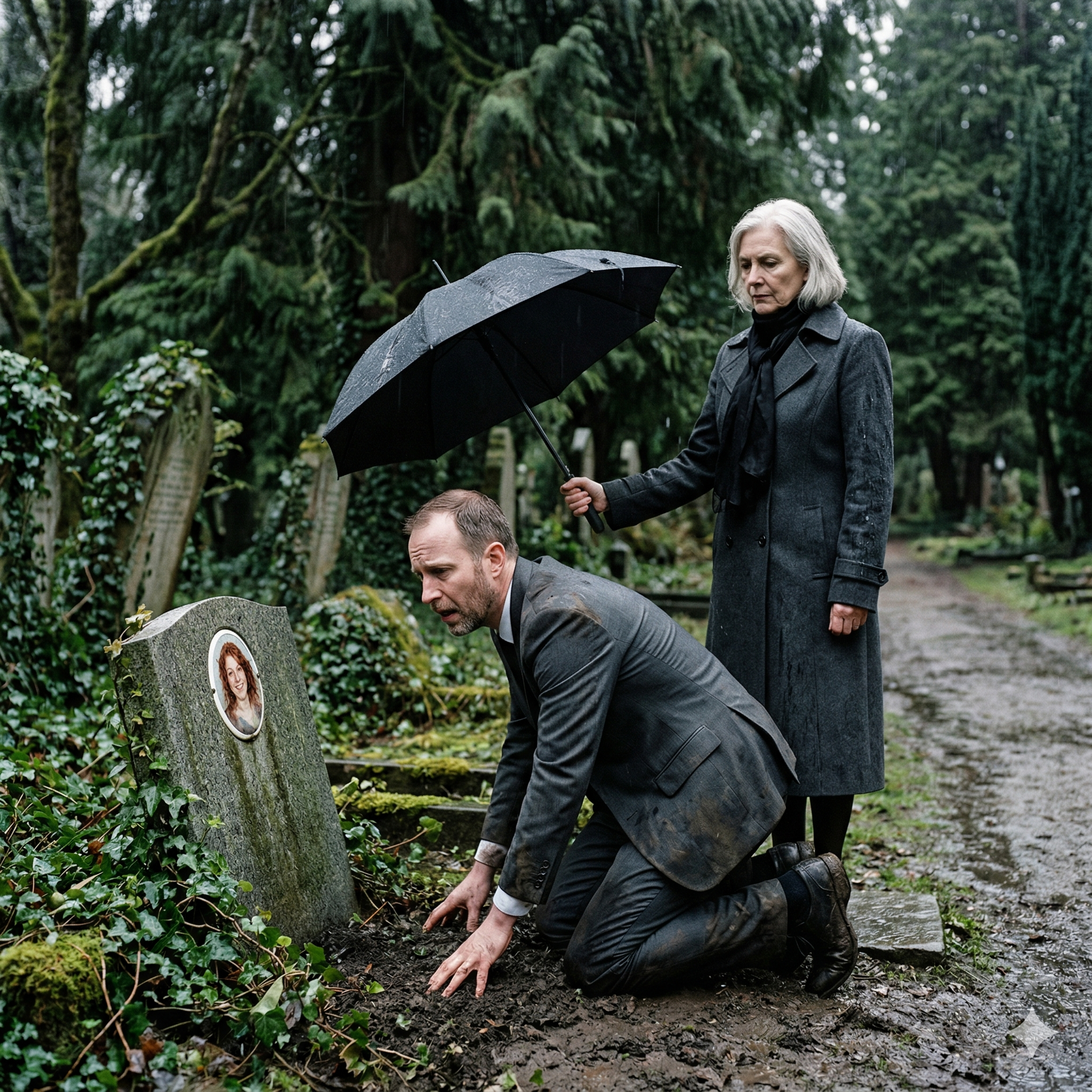
She stopped in front of a grave that looked newer than the rest, though it was still stained by the perpetual damp of the Northwest.
“Kneel,” she said.
I froze. “Ma’am?”
“Kneel, Elias. Right there in the mud. I want you to look at this person.”
Her voice wasn’t loud, but it had the authority of a falling guillotine. I lowered myself. The cold mud soaked into my suit trousers instantly. I held the umbrella over her head while I stared at the headstone.
It was a simple granite block. In the center was a small, oval porcelain photograph—the kind they use in older traditions to keep the memory of the deceased vivid.
I looked at the photo, and the world stopped.
It was a girl. Maybe nineteen. She had bright, messy red hair and a spray of freckles across a nose that was slightly crooked. She was laughing in the photo, caught in a moment of genuine, unshielded joy.
I felt the blood drain from my face. My heart didn’t just race; it felt like it was trying to punch its way out of my throat. My hands began to shake so violently that the umbrella wobbled, sending a stream of cold rainwater down Eleanor’s neck. She didn’t flinch.
I knew that girl.
I knew her because I had seen her face every single night for the last five years. I had seen her face in the headlights of my car on a rainy night in Chicago. I had heard the sickening thud of her body hitting the hood. I had felt the steering wheel jerk as I panicked, flooring the accelerator instead of the brake.
I had watched her disappear in my rearview mirror, a splash of red on the gray asphalt, and I had never stopped driving.
I had changed my name. I had moved across the country. I had scrubbed my life clean. I thought I was a ghost.
“She was my granddaughter,” Eleanor said, her voice as calm as a frozen lake. “Her name was Clara. She was an artist. She was coming home from a gallery opening when a black SUV took her life and kept going.”
I couldn’t breathe. I couldn’t move. I was still on my knees in the mud, staring at the porcelain eyes of the girl I had killed.
“You’ve been a very good driver, Elias,” Eleanor whispered, leaning down so her lips were inches from my ear. “The best I’ve ever had. So steady. So quiet. I suppose it’s easy to be quiet when you’re carrying a corpse in your trunk for five years.”
She stepped back, letting the rain fall on her.
“Now,” she said, looking down at me like I was an insect she was deciding whether or not to crush. “You’re going to tell me exactly what happened that night. And then, we’re going to discuss your final destination.”
Part 2: The Long Way Home
The silence of the cemetery was absolute, broken only by the rhythmic thrum of rain on the cedar trees. I remained on my knees, the mud seeping into my skin, feeling the weight of three years of “perfect service” turn into a noose.
“I… I didn’t see her until it was too late,” I whispered. My voice sounded like it belonged to someone else. Someone smaller. Someone broken. “It was the rain. The glare. I panicked, Eleanor. I didn’t want to… I didn’t mean to…”
“We never mean to, do we?” Eleanor’s voice was devoid of grief. It was purely clinical. “We just find ourselves in a moment where our survival instinct outweighs our humanity. And we choose ourselves. Every time.”
She reached out and took the umbrella from my trembling hand. She stood over me, silhouetted against the gray sky like an ancient, vengeful deity.
“Do you know how much it cost to find you, Elias? To track a ‘ghost’ who changed his social security number and moved to the edge of the world? It cost more than this car. More than your salary for a hundred lifetimes.”
“Why didn’t you just call the police?” I managed to look up at her. “Why hire me? Why wait three years?”
Eleanor smiled. It was the most terrifying thing I had ever seen. “The police provide justice. Justice is a flat, bureaucratic thing. It has no flavor. It doesn’t bring Clara back. And prison? Prison is just another place to hide. No, I wanted you to serve.”
She began to walk back toward the car, her voice trailing behind her. “Get up. We aren’t finished.”
I stood on shaky legs, my suit ruined, my life over. I considered running into the woods. But I knew Eleanor. A woman who could track a hit-and-run driver across 2,000 miles and hire him as her personal chauffeur didn’t leave back doors open. If I ran, I’d be dead before I hit the tree line.
I got back into the driver’s seat. I looked at her in the rearview mirror. For the first time in three years, our eyes met.
“Drive,” she said.
“Where to?”
“Home. But take the long way. Through the mountain pass.”
The drive back was a descent into a different kind of madness. The “safety” of my routine was gone. Every turn I made, every time I checked my blind spot, I felt her watching me. I realized with a sickening jolt that every “compliment” she’d given me about my driving over the years had been a taunt.
“You’re so careful, Elias.” “You have such a steady hand, Elias.” “I feel so safe when you’re behind the wheel.”
She had been mocking the man who had killed her granddaughter every single day for over a thousand days.
We reached the summit of the mountain pass. To the right, a sheer drop-off fell hundreds of feet into a rocky gorge. The fog was thick here, a wall of white that turned the world into a void.
“Stop the car,” she said.
I pulled over onto the narrow gravel shoulder. The engine hummed quietly.
“Get out, Elias. Go to the edge.”
This was it. The “final destination.” She was going to make me jump, or she was going to push me. I stepped out into the cold mountain air. The wind whipped my hair. I walked to the rusted guardrail and looked down into the abyss.
Eleanor stepped out of the car and walked up beside me. She didn’t have a gun. She didn’t have a knife. She just had a small, leather-bound ledger.
“This is your life, Elias,” she said, tapping the book. “Every debt you owe. Every cent I’ve paid you. Every meal you’ve eaten on my dime. Every night you’ve slept soundly because you thought you were safe.”
She handed me the book. I opened it. It wasn’t a ledger. It was a photo album.
It was full of photos of me.
Me at the grocery store. Me sleeping in my apartment. Me washing the Cadillac. And in every photo, there was a red circle around my head. And next to each photo, a date and a time.
“I didn’t hire you to kill you,” Eleanor said, her voice caught in the wind. “That would be an ending. I don’t want an ending. I want a cycle.”
She leaned against the guardrail, looking out at the fog. “You are the best driver I’ve ever had because you are a man who knows the cost of a mistake. And you will continue to be my driver. You will drive me to my meetings. You will drive me to the grocery store. You will drive me to Clara’s grave every Tuesday for the rest of my life.”
I stared at her. “You’re keeping me?”
“You are my penance, Elias. And I am yours. You will live in the guest house on my estate. You will have no phone, no internet, no contact with the outside world. You will be the ghost you always wanted to be. But you will be my ghost.”
She turned and headed back to the car. “If you ever leave, if you ever even think about running, the file on the Chicago hit-and-run goes to the FBI. Along with the dashcam footage I’ve been collecting for three years of you admitting your guilt to a woman you thought was a senile old lady.”
She got into the backseat and closed the door. The sound of the latch was like a jail cell locking.
I stood at the edge of the cliff for a long time. I looked at the gray void of the gorge and then at the black Cadillac.
I realized then that Eleanor Montgomery hadn’t just found the man who killed her granddaughter. She had found a way to make sure he never died. She had turned my life into a three-year sentence that had just been extended to life without parole.
I walked back to the car. I opened the driver’s side door. I sat down and adjusted the mirror. I didn’t look back at her this time.
“Where to now, ma’am?” I asked.
“Home, Elias,” she said, her voice returning to that distant, chilling politeness. “And please, turn the heater up to 70. It’s getting a bit chilly, don’t you think?”
“Yes, ma’am,” I said.
I put the car in gear and drove back into the fog. I was a driver. I was a ghost. And for the first time in five years, I knew exactly where I was going.
Nowhere. Forever.
Part 3: The Last Mile
Five years later, the “Three-Year Sentence” had become a permanent state of being.
I no longer remembered the man I was in Chicago. That man—the one with a different name and a life full of logistical errors—had been buried in the mud of Blackwood Creek alongside Clara. Now, there was only Elias. I was a precision instrument. I was the heartbeat of the Montgomery estate.
My life was measured in the distance between the guest house and the main garage. I woke at 5:00 AM, polished the Cadillac until the black paint looked like a dark mirror, and waited. I had no phone. I had no internet. My only window to the world was the satellite radio in the car, and even then, I only listened to the weather reports. I needed to know when the rain was coming. I needed to know when the roads would be slick.
Mrs. Montgomery had aged. The predatory grace had slowed into a brittle, calculated movement. Her lungs were failing, tethered to a portable oxygen concentrator that hissed like a snake in the backseat.
But her eyes—those cold, blue gems—remained as sharp as the day she stood over me in the cemetery.
1. The Death Watch
The “cycle” was nearing its end, but not in the way I had hoped. Eleanor was dying.
One evening, as I helped her from the car after our weekly pilgrimage to Clara’s grave, she gripped my forearm. Her hand felt like a bird’s claw, cold and desperate.
“You think you’re going to be free soon, don’t you, Elias?” she wheezed. The oxygen machine hummed a steady, mocking rhythm.
“I don’t think about the future, ma’am,” I said, my voice as flat as the pavement.
“Liar,” she spat. “You’re counting the breaths I have left. You think when I’m gone, the file disappears. You think you can go back to being a ghost.”
She leaned in, her breath smelling of peppermint and medicine. “I’ve made arrangements. My lawyers… they have instructions. If my heart stops, and you aren’t standing by the bed to call the funeral home, the Chicago file is sent automatically. You are my shadow, Elias. And a shadow cannot exist without the body.”
I didn’t blink. I had learned that from her. “I understand, ma’am.”
2. The Final Drive
Two weeks later, the call came over the estate’s intercom at 2:00 AM.
“Elias… the car. Now.”
Her voice was a ragged whisper. I dressed in my suit—the same charcoal gray I had worn for eight years—and pulled the Cadillac to the front entrance. I found her slumped on the porch, wrapped in a heavy fur coat, clutching a small, velvet box.
“Drive,” she commanded. “To the coast. The cliffs. Not the cemetery. The cliffs.”
We drove in total silence. The fog was so thick I could barely see the hood of the car, but it didn’t matter. I knew every curve of the mountain pass. I knew every dip in the road. I was the car, and the car was me.
We reached the summit—the same spot where she had revealed my life was over five years ago. I pulled onto the gravel shoulder.
“Help me out,” she whispered.
I lifted her. She weighed nothing. She was just a collection of grudges and expensive fabric. I carried her to the edge of the cliff, where the wind screamed through the gorge. She looked out into the white void of the fog, her eyes wet for the first time.
“She would have been twenty-seven today,” Eleanor said. “She would have had her own gallery. She would have hated me for what I’ve done to you.”
She opened the velvet box. Inside was a small, silver key and a flash drive.
“This is the file, Elias. The original dashcam footage. The DNA reports. The confession I recorded while you were sleeping in the guest house.”
My heart hammered. This was it. The keys to the kingdom.
“Why are you showing me this?” I asked.
“Because I realized something,” she said, looking up at me. “I didn’t just turn you into a prisoner. I turned myself into a jailer. I spent the last eight years of my life thinking about you. Not her. You. I’ve lived in your crime more than I’ve lived in her memory.”
She held the box out over the abyss.
“If I drop this, you’re free. Truly free. No lawyers. No blackmail. Just… gone.”
“Drop it,” I said.
She smiled, a weary, genuine smile. “I can’t. My heart won’t let me. But… you can take it. You can take it from an old, dying woman’s hand. You can be the monster I know you are.”
3. The Shadow’s Choice
I looked at the box. I looked at the woman who had owned my soul for nearly a decade. I thought about the girl with the red hair and the crooked nose. I thought about the night in Chicago.
If I took the box, I was a murderer who got away with it. If I didn’t, I was a servant who had found a home in his own guilt.
I reached out my hand. My fingers brushed the velvet.
Eleanor closed her eyes, waiting. She wanted me to take it. She wanted to be relieved of the burden of her own vengeance. She wanted to die knowing the world was as dark as she believed it was.
I pulled my hand back.
“No,” I said.
Eleanor’s eyes snapped open. “What?”
“I’m your driver, ma’am,” I said, stepping back into the shadows of the car. “And it’s 68 degrees in the Cadillac. It’s time to go home.”
She stared at me, her mouth agape. The power had shifted, but not in the way anyone would expect. By refusing the freedom, I had rendered her blackmail useless. I wasn’t her prisoner anymore. I was her choice. I was the living, breathing reminder of the one thing she couldn’t control: my own conscience.
“You’re staying?” she whispered.
“I have nowhere else to go,” I said. “The man who lived in Chicago is dead. You killed him five years ago.”
I carried her back to the car. I settled her into the seat, adjusted her oxygen, and closed the door.
Eleanor Montgomery died three days later in her sleep.
4. The Inheritance
The reading of the will was a quiet affair. No family—only the lawyers and the “ghost.”
I expected to be handed the Chicago file and told to leave. I expected to be cast back out into a world I no longer understood.
Instead, the lawyer handed me a deed.
“Mrs. Montgomery left the estate to a charitable trust for the arts,” he said. “But there is a life-tenancy clause for the guest house. And a stipend. On one condition.”
“What condition?”
The lawyer looked uncomfortable. “You are to maintain the Cadillac. And every Tuesday, you are to drive to Blackwood Creek Cemetery. You are to sit by the grave for exactly one hour. You are to be… the witness.”
I took the deed.
I walked out to the garage. The black Cadillac sat there, gleaming, silent, waiting. I got into the driver’s seat. I smelled the peppermint and the ozone. I looked in the rearview mirror.
I didn’t see a ghost. I didn’t see a criminal. I saw a man who had finally found his place in the world.
I started the engine. It was 68 degrees. It was Tuesday. And I had a long way to go.
News
🤯 THE LOCKET, THE TAPE, & THE DETECTIVE: The Final Twist in the Kruger Investigation.
THE GRAVE SPEAKS: A Hidden Locket, a Smuggled SD Card, and the Final Trap That Broke the Kruger Syndicate PRETORIA — Just when the corrupt political elites of South Africa thought they could manage the fallout of the Kruger National…
“MY SON WAS TREATED LIKE AN ANIMAL.” THE FATHER’S UNTOLD STORY.
SOUTHAMPTON — The click of metal handcuffs is a sound meant to signify the capture of a dangerous criminal. But on a freezing December night in 2025, that sharp, metallic snap became the soundtrack to one of the most profound…
💔 5 WORDS THAT SHAMED A NATION: “DON’T THINK YOU HAVE, MATE.”
SOUTHAMPTON — The click of metal handcuffs is a sound meant to signify the capture of a dangerous criminal. But on a freezing December night in 2025, that sharp, metallic snap became the soundtrack to one of the most profound…
THE 2037 DREAM IS DEAD: How A Single “Hot Mic” Recording Just Guaranteed Mackenzie Will Never Walk Free
THE “HOT MIC” BOMBSHELL: Leaked Audio And Prison Secrets Just Destroyed Mackenzie Shirilla’s Netflix Lie For Good 🎙️🛑 “I am not a monster. I am a driver in a tragedy.” Millions of viewers watched the tear-streaked face of 21-year-old Mackenzie…
THE WHISTLEBLOWER SPEAKS: Why A Netflix Editor Risked Everything To Expose Mackenzie Shirilla’s Sickening Act
THE “HOT MIC” BOMBSHELL: Leaked Audio And Prison Secrets Just Destroyed Mackenzie Shirilla’s Netflix Lie For Good 🎙️🛑 “I am not a monster. I am a driver in a tragedy.” Millions of viewers watched the tear-streaked face of 21-year-old Mackenzie…
💔 THE PLOT TWIST NO ONE SAW COMING: We Finally Know Where The Mother Is.
🚨 SHOCKING DISCOVERY: Police Breached A “Fake Wall” Inside The Temple Home. The True Source of the “Odor” Finally Revealed. By Senior Investigative Desk Dateline: Temple, Texas — June 2, 2026 When Temple Police Department tactical teams first breached the…
End of content
No more pages to load