The flour in my lungs felt like the dust of the twelve years I’d spent running away.
I pulled my truck into the gravel lot of Romano’s Hearth at three in the morning. In this corner of Pennsylvania, the air was always heavy with the scent of coal dust and damp earth, but as I stepped out, the smell of fermenting yeast and scorched sugar cut through the mist. It was the smell of my childhood—and the smell of the fire that had burned my family apart.
I’m Lucia Romano. I left this town with a suitcase and a heart full of spite when I was twenty-three. I became a logistics manager in Chicago, someone who dealt in hard numbers and cold facts because emotions were too messy. But when a lawyer called to tell me the bakery was expanding—and that my signature was “missing” from certain updated deeds—I knew Marco was up to his old tricks.
My brother, Marco, was the golden boy. The one who stayed. The one who promised our mother on her deathbed that the Romano name would mean something more than just a local shop. As I approached the back entrance, I saw the new neon sign flickering: Romano’s—The Spirit of the Valley.
It looked expensive. Too expensive for a town where the mills had closed years ago.
Part I: The Ghost in the Kitchen
The back door was propped open with a rusted flour tin. I stepped inside, expecting to find the night shift buzzing with activity. Instead, the kitchen was silent, save for the low, rhythmic hum of the massive industrial ovens.
I walked past the stainless-steel prep tables. The bakery was pristine—too clean. Marco always liked a show. But as I rounded the corner toward the proofing cabinets, I saw something that made my blood run cold.
There, on a pile of empty flour sacks tucked between the two main ovens, was a woman.
She was curled into a ball, a thin, moth-eaten blanket draped over her shoulders. Her face was smudged with soot and flour, her breathing shallow and ragged. On the floor beside her was a small plastic bowl of cold water and a pair of industrial burn-creams.
“Sofia?” I whispered.
I’d only seen pictures of my brother’s wife. He’d married a girl from a small village outside of Naples three years ago. In the photos Marco sent, she looked like a saint in white lace. The woman on the floor looked like a prisoner of war.
She bolted upright, her eyes wide with terror. She scrambled backward, her hand accidentally brushing the hot casing of the oven. She didn’t scream; she just hissed through her teeth, a sound of practiced endurance.
“I’m sorry! I am awake! I start the brioche now!” she cried out, her English thick and panicked.
“Sofia, it’s okay. It’s Lucia. Marco’s sister,” I said, holding my hands up.
She froze, squinting at me through the dim orange light. “Lucia? The one who… the one who left?”
“The one who left,” I confirmed. I looked at her hands. They were a map of scars—fresh red welts and silver lines of old burns. “What are you doing sleeping on the floor? Where is the house? Where is my brother?”
Sofia looked at the floor, pulling the blanket tighter. “Marco says the commute from the house is too long. He says I am slow. He says the apartment rent is ‘too expensive for useless people’ who cannot finish the quota on time. If I sleep here, I save the time. I save the money for the new shop.”
“Useless?” I felt a familiar, hot coal of anger ignite in my chest. “You’re the head baker, Sofia. I’ve seen the reviews. People drive from Philly for your rosemary sourdough.”
“Marco says… he says he gave me the recipes,” she whispered. “He says without him, I have no papers. No house. No name. He says he is my ‘benefactor’.”
The door to the front office swung open, and the lights flared to life, blinding us.
“Lucia?”
Marco stood there, looking every bit the successful American businessman. He was wearing a crisp white apron over a designer shirt, his hair slicked back. He’d put on weight—the kind of weight that comes from eating while others work.
“Marco,” I said, my voice like a serrated knife.
“What a surprise! The big city sister returns to the dirt,” he said, stepping forward with a fake, boisterous grin. He didn’t even glance at Sofia, who had scrambled to her feet and was already frantically kneading a massive mound of dough. “I see you’ve met the help. Sofia is a bit dramatic, as you can see. She likes to be near the ovens. Claims it reminds her of home.”
“She’s sleeping on flour sacks, Marco. In a workspace.”
“She’s dedicated,” Marco corrected, his eyes turning hard. “And she’s my wife. Which makes this a family matter. Why are you here, Lucia? Come to beg for a piece of the second location?”
“I’m here because the lawyer said you’re trying to trademark Mom’s ‘Grandma’s Loaf’ as your own invention. I’m here because I still own half this building, and I don’t like the smell of what you’re cooking.”
Marco laughed, a harsh, jagged sound. “Mom’s recipes were garbage, Lucia. They were old-world peasant food. I modernized them. I built the brand. Sofia just follows my instructions.”
I looked at Sofia. She was working the dough with a ferocity that was almost violent, her head down, her scarred hands moving in a blur. I walked over to the cooling rack and broke off a piece of a fresh loaf.
I tasted it.
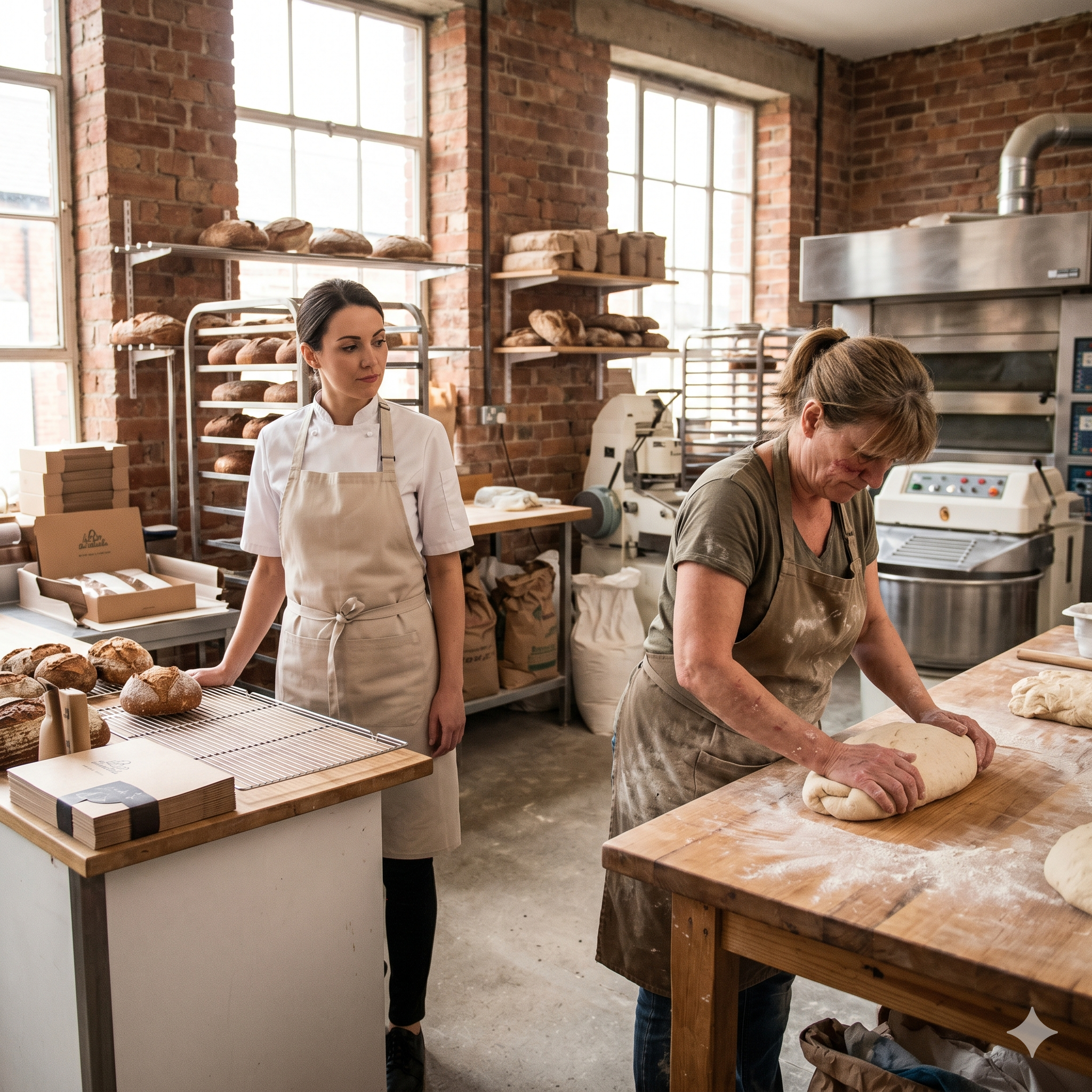
The crust was shattered glass; the crumb was airy, tangy, and complex. It wasn’t Mom’s recipe. It was better. It had a hint of wild honey and a specific fermentation rhythm that took genius to master.
“You didn’t write this, Marco,” I said, turning back to him. “You don’t have the patience for this kind of crumb. You never did.”
“Get out, Lucia,” Marco hissed, leaning over the table. “You left this family. You don’t get to come back and judge how I run it. Sofia is happy. She’s lucky. Without me, she’s an undocumented girl with nothing but a rolling pin. Here, she’s a Romano.”
“She’s a slave,” I countered.
“I’m a businessman,” he replied. “And if you try to interfere with the opening of the second shop, I’ll make sure the authorities take a very close look at who exactly has been working my ovens. You want to save her? You’ll only end up sending her back to a village with nothing.”
He turned to Sofia. “Finish the batch, Sofia. And clean up that mess on the floor. It looks unprofessional.”
He walked out, slamming the door. I looked at Sofia, whose tears were falling silently into the flour, disappearing into the white dust.
“I have to work,” she whispered. “Please. Go away.”
Part II: The Living Recipe
I didn’t go back to a hotel. I sat in my truck in the dark, watching the steam rise from the bakery’s vents. My brother had underestimated one thing: I didn’t deal in bread; I dealt in paper trails.
For the next three days, I played the part of the “visiting sister.” I helped Marco with the logistics of the second shop, pretending to be impressed by his spreadsheets. But every night, when he went home to his sprawling suburban house, I stayed in the bakery with Sofia.
I started digging through the office files while she baked. Marco was sloppy. He’d registered the new “Romano Signature” trademarks under his personal LLC, completely bypassing the family trust our mother had set up. He was draining the main bakery’s accounts to fund the second location, leaving the original shop—and Sofia’s “salary”—in the red.
But the real discovery came on the third night.
I found a hidden compartment in our mother’s old roll-top desk. Inside wasn’t a ledger, but a letter and a legal codicil, dated just weeks before she died. My mother had been a quiet woman, but she wasn’t a blind one. She had seen Marco’s greed even then.
The will didn’t split the bakery 50/50.
The text was clear: “The physical building shall be shared. But the business—the name, the brand, and the equity—shall be controlled by the ‘Keeper of the Living Recipes.’ Whosoever holds the secrets of the hearth holds the power. 51% goes to the one who kneads the bread.”
Marco had hidden this. He’d assumed that because he was the son, the “Keeper” title was his by default.
The following morning, I brought a man in a gray suit into the flour-dusted kitchen. Marco was there, posing for a local news photographer for a “Success Story” feature.
“What is this, Lucia? I told you, we’re busy,” Marco snapped, trying to block the photographer’s view of the sleeping bag I’d intentionally left in the corner.
“Marco, this is Mr. Henderson. He’s an intellectual property lawyer,” I said, smiling for the camera. “And he’s here to help Sofia file her claim.”
“Claim? For what? To being a clumsy cook?” Marco laughed nervously.
“For the business,” I said. I pulled out the codicil. “Mom didn’t leave you the shop, Marco. She left it to the baker. And we both know you haven’t touched a dough-hook in five years.”
“That doesn’t mean anything! I’m the Romano!”
“And Sofia is the ‘Living Recipe’,” I said, gesturing to the scarred woman standing by the ovens. “I’ve spent the last forty-eight hours documenting her work. I have hours of footage of her creating the ‘Signature Loaves’ while you were at the country club. I have the logs of her hours. And I have the trademark filings you tried to steal.”
Sofia stepped forward, her hands shaking, but her eyes were fixed on Marco. “You told me… you told me I was nothing,” she said, her voice small but gaining strength. “You told me the recipes belonged to the house.”
“They do!” Marco shouted.
“No,” Sofia said. She reached into her apron and pulled out a small, flour-stained notebook. “The house is stone. The recipes are in the hands. I changed them. I made them better because I wanted to survive you.”
Marco lunged for the notebook, but the photographer—a local kid who had grown up eating Mom’s bread—stepped in his way, his camera flashing.
“The news is going to love this, Marco,” I said. “The ‘Spirit of the Valley’ is actually a sweatshop run by a fraud. Or, you can sign the papers. You walk away with the second location—under a different name—and Sofia gets 100% of the original Romano’s Hearth. No more ‘rent’ for useless people. No more sleeping by the ovens.”
Marco looked at the camera, at the lawyer, and finally at the notebook in Sofia’s hand. He was a narcissist, and a narcissist’s greatest fear is being seen as a failure.
“Fine,” he spat. “Take this dump. It’s a dying business in a dying town anyway. I’ll be the king of the city.”
He signed the papers with a jagged flourish and stormed out, leaving a cloud of silence behind him.
Sofia collapsed onto a stool, the notebook clutched to her chest. “Is it… is it over?”
“It’s just beginning,” I said, putting a hand on her shoulder. “You’re the boss now, Sofia. And the first order of business? We’re buying you a bed. A real one.”
She looked at the notebook, then at me. “Lucia? Why did you come back? Truly?”
“Because,” I said, looking at the ovens my mother had built with her own hands. “Some things are worth the heat.”
A month later, we were in a mediation room for the final handover. Marco’s lawyer was trying to argue that Sofia couldn’t prove she was the one who improved the recipes—that she was just a “technician.”
“Mr. Romano provided the framework,” the lawyer argued. “Mrs. Romano has no proof of her creative input.”
Sofia didn’t look at the lawyer. She didn’t look at Marco, who was smirking in his expensive suit. She reached into her bag and placed the flour-stained notebook on the table.
She pushed it toward Marco’s lawyer. “Open the first page,” she said.
The lawyer opened it. Marco leaned in, his smirk fading.
Written in faded ink, dated twelve years ago—the day I left—was a note in my mother’s handwriting.
“To my future daughter, or whoever finds the courage to stand in this heat: Marco will try to take the credit. He always has. But the bread knows the truth. If he ever steals this, call Lucia. She’s the only one with enough Romano fire to burn his lies down.”
Sofia looked at Marco, her scarred hands resting calmly on the table.
“I called her,” she said.
The silence that followed was the sweetest thing I’d ever tasted.
News
🤯 THE LOCKET, THE TAPE, & THE DETECTIVE: The Final Twist in the Kruger Investigation.
THE GRAVE SPEAKS: A Hidden Locket, a Smuggled SD Card, and the Final Trap That Broke the Kruger Syndicate PRETORIA — Just when the corrupt political elites of South Africa thought they could manage the fallout of the Kruger National…

“MY SON WAS TREATED LIKE AN ANIMAL.” THE FATHER’S UNTOLD STORY.
SOUTHAMPTON — The click of metal handcuffs is a sound meant to signify the capture of a dangerous criminal. But on a freezing December night in 2025, that sharp, metallic snap became the soundtrack to one of the most profound…
💔 5 WORDS THAT SHAMED A NATION: “DON’T THINK YOU HAVE, MATE.”
SOUTHAMPTON — The click of metal handcuffs is a sound meant to signify the capture of a dangerous criminal. But on a freezing December night in 2025, that sharp, metallic snap became the soundtrack to one of the most profound…

THE 2037 DREAM IS DEAD: How A Single “Hot Mic” Recording Just Guaranteed Mackenzie Will Never Walk Free
THE “HOT MIC” BOMBSHELL: Leaked Audio And Prison Secrets Just Destroyed Mackenzie Shirilla’s Netflix Lie For Good 🎙️🛑 “I am not a monster. I am a driver in a tragedy.” Millions of viewers watched the tear-streaked face of 21-year-old Mackenzie…

THE WHISTLEBLOWER SPEAKS: Why A Netflix Editor Risked Everything To Expose Mackenzie Shirilla’s Sickening Act
THE “HOT MIC” BOMBSHELL: Leaked Audio And Prison Secrets Just Destroyed Mackenzie Shirilla’s Netflix Lie For Good 🎙️🛑 “I am not a monster. I am a driver in a tragedy.” Millions of viewers watched the tear-streaked face of 21-year-old Mackenzie…
💔 THE PLOT TWIST NO ONE SAW COMING: We Finally Know Where The Mother Is.
🚨 SHOCKING DISCOVERY: Police Breached A “Fake Wall” Inside The Temple Home. The True Source of the “Odor” Finally Revealed. By Senior Investigative Desk Dateline: Temple, Texas — June 2, 2026 When Temple Police Department tactical teams first breached the…
End of content
No more pages to load