He Hired a Wife to Keep the Farm… But She Came With a Child Who Called Him Father
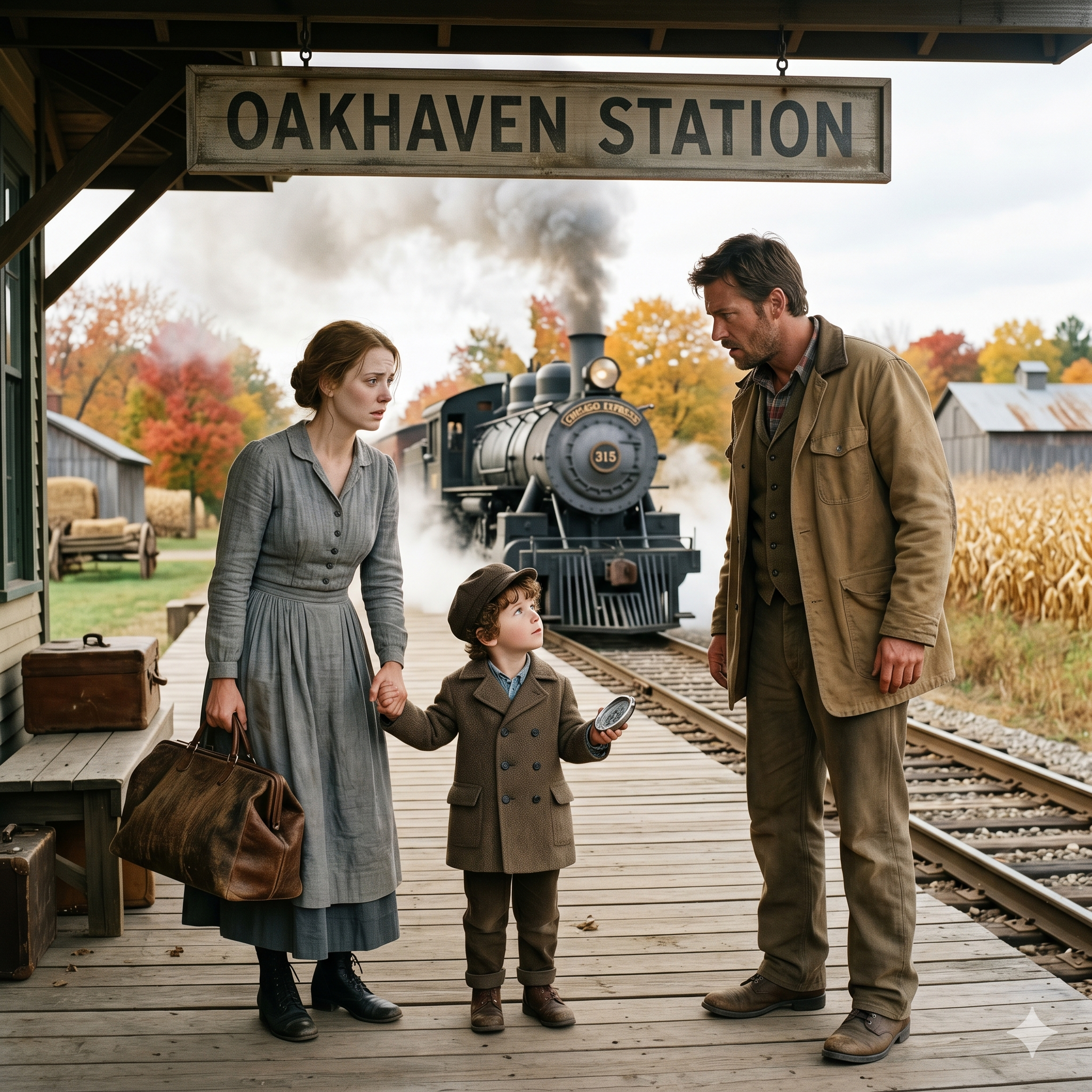
The Ohio autumn wind bit through Nathan Bell’s worn canvas coat as he stood on the platform of the Oakhaven train station. He pulled his pocket watch from his vest, checking the time for the fourth time in ten minutes.
The 3:15 from Chicago was late.
Nathan didn’t want to be here. At thirty-two, he was a man who preferred the company of his plow horses and the quiet solitude of his two-hundred-acre corn farm. But the local land office had tightened the terms of his homestead claim. To keep the deed, the state required the property to be worked by a “settled family.” The greedy local bank manager had given Nathan exactly thirty days to produce a wife, or the land would be seized and auctioned off to the railroad.
Desperate, Nathan had placed an advertisement in a city paper: Seeking a marriage of convenience. Room, board, and a respectable name in exchange for legally securing a farm. No romantic expectations.
The train’s whistle finally shrieked, cutting through the crisp October air. A thick cloud of steam enveloped the wooden platform as the iron beast ground to a halt.
Passengers trickled out, but Nathan’s eyes locked on a woman stepping down from the third car. She wore a faded but meticulously clean gray dress, holding a worn carpetbag in one hand. She was striking—sharp cheekbones, dark, intelligent eyes, and a posture that refused to bow to the weight of her obvious exhaustion.
But it wasn’t the woman that made Nathan’s breath hitch.
It was the little boy clinging to her skirt.
Nathan hadn’t agreed to a child. The letters exchanged with Lydia Crane had mentioned she was a widow, but nothing about a five-year-old boy.
He stepped forward, clearing his throat. “Mrs. Crane?”
The woman turned, her dark eyes scanning his face with an intensity that felt almost invasive. “Mr. Bell. Thank you for the ticket.”
“I… I wasn’t aware you had a son,” Nathan stammered, looking down at the small boy. The kid had a mess of curly brown hair and bright, perceptive blue eyes.
Lydia’s jaw tightened. “If the boy is a problem, Mr. Bell, I can repay you for the train fare by working as a seamstress in town. But we come together. Or not at all.”
Nathan looked at the boy, then at the looming deadline in his mind. “It’s fine. The land office wants a family. A boy makes it look more convincing. What’s his name?”
“Elias,” she said softly.
Nathan knelt down in the dust of the platform, trying to muster a welcoming smile. “Hello, Elias. I’m Nathan.”
Elias didn’t hide behind his mother’s skirt. Instead, the boy took a step forward, staring directly into Nathan’s eyes with a chillingly familiar gaze. He reached into his small coat pocket, pulled out a battered, silver-plated compass, and looked back up at Nathan.
“You’re the man in Mama’s picture,” Elias said, his voice ringing clear across the empty platform.
Nathan froze. The forced smile vanished from his face. A cold shiver ran down his spine. “Excuse me?”
Lydia’s face instantly drained of color. She snatched the boy’s hand, pulling him back. “Hush, Elias. You’re tired from the journey.”
“What picture?” Nathan stood up, his heart suddenly hammering against his ribs. He looked at Lydia, the suspicion flaring hot and fast in his chest. “I have never had my photograph taken in my life, Mrs. Crane. Except once. In the army.”
Lydia didn’t answer. She grabbed her carpetbag, her knuckles white. “Are you taking us to the farm, Mr. Bell, or are we sleeping on this platform?”
For the first week, the farmhouse was a tomb of polite, agonizing tension.
They married in front of the town magistrate the day after she arrived. It was a cold, transactional affair. Lydia was an immaculate housekeeper; she cooked, she cleaned, and she kept Elias out of Nathan’s way while he worked the fields.
But Nathan couldn’t shake the boy’s words. You’re the man in Mama’s picture.
Every time Nathan looked at Lydia, he saw a woman holding her breath. She wasn’t a desperate widow looking for charity. She watched him. She watched the way he walked, the way he favored his left leg when it rained, the way he organized the tools in the barn. She was studying him.
On the seventh night, the storm broke.
Thunder rattled the farmhouse windows. Nathan couldn’t sleep. The phantom pains in his shoulder—where a piece of Confederate shrapnel had torn through him at the Battle of Gettysburg—were burning like fire.
He walked down to the kitchen for a glass of water and found Lydia sitting at the oak table, illuminated by a single kerosene lamp. She was holding a small, cracked tintype photograph.
Nathan stepped into the light. “Show it to me.”
Lydia jumped, instinctively covering the photo with her hand. “Nathan, please—”
“Show it to me, Lydia.” His voice was low, leaving no room for argument.
Slowly, she slid her hand away. Nathan stepped closer, leaning over the table.
It was a photograph of two young men in Union Army uniforms. One of them was laughing, a handsome man with curly hair and bright eyes—eyes that belonged to five-year-old Elias.
The man standing next to him, looking severe and unsmiling, was Nathan.
Nathan backed away, his hand flying to his injured shoulder. His breathing grew shallow. “Who is that?”
“You don’t know him?” Lydia’s voice cracked, a mixture of disbelief and profound grief. “Look at him, Nathan. Really look at him.”
“I don’t remember!” Nathan shouted, the frustration of the last five years boiling over. “I took a mortar shell to the chest in ’63. I woke up in a field hospital in Washington three months later. I lost a whole year of my life. The doctors said the trauma wiped it clean. Who is he?”
Tears finally spilled over Lydia’s eyelashes. “His name was Arthur Crane. He was my husband. And he was your platoon brother.”
Nathan felt the floor drop out from beneath him. He sank into the chair opposite her. “Arthur…” The name felt like a ghost brushing against his mind, a whisper in the dark.
“Arthur died on that battlefield,” Lydia whispered, tracing the face in the photograph. “The army sent me his effects. A compass, his wedding ring, and this picture. But they didn’t send the one thing he promised would keep us safe.”
“What?”
“The deed to this farm.”
Nathan stared at her, the blood roaring in his ears. “My farm? I bought this land from the bank when I was discharged. The deed is in my name.”
“No, Nathan,” Lydia said, her voice hardening with a fierce, protective edge. “You and Arthur bought it together before you deployed. He paid eighty percent of the share with his family’s savings. But because he was younger, he put the claim in your name, trusting you to split it when you both got back.”
Nathan felt physically sick. Twist 1 and Twist 2 hit him simultaneously.
Elias isn’t just a random fatherless boy. He was the son of the man who fought beside him. And this farm… it wasn’t Nathan’s sanctuary. He was living on the stolen inheritance of a dead man.
“When Arthur didn’t come home,” Lydia continued, wiping her face, “the bank refused to recognize my claim without a paper trail. I lost our apartment. I was washing clothes for pennies. Then, a month ago, I saw your advertisement in the Ohio Gazette. The man from my husband’s photograph, living on the very farm Arthur dreamed of, looking for a wife.”
She looked up at him, her eyes burning with quiet fury. “I didn’t come here for a marriage of convenience, Nathan. I came to take back my son’s land.”
Nathan couldn’t speak. His mind was a chaotic blur of smoke, phantom explosions, and the smell of gunpowder. He stumbled out of the kitchen, grabbing a lantern, and walked out into the pouring rain.
He practically ran to the barn, ignoring the agonizing pain in his shoulder. He climbed the ladder to the hayloft, digging frantically into the back corner where he kept his old army trunk.
He smashed the rusted padlock with a hammer and threw the lid open. Inside were his neatly folded blue uniform, a rusted canteen, and a bundle of letters the hospital nurses had packed for him—letters he had never been able to bring himself to read.
His trembling hands tore through the paper until he found a sealed envelope bearing the emblem of his old regiment. It was dated July 1st, 1863.
Nathan broke the wax seal. A single piece of blood-stained parchment slipped out.
He held the lantern close, reading the hastily scrawled handwriting of his commanding officer.
Private Bell,
If you wake up to read this, know that Arthur Crane pulled you from the trench. He took two bullets to the chest carrying you to the medic tent. His final words were not of the war. He asked me to write this to you.
Nathan’s eyes dropped to the final line of the letter, and a sob violently tore from his throat.
“If I don’t come home, give my land to the boy.”
Nathan sat in the dust of the hayloft for hours, the rain pounding against the tin roof of the barn like a drumbeat.
He held the blood-stained letter against his chest, the phantom memories finally breaking through the dam in his mind. He remembered the smoke. He remembered the blinding pain. And he remembered the strong arms of a younger man—a man who laughed easily and talked constantly about his beautiful wife and the baby boy he hadn’t yet met—dragging him through the mud to safety.
Arthur Crane had given his life so Nathan could live. And for five years, Nathan had lived in blissful ignorance on the very land Arthur had bought for his family.
When the sun finally rose, casting a pale gray light over the Ohio fields, Nathan stood up. He walked back to the house.
Lydia was in the kitchen, packing her carpetbag. Elias was sitting at the table, wearing his coat, holding the silver compass tightly in his little hands.
“I’m sorry,” Lydia said, her voice devoid of emotion. She didn’t look at him. “I shouldn’t have ambushed you. I let my anger get the better of me. We’ll leave today. I’ll sign whatever annulment papers the magistrate requires.”
“No,” Nathan said, his voice raw and gravelly.
Lydia paused, looking up.
Nathan walked over to the table and placed the blood-stained letter gently down in front of her. “Read it.”
Lydia hesitated, her eyes darting to Nathan’s face, before she looked down at the parchment. As she read the words, her hands began to tremble. A hand flew to her mouth, stifling a heartbreaking sob.
“I didn’t know, Lydia,” Nathan whispered, dropping to one knee beside the table, so he was eye-level with Elias. “I swear to you, on my life, I didn’t remember. If I had known… I would have walked barefoot to Chicago to find you.”
He looked at Elias. The boy’s bright blue eyes—Arthur’s eyes—stared back at him.
“Your father,” Nathan said to the boy, his voice thick with unshed tears, “was the bravest man I ever met. He saved my life. And this farm… it doesn’t belong to me.”
He stood up, looking at Lydia. “I’m going into town. I’m going to see the magistrate and the bank manager. I’m signing the deed over to Elias. It will be put in a trust, controlled by you, until he comes of age.”
Lydia stared at him, stunned. “Nathan… if you do that, you have nothing. The bank will kick you out. You’ll lose your livelihood.”
“It was never mine to begin with,” Nathan replied gently. He put on his hat. “It’s time I paid my debts.”
The town of Oakhaven was bustling when Nathan rode his wagon up to the bank. Mr. Vance, the greedy, impeccably dressed bank manager, was sitting behind his mahogany desk, looking extremely smug when Nathan walked in.
“Ah, Mr. Bell,” Vance purred, steepling his fingers. “I hear you got yourself a mail-order bride. I sent the sheriff out to the property this morning to investigate. A marriage of convenience won’t save your claim, Nathan. If she’s just a hired woman, the land reverts to the state. And I already have a railroad buyer lined up.”
“She’s not a hired woman,” Nathan said, slamming a heavy folder onto Vance’s desk.
Vance jumped, his smugness faltering. He opened the folder.
Inside was the letter from Nathan’s commanding officer, alongside a newly notarized document from the town magistrate.
“What is this?” Vance demanded.
“That is a transfer of deed,” Nathan said coldly. “I’m not the sole owner of the Bell-Crane farm. I am legally transferring my share to Elias Crane, the rightful heir of my business partner, Arthur Crane.”
Vance’s face turned purple. “You can’t do this! The boy is five years old!”
“And his mother, my legal, wedded wife, is his trustee,” Nathan fired back, leaning over the desk. “The claim is ironclad. The state requires a settled family. A mother, a child, and a husband. You try to take that land now, Vance, and I’ll bring the federal land marshals down on this bank so fast your head will spin.”
Vance glared at the documents, his jaw clenching. He knew he was beaten. With an angry, defeated huff, he slammed his stamp onto the transfer papers, making it official.
When Nathan walked out of the bank, the crisp autumn air had never felt cleaner. He untied his horse, preparing to ride back to the farm to pack his own bags. He had done the right thing. He had secured the land for Arthur’s family. Now, it was time for him to leave and start over.
But as he turned the wagon around, he saw them.
Lydia and Elias were standing on the wooden boardwalk outside the general store.
Nathan pulled the wagon up, stepping down. He reached into his coat and handed the stamped deed to Lydia.
“It’s done,” Nathan said softly. “The farm is Elias’s. The bank can’t touch you. You’re safe now.”
Lydia looked down at the heavy parchment. She traced the official seal with her thumb. Then, she looked up at Nathan. The cold, guarded walls she had built around herself since the day she arrived were completely gone.
“Where are you going?” she asked.
“I’ll head west,” Nathan said, forcing a small smile. “Try my hand at ranching. Or maybe find work on the railroad.”
Lydia shook her head. She took a step closer to him. “The farm needs to be worked, Nathan. Winter is coming. I don’t know the first thing about harvesting corn.”
Nathan blinked. “Lydia, you don’t have to pretend anymore. You have the land.”
“I’m not pretending,” she said, her voice steady and warm. She reached out, her fingers gently wrapping around his calloused hand. “Arthur saved you because he knew you were a good man. He trusted you. And… I think I’m starting to understand why.”
Elias ran forward, wrapping his small arms around Nathan’s leg. “Don’t go,” the boy mumbled into Nathan’s coat.
Nathan looked down at the boy, then back up to the woman holding his hand. For the first time since the war, the hollow, aching emptiness in his chest felt full.
He didn’t just have a farm anymore. He had a family.
Nathan squeezed Lydia’s hand, a genuine, profound smile breaking across his face.
“Alright,” Nathan whispered, lifting Elias up and setting him on his shoulders. “Let’s go home.”
Epilogue: The Harvest
(Five Years Later)
The Ohio sun hung low in the late afternoon sky, casting a rich, golden hue over the endless stalks of harvest-ready corn.
Nathan Bell wiped the sweat from his brow, leaning against the wooden fence of the main pasture. His left shoulder still ached when the autumn air turned cold, but the phantom pains that had haunted him for years were entirely gone. They had been replaced by the very real, very vibrant chaos of a life fully lived.
“Keep your heels down, Eli!” Nathan called out, his voice carrying over the rustling fields. “Let him know who’s guiding the reins!”
Ten-year-old Elias sat atop a gentle chestnut mare, his face a mask of fierce concentration. He adjusted his grip on the leather straps, nudging the horse forward with a confident click of his tongue. He had grown tall, his shoulders broadening, but he still had those bright, perceptive blue eyes that mirrored the man who had given his life at Gettysburg.
“I’ve got him, Pa!” Elias shouted back, a triumphant grin breaking across his face as the horse broke into a smooth trot.
Nathan smiled, a deep, resonant warmth blooming in his chest. Pa. It had taken Elias almost a year to transition from calling him “Nathan” to “Pa,” and every time the boy said it, Nathan felt like the luckiest man on earth.
“Don’t let him ride too far, Nathan!” a voice called from the farmhouse.
Nathan turned. Lydia was standing on the wraparound porch they had expanded two summers ago. She was wiping her flour-dusted hands on an apron, her dark hair pinned loosely against the breeze. Resting comfortably on her hip was a chubby, giggling two-year-old girl with Nathan’s exact hazel eyes—their daughter, Clara.
“He’s doing just fine, Lydia!” Nathan yelled back, walking toward the house. “He’s a natural. Just like his father.”
Lydia’s smile softened. The heavy, guarded tension that had defined her when she first arrived at the Oakhaven train station was a distant memory. Now, she was the vibrant, beating heart of the Bell-Crane farm. She managed the accounts, baked pies for the town fairs, and commanded the respect of every merchant in town—including the former bank manager, Mr. Vance, who had been replaced shortly after his corrupt practices were brought to light.
Nathan climbed the porch steps, wrapping his arms around Lydia’s waist from behind and pressing a kiss into her hair. Little Clara babbled, reaching out to yank on Nathan’s nose.
“You’re going to spoil that boy,” Lydia murmured, leaning back into his embrace.
“He works hard,” Nathan replied, looking out over the fields. “He earned a ride before dinner.”
Lydia turned her head, looking out toward the edge of the property. Beneath the shade of a massive oak tree, a small, beautifully carved stone monument sat surrounded by a bed of blooming marigolds. It was the memorial Nathan had built by hand.
Arthur Crane. A devoted husband, a loving father, a brother-in-arms.
Every Sunday, without fail, Nathan and Elias would walk out to the oak tree. They would polish the silver-plated compass, and Nathan would tell Elias a new story about Arthur’s bravery, his humor, and his unwavering love for the family he left behind. Arthur wasn’t a ghost haunting their marriage; he was the foundation it was built upon.
“He would be so proud of the man you are raising him to be,” Lydia whispered, resting her hand over Nathan’s.
Nathan turned her around, looking deep into the eyes of the woman who had crossed the country to claim a deed, but had ended up claiming his heart.
“I’m just the steward,” Nathan said softly, brushing a stray curl behind her ear. “Of the land, and of this family.”
Lydia smiled, rising on her tiptoes to press a tender, lingering kiss to his lips. “You’re much more than that, Nathan Bell. You’re home.”
As the sun dipped below the horizon, painting the Ohio sky in brilliant strokes of violet and gold, Elias rode the chestnut mare back toward the barn. Nathan took his daughter in one arm, took his wife’s hand with the other, and walked inside to the warmth of the hearth.
The contract had been one of convenience. But the love was the truest thing Nathan had ever known.
News
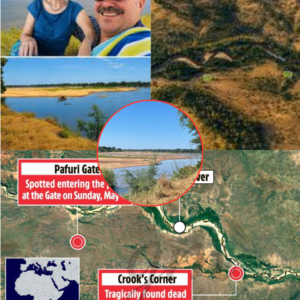
🤯 THE LOCKET, THE TAPE, & THE DETECTIVE: The Final Twist in the Kruger Investigation.
THE GRAVE SPEAKS: A Hidden Locket, a Smuggled SD Card, and the Final Trap That Broke the Kruger Syndicate PRETORIA — Just when the corrupt political elites of South Africa thought they could manage the fallout of the Kruger National…
“MY SON WAS TREATED LIKE AN ANIMAL.” THE FATHER’S UNTOLD STORY.
SOUTHAMPTON — The click of metal handcuffs is a sound meant to signify the capture of a dangerous criminal. But on a freezing December night in 2025, that sharp, metallic snap became the soundtrack to one of the most profound…
💔 5 WORDS THAT SHAMED A NATION: “DON’T THINK YOU HAVE, MATE.”
SOUTHAMPTON — The click of metal handcuffs is a sound meant to signify the capture of a dangerous criminal. But on a freezing December night in 2025, that sharp, metallic snap became the soundtrack to one of the most profound…

THE 2037 DREAM IS DEAD: How A Single “Hot Mic” Recording Just Guaranteed Mackenzie Will Never Walk Free
THE “HOT MIC” BOMBSHELL: Leaked Audio And Prison Secrets Just Destroyed Mackenzie Shirilla’s Netflix Lie For Good 🎙️🛑 “I am not a monster. I am a driver in a tragedy.” Millions of viewers watched the tear-streaked face of 21-year-old Mackenzie…

THE WHISTLEBLOWER SPEAKS: Why A Netflix Editor Risked Everything To Expose Mackenzie Shirilla’s Sickening Act
THE “HOT MIC” BOMBSHELL: Leaked Audio And Prison Secrets Just Destroyed Mackenzie Shirilla’s Netflix Lie For Good 🎙️🛑 “I am not a monster. I am a driver in a tragedy.” Millions of viewers watched the tear-streaked face of 21-year-old Mackenzie…
💔 THE PLOT TWIST NO ONE SAW COMING: We Finally Know Where The Mother Is.
🚨 SHOCKING DISCOVERY: Police Breached A “Fake Wall” Inside The Temple Home. The True Source of the “Odor” Finally Revealed. By Senior Investigative Desk Dateline: Temple, Texas — June 2, 2026 When Temple Police Department tactical teams first breached the…
End of content
No more pages to load