He Rejected Every Woman in Town—Until She Asked, ‘You Want a Wife… or Another Winter Alone?’
Part 1: The Ghost of Milstone Creek
The bell above the door of the general store didn’t just ring; it announced a shift in the air. Luke Bradford didn’t turn. He didn’t have to. He could smell the change—the scent of rain-dampened sage and lye soap cutting through the oppressive, dusty heat of the July afternoon.
“Mama, can we get the peppermints? The ones in the jar by the window?”
The boy’s voice was high and hopeful, the kind of sound that usually made Luke’s chest tighten with a phantom ache. He kept his eyes fixed on a jar of pickled pig’s feet on the shelf behind the counter.
“We’ll see, Jack. Don’t touch anything,” the woman replied.
Her voice wasn’t like the local women’s. It didn’t have the nasal twang of the valley or the tired, rhythmic drawl of the ranch wives who had spent thirty years yelling over the wind. It was steady. It was the voice of someone who had practiced being calm because they couldn’t afford to be anything else.
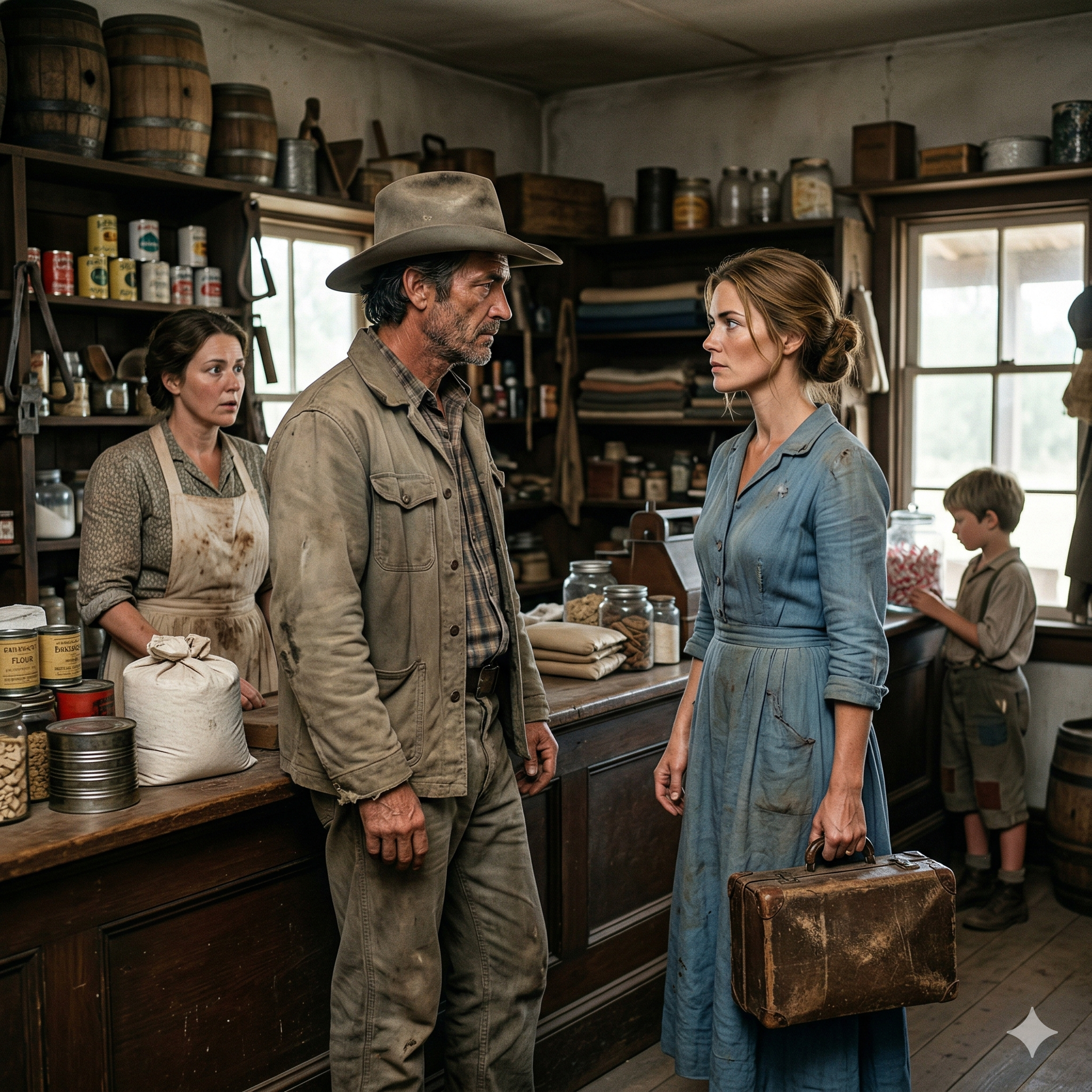
Clara Wells returned to the counter, thumping a heavy sack of flour down. She glanced past Luke toward the newcomers, her eyes widening. In a small town like Milstone Creek, a new face was more than news—it was an event.
“Can I help you, Ma’am?” Clara asked, her voice hitching with curiosity.
Luke felt the woman move to the space beside him. She didn’t crowd him, but she didn’t shrink away either. Most people in town gave Luke a wide berth, as if his grief were a contagious fever. This woman stood her ground. Out of the corner of his eye, he saw a faded blue travel dress, mended at the cuffs, and a pair of hands that had seen hard work, gripping the handle of a small, battered valise.
“I’m looking for the Bradford ranch,” she said.
The silence that followed was so heavy you could have dropped a lead weight through it. Clara’s eyes darted to Luke, then back to the woman.
Luke finally turned.
She was younger than him, maybe thirty. Her hair was a dark, honeyed brown pulled back into a sensible knot, but a few stubborn strands had escaped to frame a face that was more “handsome” than “pretty”—strong jaw, high cheekbones, and eyes the color of a stormy Atlantic.
“I’m Luke Bradford,” he said, his voice gravelly from weeks of disuse. “What do you want with my land?”
The woman didn’t flinch. She looked him square in the eye—something no woman in Milstone Creek had done in a decade. “I don’t want your land, Mr. Bradford. I’m here about the advertisement.”
Luke frowned. “What advertisement?”
She reached into her small bag and pulled out a crumpled clipping from a St. Louis newspaper. She smoothed it out on the counter next to his grocery list.
WANTED: WIFE AND MOTHER. Hard-working man with 400 acres in Milstone Creek seeks a woman of character. Must be able to cook, sew, and endure the isolation of the high plains. Widow preferred. Send inquiries to L. Bradford.
Luke stared at the ink until the letters blurred. He felt a sudden, hot surge of blood to his face. “I didn’t write this.”
Clara Wells leaned in, squinting at the paper. “That’s your name, Luke. And that’s certainly your ranch.”
“I don’t care what it says,” Luke growled, snatching his flour sack. “I didn’t seek no wife. I don’t want no wife.”
He turned to leave, his spurs jingling sharply against the floorboards, but the woman stepped directly into his path. The little boy, Jack, hovered behind her skirts, clutching a wooden soldier.
“Mr. Bradford,” she said, her voice dropping an octave, losing its polite veneer. “I spent the last of my money on a stagecoach ticket from Missouri. My son and I have nowhere to go, and your name is on this paper. If it’s a cruel joke, then God help whoever played it, but I’m here to work.”
“Then find work at the hotel,” Luke snapped. “Or the saloon. I live alone. I stay alone. That’s the way it’s been, and that’s the way it’s staying.”
He brushed past her, the heat of the street hitting him like a physical blow. He swung onto his horse, his heart hammering against his ribs. He could feel the eyes of the town on him—Old Thomas from the barber shop, the Sheriff from across the way. They were all watching the “Ghost” finally being haunted by something living.
He kicked his horse into a gallop, leaving a cloud of red dust behind.
The Long Shadow
The ride back to the ranch took two hours. Usually, the solitude was his sanctuary. Today, it felt like a cage.
He knew who had done it. It had to be his brother, Silas. Silas lived in St. Louis and had been writing Luke for years, begging him to “rejoin the land of the living.” His last letter had said: Luke, Sarah has been gone ten years. You’re turning into a stump. If you won’t find a woman, I’ll find one for you.
Luke had burned the letter. He hadn’t realized Silas was serious.
He reached the ranch house—a sturdy, grey-timbered structure that sat beneath the shadow of the jagged hills. Inside, the house was cold, despite the July heat. It was clean, but it was the cleanliness of a museum. Nothing had been moved since Sarah died in childbirth a decade ago. The cradle he had built still sat in the corner of the bedroom, draped in a white sheet.
He threw his supplies on the table and sat in the dark, watching the sun dip below the horizon.
He expected that to be the end of it. He figured the woman—whatever her name was—would find a job in town or catch the next stage back east.
But at dawn the next morning, as the first light turned the prairie into a sea of gold, he heard the sound of wheels.
He walked out onto the porch, a rifle in the crook of his arm, more out of habit than intent. A buckboard wagon, driven by a local boy from the livery, was pulling up the long, winding drive. In the back sat the woman and the boy, perched on their single trunk.
Luke stepped off the porch as the wagon stopped. “I thought I made myself clear, Ma’am.”
The woman climbed down. She looked exhausted, her face pale under the morning sun, but her shoulders were set. She handed the boy a piece of hardtack and turned to Luke.
“My name is Catherine Miller,” she said. “This is Jack. He’s six. He’s quiet, he works hard, and he doesn’t eat much.”
“I don’t care if he’s a saint who eats air,” Luke said. “You can’t stay here.”
Catherine looked around the yard. She saw the rusted pump, the overgrown garden patch that had once been Sarah’s pride, and the stack of unwashed linens hanging over the porch rail.
“You’ve got four hundred acres, Mr. Bradford. You’ve got a barn full of livestock and a house that’s falling into mourning,” she said. She stepped closer, and for the first time, Luke saw the desperation behind the steel in her eyes. “The Sheriff told me no one in town will hire a woman with a child. He said you’re a ‘good man’ who’s just ‘lost his way.’ I don’t care about your way. I care about a roof.”
“Go back to town,” Luke whispered.
“With what? I have four cents in my pocket.” She took a step toward him, her voice dropping to a whisper that cut through the morning air. “Look at this place, Luke. The porch is rotting. The garden is dead. You’re skinny as a rail and you smell like old tobacco and regret.”
Luke winced as if she’d struck him.
“Winter is coming in four months,” she continued, gesturing to the peaks of the mountains where the white caps never truly melted. “The locals say the storms here can bury a house in a single night. You want to spend another one of those winters talking to the walls? You want to die out here alone just to prove a point to a dead woman who’d probably be ashamed to see you like this?”
Luke’s hand tightened on his rifle. “Don’t you speak for her.”
“I’m not. I’m speaking for me.” She looked at her son, who was kicking a rock in the dirt. “I’ll cook. I’ll scrub. I’ll fix that garden. I’ll stay in the guest room—I saw the light in the window. You won’t even know I’m here. But I am not getting back on that wagon.”
She turned to the livery boy. “Unload the trunk, please.”
“Don’t you touch that trunk,” Luke commanded.
The boy looked between the hulking, angry rancher and the small, defiant woman. He chose the woman. He heaved the trunk onto the dirt.
Luke watched, stunned, as the buckboard turned and headed back to Milstone Creek. He was left standing in the dust with a woman who wouldn’t leave and a boy who was currently staring at Luke’s rifle with wide, curious eyes.
“Fine,” Luke said, the word tasting like ash. “You stay. But I don’t want to hear your voice. You do the chores, you eat your meals, and you stay out of my sight. When the first stage leaves after I get my harvest pay, you’re on it.”
Catherine didn’t thank him. She simply picked up one end of the trunk. “Pick up the other end, Mr. Bradford. It’s heavy.”
The Sound of Life
The first week was a war of silence.
Luke woke at 4:00 AM, as he always did. But for the first time in ten years, he didn’t wake to a cold, silent house. He woke to the smell of coffee—real coffee, not the bitter sludge he made—and the rhythmic thwack-thwack of a rug being beaten outside.
He walked into the kitchen to find a plate of biscuits and gravy covered with a clean cloth. Catherine was nowhere to be seen. He ate in silence, the food tasting better than anything he’d had in a decade, which only made him angrier.
He spent his days in the far pastures, mending fences he had let fall into disrepair. He pushed himself harder than usual, trying to drown out the knowledge that there were people in his house.
When he returned on the third evening, he stopped at the edge of the woods.
The garden had been cleared of weeds. The porch had been scrubbed. And there, sitting on the top step, was the boy, Jack. He was playing with a set of carved wooden animals—the ones Luke had carved for the son he never got to meet.
Luke felt a surge of white-hot rage. He stormed up to the porch. “Who told you you could touch those?”
The boy jumped, dropping a wooden horse. His lip trembled.
Catherine appeared in the doorway, a dishcloth in her hand. “He found them in a box in the shed, Luke. They were covered in cobwebs.”
“They weren’t for him!” Luke shouted. “Nothing in this house is for you! You’re guests! You’re workers! That’s it!”
He snatched the wooden horse from the dirt and retreated into his room, slamming the door. He sat on the edge of his bed, clutching the little wooden animal until the edges bit into his palm.
But as he sat there, he heard something through the thin walls.
It wasn’t crying. It was Catherine’s voice, low and melodic, singing a lullaby to the boy.
“Over the hills and far away…”
Luke put his head in his hands. The silence he had cultivated for ten years wasn’t being broken; it was being shattered. And the worst part was, as he drifted off to sleep, he found himself waiting for the next verse.
The Crack in the Armor
By the second week, the heatwave broke. A massive thunderstorm rolled off the mountains, turning the parched earth into a swamp of mud.
Luke was out in the barn, trying to calm a panicked mare, when the lightning struck a dead oak tree near the creek. The crack was like a cannon shot. The mare reared, her hoof clipping Luke’s shoulder, sending him spinning into the wooden stalls.
He hit the ground hard, the world going grey at the edges. He tried to stand, but his left arm wouldn’t obey. He slumped against the hay, the sound of the torrential rain drowning out his groans.
He didn’t know how long he sat there. But then, the barn door creaked open.
A small figure darted in, soaked to the bone. It was Jack.
“Mr. Luke? Mama sent me to check… Mr. Luke!”
The boy ran over, his face pale with terror. He didn’t run away. He put his small shoulder under Luke’s good arm. “You gotta get up. The water is coming up from the creek. Mama says it’s a flood.”
Luke looked at the boy. For the first time, he didn’t see an intruder. He saw a child who was terrified but staying anyway.
“Help me up, kid,” Luke wheezed.
With the boy’s help, Luke staggered toward the house. Catherine met them at the porch, her hair wild and wet. She didn’t scream. She didn’t panic. She grabbed Luke’s other side and hauled him into the kitchen.
She stripped off his soaked coat and saw the bruising on his shoulder. Her hands were warm and efficient as she checked for broken bones.
“You’re a stubborn fool, Luke Bradford,” she whispered as she wrapped his shoulder in a tight linen bandage.
“I’m fine,” he gritted out, though his teeth were chattering.
“You’re not fine. You’re breaking.” She sat back on her heels, looking up at him. The firelight flickered in her eyes. “Why do you fight it so hard? The living need you just as much as you think the dead do.”
Luke looked away, but he didn’t pull back. “You don’t know what I lost.”
“I lost a husband to the fever and a daughter to the winter,” Catherine said, her voice flat. “I know exactly what you lost. But I decided that Jack wasn’t going to grow up in a graveyard. Why did you?”
Luke had no answer.
That night, for the first time in ten years, Luke didn’t sleep in his boots. He slept in his bed, listening to the rain.
But as the storm subsided, a new sound replaced it. A sound from the road.
The jingle of harness. The heavy thud of multiple horses.
Luke sat up, his shoulder screaming in pain. He moved to the window. In the moonlight, he saw three riders. They weren’t from Milstone Creek. They wore long duster coats and carried carbines across their saddles.
They stopped at the gate. One of them pointed at the house.
Luke felt a cold dread that had nothing to do with the storm. He looked toward the guest room where Catherine and Jack were sleeping.
He realized then that Catherine hadn’t just come to Milstone Creek for a job. She was running.
And the things she was running from had just caught up.
The moonlight caught the steel of their rifles, a cold glint that mirrored the ice suddenly forming in Luke’s chest. He didn’t wake Catherine. He didn’t have to. The floorboards in the hallway creaked, and she appeared in the doorway of his room, a shadow among shadows. She wasn’t wearing her nightgown; she was fully dressed in the same faded blue travel dress, her valise already in her hand.
“They’re here,” she whispered. It wasn’t a question.
Luke stood, ignoring the fire in his injured shoulder. “Who are they, Catherine?”
“My past,” she said, her voice trembling for the first time. “My husband didn’t die of a fever, Luke. He died in a federal prison. And those men… they think he hid what he stole on the night he was caught. They think I have it.”
Luke looked at the three riders through the glass. They weren’t lawmen. They were vultures. “Do you? Have it?”
Catherine looked at him, her Atlantic-grey eyes clear even in the dark. “If I had a thousand dollars in gold, do you think I’d be begging a broken-hearted rancher for a roof and a bag of flour? I have nothing but Jack.”
Luke reached for the Winchester leaning against the bedpost. “Get the boy. Go to the cellar. There’s a bolt on the inside. Don’t open it for anyone but me.”
“Luke—”
“Go!”
Part 2: The Winter Inside
The front door didn’t just open; it was kicked off its hinges. The humid night air rushed into the pristine, quiet house, bringing the smell of horse sweat and cheap whiskey.
Luke stood in the center of the kitchen, his rifle leveled at the chest of the first man who stepped through. He was a tall, skeletal man with a jagged scar running from his ear to his chin. He went by the name of Miller—no relation to Catherine, just a name he’d stolen.
“Now, Bradford,” Miller said, his voice a dry wheeze. “We don’t want no trouble with a local legend. We just want the lady and the boy. And the heavy little box she’s carrying.”
“She’s carrying a trunk of old clothes and a boy who’s seen too much of men like you,” Luke said, his finger tightening on the trigger. “There’s no gold here. Only dirt and debt.”
The man laughed, a sound like dry leaves skittering on a grave. “That’s what they all say. Move aside. I’d hate to turn this nice, clean house into a slaughterhouse. I hear you’ve already got enough ghosts in here.”
Luke didn’t blink. He thought of the wooden horse Jack had dropped. He thought of the smell of coffee that had replaced the scent of dust. He thought of the way Catherine had looked at him when she told him he was “breaking.”
“You want to see a ghost?” Luke whispered. “Look at me. I’ve been dead for ten years. You can’t kill a man who’s already gone. But I can sure as hell take you with me.”
The standoff lasted a heartbeat. Then, the world exploded.
A shot rang out from the porch—one of the riders outside. The bullet shattered the jar of pickled feet on the counter, spraying brine and glass. Luke fired back, the recoil jarring his injured shoulder, but he didn’t falter. He dived behind the heavy oak table, the very table where he had eaten his solitary meals for a decade.
“Jack! Mama!” The boy’s voice suddenly echoed, not from the cellar, but from the hallway.
The boy had escaped the cellar. He was running toward his mother, who had been caught in the crossfire while trying to reach the back door.
“Get down!” Luke roared.
Miller lunged for the boy, his dirty hand reaching for Jack’s collar.
In that moment, something in Luke Bradford snapped. It wasn’t the grief that broke; it was the wall he had built to protect it. For ten years, he had been a man waiting to die. But as he saw that predator reaching for the child, he chose to live.
He didn’t use the rifle. He lunged across the kitchen, his large frame colliding with Miller. They crashed into the stove, knocking over the coffee pot. Luke pinned the man against the wall, his hands—hands that had broken horses and pulled calves from the frozen earth—finding the man’s throat.
“Out,” Luke hissed, his face inches from the outlaw’s. “Out of my house!”
A second man stepped into the doorway, raising a pistol.
Crack.
The man slumped over, falling backward onto the porch.
Luke looked up, stunned. Standing in the kitchen doorway, holding Luke’s old backup Remington, was Catherine. Her hands were shaking, but her aim had been true.
The third rider, seeing his companions down or pinned, didn’t stay for the spoils. He spun his horse around and vanished into the darkness of the woods.
The Clearing
The silence that followed was louder than the gunfire.
Luke let go of Miller, who slumped to the floor, unconscious or worse. He turned to Catherine. She was still holding the pistol, her breath coming in ragged gasps. Jack was huddled behind her, his face buried in her skirts.
Luke walked over to her. He didn’t take the gun. He simply put his hand over hers, gently lowering the weapon.
“He’s gone,” Luke said. “The others won’t be back.”
Catherine looked around the room—the shattered glass, the blood on the floor, the ruined peace of Luke’s museum. “I’m so sorry, Luke. I brought this to your door. I’ll take Jack. We’ll leave tonight. We’ll go into the hills—”
“The hills are full of wolves, Catherine,” Luke said.
He looked at the kitchen. It was a mess. It was violent. It was loud. And for the first time in ten years, it felt like a home instead of a tomb.
“You said you wanted to know if I wanted a wife or another winter alone,” Luke said, his voice cracking. He reached into his shirt and pulled out the locket he had worn against his skin for 3,650 days.
He looked at the gold heart in his palm. Then, he walked over to the mantle above the fireplace. He set the locket down, next to a small, carved wooden horse.
He turned back to her.
“The winter is coming, Catherine. And the roof needs fixing. The garden needs planting. And that boy… he needs a place to grow up that isn’t on the back of a stagecoach.”
Catherine wiped a stray tear from her cheek. “You’re a hard man, Luke Bradford.”
“I was,” he said. He took a step toward her, crossing the distance he had sworn never to bridge. “But I think I’m tired of being a ghost.”
The Twist in the Tall Grass
A month later, the Sheriff rode out to the Bradford ranch. He expected to find Luke in his usual state—sullen, silent, and smelling of whiskey.
Instead, he found the porch repaired. He found a woman hanging laundry and a boy chasing a dog through the tall grass.
“Bradford!” the Sheriff called out.
Luke came out of the barn, wiping grease from his hands. He looked younger. The hollows in his cheeks had filled out, and the “pity” the town used to feel for him had been replaced by something else: respect.
“Sheriff,” Luke nodded.
“I came to tell you… we found those men’s camp. They weren’t looking for gold, Luke.” The Sheriff leaned over his saddle, lowering his voice. “They were hired by a land speculator out of St. Louis. Someone who wanted your 400 acres for the new railroad expansion. They used the woman to get close to you, figuring she’d be an easy way to stir up trouble or drive you out.”
Luke went still. He looked at Catherine, who was laughing as Jack tripped over a bucket.
“Did she know?” Luke asked, his voice dangerously low.
“No,” the Sheriff said. “She was just a pawn. They sent her that advertisement, Luke. They knew she was desperate. They hoped you’d kick her out and she’d end up dead on the road, or that you’d take her in and they could use her to frame you for harboring a criminal’s wife.”
Luke looked at the woman who had saved his life with a Remington and a cup of coffee. He thought about the advertisement Silas had supposedly sent.
“The speculator,” Luke said. “What was his name?”
“A man named Miller. No relation to her.”
Luke realized then that the “past” Catherine was running from was a lie manufactured by greedy men. She wasn’t a criminal’s widow; she was just a mother who had been chosen as a weapon.
The Sheriff turned his horse to leave. “You’re lucky, Luke. Most men would have seen a woman like that and turned her away. If you had, they’d have had you off this land by Christmas.”
Luke watched the Sheriff ride away. He walked over to Catherine. She looked up at him, sensing the weight of his gaze.
“What is it?” she asked.
Luke didn’t tell her about the railroad or the speculator. Not yet. He didn’t want to spoil the first bit of peace she’d had in years. He simply reached out and took the laundry basket from her hands.
“The wind is picking up,” Luke said, looking toward the mountains where the first frost was already biting the peaks. “Let’s get inside. We’ve got a long winter ahead of us.”
Catherine smiled—a real, bright smile that reached her Atlantic-grey eyes. “Is that a complaint, Mr. Bradford?”
Luke caught her hand, his thumb brushing over her knuckles. “No,” he said softly. “It’s a promise.”
As they walked into the house, the door closed with a solid, certain thud. The silence of Milstone Creek remained, but for the first time in a decade, the Bradford ranch was no longer a grave. It was a fortress.
News
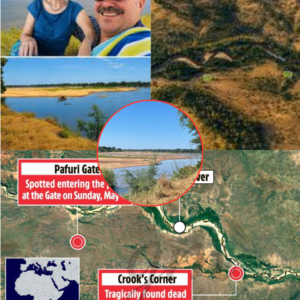
🤯 THE LOCKET, THE TAPE, & THE DETECTIVE: The Final Twist in the Kruger Investigation.
THE GRAVE SPEAKS: A Hidden Locket, a Smuggled SD Card, and the Final Trap That Broke the Kruger Syndicate PRETORIA — Just when the corrupt political elites of South Africa thought they could manage the fallout of the Kruger National…

“MY SON WAS TREATED LIKE AN ANIMAL.” THE FATHER’S UNTOLD STORY.
SOUTHAMPTON — The click of metal handcuffs is a sound meant to signify the capture of a dangerous criminal. But on a freezing December night in 2025, that sharp, metallic snap became the soundtrack to one of the most profound…
💔 5 WORDS THAT SHAMED A NATION: “DON’T THINK YOU HAVE, MATE.”
SOUTHAMPTON — The click of metal handcuffs is a sound meant to signify the capture of a dangerous criminal. But on a freezing December night in 2025, that sharp, metallic snap became the soundtrack to one of the most profound…

THE 2037 DREAM IS DEAD: How A Single “Hot Mic” Recording Just Guaranteed Mackenzie Will Never Walk Free
THE “HOT MIC” BOMBSHELL: Leaked Audio And Prison Secrets Just Destroyed Mackenzie Shirilla’s Netflix Lie For Good 🎙️🛑 “I am not a monster. I am a driver in a tragedy.” Millions of viewers watched the tear-streaked face of 21-year-old Mackenzie…

THE WHISTLEBLOWER SPEAKS: Why A Netflix Editor Risked Everything To Expose Mackenzie Shirilla’s Sickening Act
THE “HOT MIC” BOMBSHELL: Leaked Audio And Prison Secrets Just Destroyed Mackenzie Shirilla’s Netflix Lie For Good 🎙️🛑 “I am not a monster. I am a driver in a tragedy.” Millions of viewers watched the tear-streaked face of 21-year-old Mackenzie…
💔 THE PLOT TWIST NO ONE SAW COMING: We Finally Know Where The Mother Is.
🚨 SHOCKING DISCOVERY: Police Breached A “Fake Wall” Inside The Temple Home. The True Source of the “Odor” Finally Revealed. By Senior Investigative Desk Dateline: Temple, Texas — June 2, 2026 When Temple Police Department tactical teams first breached the…
End of content
No more pages to load