In the world of *Marshals: A Yellowstone Story*, loss is never merely a shock to propel the plot forward. It’s a lingering state, an invisible force shaping behavior, choices, and even how the characters understand themselves. Therefore, Monica Dutton’s death isn’t simply “a character leaving.” It’s like the film withdrawing an emotional pillar—a point of balance whose value audiences only truly appreciate when it’s gone.
In *Yellowstone*, Monica was never the loudest, nor the one who created the most conflict. But it was her quiet presence that served as a regulator. In a world where violence and power often overshadow everything, Monica represented a different direction—family, identity, connection to culture, and a deeper sense of belonging. She wasn’t aloof from the conflict, but she constantly reminded the audience of its meaning.
Therefore, when Marshals decides to let Monica go, the audience’s reaction isn’t just sadness. It’s a kind of disorientation. When a character who serves as the story’s “conscience” disappears, the natural question arises: who will maintain balance? Who will remind the other characters what they’re fighting for?
It is in this context that Mo Brings Plenty’s contribution becomes particularly noteworthy. Instead of viewing Monica’s death as an end, he chooses to see it as a transformation. Not because the loss is insignificant—on the contrary, precisely because it is so great—but because Monica’s value lies not in whether she lives or not, but in what she leaves behind.

This is an approach that is very much in line with how Marshals constructs its story. The film is not only concerned with what happens, but also with what remains afterward. And in Monica’s case, what remains isn’t a void, but an influence. She’s no longer on screen, but she remains present in how the characters think, choose, and act.
This is especially evident when looking at Kayce Dutton. Throughout his journey, Kayce is torn between two worlds—on one side, violence, responsibility, difficult decisions; on the other, family, love, and a desire for peace. Monica is the one who helps him maintain that balance. And when she’s gone, this conflict doesn’t disappear—it becomes more apparent, more intense.
A deeper look reveals that Monica is not just a “wife” in Kayce’s story. She is his moral frame of reference. Kayce’s choices, right or wrong, are measured by whether they align with the values Monica represents. And so, even after her death, she continues to be “present” in all of his decisions.
This creates a very special kind of influence—an influence that doesn’t require physical presence. Monica no longer speaks, but her “voice” remains, within the hearts of those she leaves behind. This is a subtle form of storytelling, because it doesn’t need flashbacks or direct reminders. It exists in the way the characters react, in the moments they pause before acting.
With *Tate Dutton*, Monica’s influence takes on a different color. If for Kayce, Monica is memory and responsibility, for Tate, she is the foundation. A child doesn’t fully understand loss in the way adults understand it, but feels it in a deeper way. Monica, for Tate, is not just someone who has passed away, but a part of the world he is trying to understand.
This makes Tate’s story particularly important in *Marshals*. He’s not just an “heir” in the family sense, but also a bearer of the values Monica represented. In a world that may be increasingly harsh, whether those values are preserved—in whatever form—becomes a major question.
When Mo Brings Plenty says he’s “grateful” that Monica’s legacy lives on, it’s not an understatement. It’s a recognition that a person’s value doesn’t end with their existence. In many cultures, especially the indigenous cultures *Marshals* often touches, memory and legacy aren’t things of the past. They are things that continue to live on, continue to influence.
And perhaps it’s this approach that makes Monica’s death “different.” It’s not a shock meant to evoke fleeting emotion. It’s a structural shift—a move from presence to influence. And when viewed that way, her story doesn’t end. It just changes form.
A noteworthy detail is how Marshals don’t try to “fill” the void Monica leaves with another character. No one replaces her. No one takes on her role directly. This is a crucial decision, because it respects the character’s uniqueness. At the same time, it forces the other characters to adapt—not by finding a “new Monica,” but by changing themselves.
This opens up an interesting direction for the series. Instead of continuing to…
By delving into established structures, *Marshals* has the opportunity to build new dynamics—based on absence, rather than presence. And in the process, Monica’s legacy may become one of the most powerful defining elements.
It’s also worth noting that the audience’s reaction to Monica’s death reveals something crucial: the character exists not only in the story, but also in how the viewer understands it. She is the point many cling to for meaning amidst the conflicts. Therefore, her death affects not only the character, but also how the audience experiences the series.
But it is here that Mo Brings Plenty’s words take on a different value. They don’t ask the viewer to “accept” the loss, but suggest a different perspective on it. Perhaps, instead of asking “why did she have to die,” the question could be “where will what she leaves behind lead the story?”
Looking back, it’s clear that Monica’s greatest strength didn’t lie in what she did while alive.
But in what continues to exist after she’s gone.
In Kayce’s choices.
In Tate’s growth.
In the way the story searches for meaning amidst loss.
And perhaps, that’s what makes this character so unforgettable.
Monica Dutton may have left the world of *Marshals*.
But she never left the story.
Because there are people—
who don’t need to be present
to shape everything that happens afterward.
News

As my eyelids grew heavy and prepared to close forever, as my heart beat its last slow beats before stopping… a strange sound emerged from the thick snow in the bushes ahead.
They Left Her Hanging From a Tree With a Sign That Said “Indian Lover”—A Bear Cub She’d Raised Found Her Before She Froze Chapter 1: The Judgment at the Edge of the Forest A blizzard swept through Blackwood Valley late…

Part 2 Alone at 18, She Bought a Dying Sunflower Farm — The Secret Beneath the Soil Changed Everything
Alone at 18, She Bought a Dying Sunflower Farm — The Secret Beneath the Soil Changed Everything ### Chapter 1: The Stranger’s Will and the Dead Land The autumn of 2025 swept through Willow Creek with dry winds, gathering withered…

My Parents Laughed. My Sister Lives There For Free. I Said: “Then Leave This House Within 24 Hours.”
I Drove 7 Hours Home For A Family Reunion. When I Asked My Parents If I Could Stay The Night, They Said: “Sure. Sleep On The Floor With The Dog And Pay $600 For Accommodation.” My Parents Laughed. My Sister…

“Transaction successful. Thank you, Mrs. Vance,” the receptionist smiled politely, handing me the bill.
The night I paid the entire bill for my in-laws’ lavish vacation, they laughed and called me their personal walking bank before leaving me alone in the Ocean Crest Resort lobby. I said nothing… Chapter 1: Fog at Ocean Crest…

I stood at the edge of the stage, a glass of sparkling champagne in hand, feeling like a misshapen ghost in an overly retouched family photo.
They Erased Me at My Sister’s “Perfect” Napa Wedding—Then My Mother Demanded One Invitation to My Own. Two Years Later, I Returned the Favor Publicly. Chapter 1: The Ghost in Napa Valley Napa Valley in June was as beautiful as…
Part 2 “Get out of my house! You mother-killing monster!”
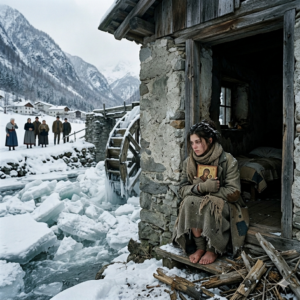
Driven out of her home by her father in the middle of winter, the young girl lived for months in an abandoned mill; when the river froze over and then broke open, the villagers finally understood why she never left….
End of content
No more pages to load