The 40-Year-Old Rancher Had Never Touched a Woman… Until a Beautiful Stranger Knocked on His Barn Door During a Violent Storm
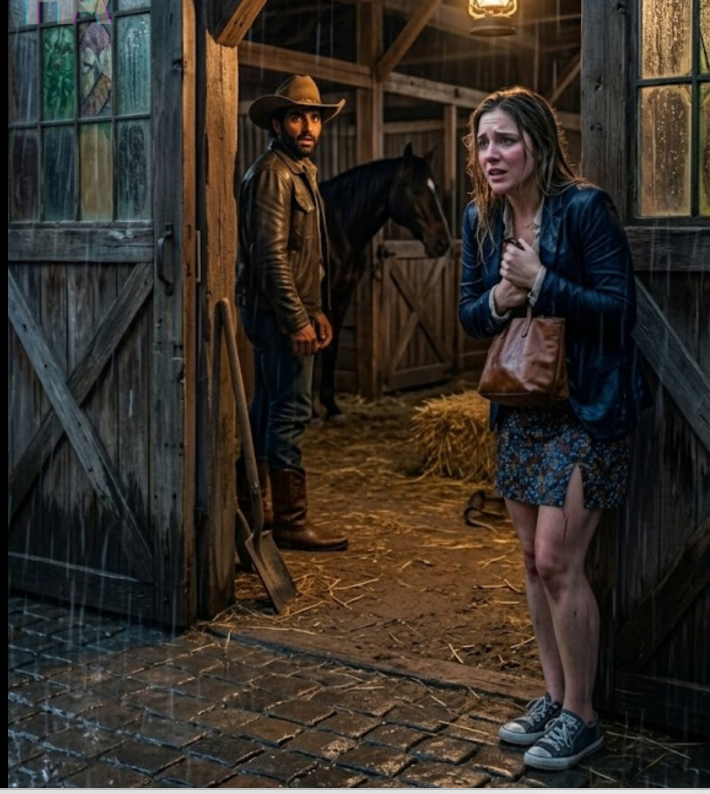
The interior of the barn fills with a trembling gold glow as you lift the oil lamp higher and hook it onto a nail in one of the cedar beams. Outside, the storm comes down hard, hammering the roof with rain so fierce it sounds like gravel poured from the hand of God. The horses stomp and snort in their stalls, uneasy from the thunder, and the air smells of hay, wet leather, dust, and lightning. For a moment, all you can do is stand there with the lamp in your hand and stare at the young woman who stepped out of the black sky and into your life.
She looks even more exhausted in the light.
Her brown skirt is soaked from the knees down, streaked with mud and desert dust. Her white blouse clings to her shoulders, and the loose strands of hair around her face are dark with rain, curling against her cheeks. Those amber eyes that caught you in the storm now seem larger, more uncertain, but no less bright. She is trying to hold herself upright with dignity, yet the way her fingers tremble tells you the effort is costing her more than she wants you to see.
“You can stay here until the storm eases,” you say, your voice sounding rougher than you intended.
She gives a tired nod and wraps both arms around herself. “Thank you. I was afraid I wouldn’t make it to shelter.” Her voice has the softness of someone raised with good manners, but under it there is something tight, some strain held together by will. “I’ve been walking since morning.”
You set the lamp down on a barrel and move toward the tack room in the back, where you keep clean blankets for cold nights and sick animals. It strikes you, suddenly and absurdly, that you have no idea how to receive a woman in a storm. You know how to calm a spooked horse, how to set a broken fence post in hard ground, how to bleed a radiator line with a bent nail and a wrench, but not this. Not the sight of a stranger standing in your barn with rain dripping from her skirt and your pulse behaving like it belongs to a much younger fool.
When you come back with the blankets, she has moved closer to the horses.
Tormenta, usually restless around strangers, has lowered her head and is breathing warm air against the woman’s sleeve. The sight unsettles you in a way you cannot name. Animals know things men spend years ignoring. Your father used to say that if a horse trusted someone too quickly, either that person carried peace or the horse had misread danger.
“Here,” you say, offering the blankets.
“Thank you.” She takes them with careful fingers and hesitates. “I don’t mean to impose. If you tell me the road to the nearest town once the rain slows, I’ll go.”
You glance at the barn doors where the wind is driving water through the cracks. “You’re not walking anywhere tonight.”
She opens her mouth as if to protest, then thinks better of it. A small, humorless smile touches her lips. “You say that like an order.”
“No,” you answer. “Just common sense.”
That makes her look at you more closely.
Maybe it is your green eyes, which strangers always notice before they trust anything else about you. Maybe it is the way solitude has shaped your face into something harder than you mean it to be. Or maybe she is simply deciding whether a man alone on a remote ranch is safer than the storm she just escaped. You know that calculation is happening, and the knowledge makes you uncomfortably aware of your own size, your own hands, your own place in this lonely barn with thunder rolling over the hills.
So you step back.
“There’s coffee in the house,” you say. “And dry clothes, maybe something my mother left behind that could fit you well enough.” You keep your tone even, practical, giving her room inside your words. “But if you’d rather stay in the tack room, I can bring you food and leave you be.”
For the first time, something eases in her face.
“You’re very careful,” she says.
You shrug, because explaining yourself would mean admitting truths you rarely say aloud. That your mother taught you no man had a right to mistake a woman’s need for kindness as permission. That your father loved your mother with such reverence you grew up thinking love must arrive clean or not at all. That shyness turned into habit, and habit turned into years, and years turned into a life so solitary the whole county began telling stories about you. You do not say any of that.
“I have room in the house,” you answer. “That’s all.”
She studies you for one beat longer, then nods. “Coffee sounds good.”
You lead her across the yard in the middle of the storm, one hand shielding the lamp, the other gripping the brim of your hat so it does not vanish into the dark. She hurries beside you, head lowered against the rain, one hand holding the blanket around her shoulders. Once, on the slick ground near the porch, she loses her footing for half a second. Without thinking, you catch her by the waist.
The contact is brief. Barely more than a moment.
But it hits you like a live wire.
Her body tenses first from surprise, then softens only enough not to fall. Your palm feels the shape of her through the wet cloth, warm and real and so startling that by the time you let go, your heart is thundering harder than the storm. She notices your reaction too. You can tell by the quick rise of color in her cheeks, even in the dim light.
Inside the house, the world changes.
The adobe walls mute the wind. The fireplace still holds a bed of coals from the morning, so you kneel and feed it fresh mesquite until flames climb again, throwing warmth across the room. The house is simple, as it has always been. Dark beams overhead. Rough wood table. A crucifix above the mantel. The old photograph of your parents watching the room with their calm sepia eyes. The guitar in the corner beside the window. All the familiar pieces of your life now seem strangely exposed under the gaze of a woman who was not part of them an hour ago.
She stands near the doorway, taking everything in.
“This place feels…” She pauses, searching for the right word. “Safe.”
The word lands somewhere deep in you.
You turn toward the old cedar chest in your parents’ bedroom and bring back a long cotton nightgown, a wool shawl, and a pair of thick socks your mother once wore in winter. The garments smell faintly of cedar and lavender, preserved by time and dry air. You place them on the arm of the sofa without meeting Isabela’s eyes. “You can change in the back room,” you say. “I’ll make coffee.”
“Thank you,” she says again, softer this time.
While she changes, you busy yourself with the coffee pot because your hands need something to do. You grind beans. You fill the kettle. You slice bread and pull out the beans you cooked that morning. Every movement should feel routine, but nothing does. The house no longer belongs entirely to silence. You can hear the faint rustle of fabric from the back room, the shift of footsteps on the old floorboards, and each small sound seems to travel through your body before it reaches your ears.
When she returns, you nearly drop the mug.
The nightgown is plain and modest, buttoned to the throat, the wool shawl draped over her shoulders, but none of that matters. It is not desire in the crude sense that stuns you. It is intimacy. The sight of a stranger wearing your mother’s clothes, standing barefoot by your fire as if your lonely house had dreamed her there, shakes something loose inside you that had stayed locked for years.
She notices your gaze and glances down at herself. “I hope you don’t mind.”
“No,” you say too quickly. Then, gentler, “They suit you.”
The smallest smile appears.
You sit across from each other at the table with coffee steaming between you. For a while, the conversation moves carefully over harmless ground. The storm. The condition of the roads. How long the drought lasted last summer. Which nearby creek floods first in a hard rain. But every answer she gives seems polished around the edges, as if the important parts were hidden just beneath the surface, waiting to see whether you deserve them.
“Where were you headed?” you ask at last.
Her fingers tighten around the mug.
“North,” she says.
“That’s a direction, not a destination.”
“I know.”
The silence that follows is not empty. It is crowded. Your father used to say a person’s lies always made more noise than their truth, but what you hear from Isabela is not exactly lying. It is caution, sharpened by experience. You know better than to press too soon.
So you stand and carry the bean pot to the stove. “You can tell me whatever you want,” you say. “Or nothing at all tonight.”
Behind you, you hear her let out a breath she had been holding.
“I haven’t met many men like you,” she says.
You ladle beans into two bowls. “Maybe you haven’t met many men who live three hours from town.”
That earns a real laugh, brief but genuine. It changes her face completely, bringing warmth where fear had been. The sound does something dangerous to you. It makes you want another one.
You eat at the table while rain thrashes the windows and thunder rolls over the hills like distant artillery. Isabela eats slowly at first, as if she does not want to seem hungry, then with more urgency once the food reaches her. You pretend not to notice the shift because dignity is often preserved by looking away at the right time. When she finishes, you offer more bread, and she accepts after only a second’s hesitation.
That is when you see the bruise.
Her sleeve slips as she reaches for the bread, revealing a dark mark near the inside of her wrist, partly yellowed at the edges, partly fresh. The kind of bruise that fingers leave when they close too hard. She sees you see it and pulls the sleeve down at once.
You say nothing.
Not because you are blind. Because you are suddenly aware that whatever brought her to your ranch in the middle of a storm did not begin on the road. It began somewhere else, somewhere with hands and fear and urgency enough to drive a woman across miles of desert toward a stranger’s barn.
Later, when the fire burns lower and the storm still shows no sign of mercy, you make up the sofa with fresh quilts. You offer her your parents’ bedroom, but she refuses immediately.
“The sofa is fine,” she says. “I won’t take your bed.”
“It’s not mine,” you say before thinking. “I use the small room in back most nights.”
She looks surprised. “Why?”
You almost smile. “Because old habits are stubborn.”
The truth is simpler and stranger. After your parents died, sleeping in their room felt like trespassing on something sacred. So you moved to the smaller room and never moved back. The house froze around grief, and you let it.
When everything is arranged, you step onto the porch for air.
Rain falls in silver sheets off the roofline. The storm lantern swings from its hook, painting the mud with wild arcs of light. You stand there listening to the desert drink, your boots planted on warped planks, your mind nowhere steady. Behind you, through the open door, you can feel the shape of another person inside your house, and the knowledge changes the whole night.
You hear the guitar before you realize you’ve picked it up.
Old habit again. When your thoughts knot too tightly, you play. Your father taught you with blunt fingers and very little patience, and your mother used to hum along from the kitchen when the songs were simple enough. Tonight the notes drift low and uncertain through the storm, more feeling than melody.
After a minute, you realize Isabela is standing just inside the doorway, listening.
“You play like someone who learned from silence instead of teachers,” she says.
You lower the strings. “Was that an insult?”
Her eyes glint in the lantern light. “No. Just accurate.”
You motion toward the rocker beside you on the porch. “You can sit if you want.”
She comes out wrapped in the wool shawl, and the sight of her there, surrounded by rain and lamplight, would have felt like fantasy to the younger version of you who once believed solitude was a permanent climate. She sits without speaking for a while, listening to the storm. Then, almost as if the darkness makes confession easier, she says, “I wasn’t heading north.”
You turn your head slightly but do not interrupt.
“I was running,” she continues. “I just didn’t know exactly where to run to.”
The storm seems to lean closer to hear the rest.
“My father is dead. My mother remarried when I was seventeen.” Her voice stays steady, though the shawl is clutched tightly at her throat. “At first, Tomás Herrera seemed respectable. Rancher. Churchgoing. Well-liked in town. The kind of man people call solid because they’ve never seen him behind a locked door.”
A coldness moves through your chest.
Isabela looks out at the rain, not at you. “After my mother got sick, everything changed. He handled the money. The land. The medicine. The visitors. Then the temper started. Not all at once. Never the way stories make it sound.” She swallows. “Little things first. Isolation. Rules. Apologies that always arrived after the fear had already done its work.”
Your hand tightens around the guitar neck.
“When my mother died last winter, I thought maybe he would soften. Instead…” She stops, and in the silence that follows, you hear how hard she is working to stay composed. “Instead he decided I was part of what he had inherited.”
You close your eyes for one second.
The desert around your ranch has always held violence the way dry earth holds old bones, hidden but never absent. You know men who beat horses until they go blind. Men who hit sons for crying. Men who boast over whiskey and lower their eyes in church. You know the breed. Still, hearing it placed like this, in the voice of a woman wrapped in your mother’s shawl, turns your blood slow and dark.
“How long?” you ask.
“Too long.” She gives a humorless little smile. “Long enough to get good at pretending I was clumsy.” Her fingers slide unconsciously over the bruise beneath her sleeve. “This morning he told me I would marry a widower from Coahuila by next week. He said it the way a man might discuss moving a horse to a different pasture. So I left.”
The storm cracks open overhead with a violent flash of lightning, and for a moment the whole porch turns white.
“When you say left,” you ask carefully, “did he know?”
“He knows now.”
You do not ask how. You do not need to. A woman does not vanish from a controlling man’s house without him noticing the same day. The thought of him out there somewhere, perhaps riding roads already turning to mud, perhaps sending others to look, changes the taste of the night.
“You can stay here tomorrow,” you say.
She turns to you, startled. “Diego…”
“You can stay until the roads dry. Until you decide where to go next. Until I know whether someone is coming after you.” The words come harder now, forged in something deeper than hospitality. “You won’t walk back into danger from my porch.”
Something flickers in her face then. Gratitude, yes, but also fear of the cost. People who have lived too long under someone else’s control learn to distrust offers that sound generous. They know help often arrives tied to a rope.
“What would you want from me?” she asks quietly.
The question slices through you.
You look at her, really look. At the guarded set of her shoulders. The intelligence in her eyes. The exhaustion pulling at the corners of her mouth. The bruises she has not named but no longer fully hidden. And you understand, maybe for the first time in your life, why the kind of man you never wanted to become is built not from monstrous desires but from the smaller rot of entitlement, from assuming kindness must earn reward.
“Nothing,” you say.
She watches you as if waiting for the trick. When none comes, her expression softens into something almost painful to witness. Not trust, not yet. But the possibility of it.
That night you sleep badly.
Not from lust, though desire arrives often enough in the hours before dawn to unsettle you. It is more complicated than that. Every sound in the house wakes you. The creak of floorboards. The shift of logs in the fire. The whisper of wind finding cracks in the shutters. Once, sometime after midnight, you hear a muffled sound from the sofa room and rise without thinking, revolver already in your hand.
You find Isabela sitting upright in the dark, breathing hard from a nightmare.
The fire has burned low. Moonless storm light presses faintly at the windows. For a second, she does not seem to recognize where she is. Then she sees you standing there, half dressed, revolver lowered at your side, and shame flashes across her face.
“I’m sorry,” she whispers. “I didn’t mean to wake you.”
“You didn’t.”
It is a useless lie. Still, she lets it sit there.
You put the revolver on the mantel and crouch a little distance away, careful not to come too close too fast. “Bad dream?”
Her laugh is thin as thread. “I don’t think they count as dreams when they’re just memory wearing a mask.”
You nod, because you understand enough of grief to know truth when it speaks like that.
After a moment, you stand and bring her a glass of water. She takes it, and your fingers brush hers. The contact is small, but in the dark, with the whole house holding its breath, it feels amplified. She notices too. Her eyes lift to yours, and for one suspended instant, there is something there that has nothing to do with gratitude or fear.
Then she looks down.
“Thank you,” she says.
You return to your room and lie awake until dawn listening to the storm finally tire itself out.
Morning comes washed and silver.
The desert after rain always looks stunned, as if it cannot quite believe mercy has visited. Water beads on the cactus spines. The earth smells alive. Thin streams run through gullies that were dry yesterday. You rise before sunrise out of habit, pull on your boots, and step outside to check the corrals.
When you come back, Isabela is already in the kitchen.
She has braided her hair properly this time, and the early light from the window turns the loose wisps around her face the color of chestnut honey. She is standing at the stove in one of your mother’s aprons, stirring eggs as if she has belonged in your kitchen longer than a single night. The sight is so intimate it makes you stop in the doorway.
“I hope you don’t mind,” she says without turning. “You were with the horses, and I found the eggs and coffee.”
“I don’t mind,” you answer.
What you do mind, suddenly and sharply, is how easily this image takes root in parts of you that have been barren for years. A woman at your stove. Morning light. Coffee. The kind of scene you never let yourself picture because picturing it felt too much like wanting, and wanting felt dangerous for a man who had built his life around control. Now here it is, offered by accident, and you feel both grateful and terrified.
Over breakfast, the world almost resembles something ordinary.
The storm has passed. The road east is a river of mud. The radio says a bridge near the crossing washed out in the night. No one is traveling anywhere today. You explain the layout of the ranch. The west fence line. The windmill. The spring that sometimes dries by August. She listens with quiet attention, as though learning a map she is not sure she is allowed to love.
Then the dogs bark.
You do not own dogs. They belong to the neighbor three miles south and only wander this far when riders are on the road. The sound hits the room like a dropped plate. You set your mug down at once. Isabela freezes, spoon halfway to her mouth.
“Stay here,” you say.
Her face drains of color. “Diego…”
“Stay here.”
You step onto the porch and see them at once. Two riders coming up from the south trail, their horses splashing through the mud, hats pulled low. Even at a distance, something in the way they sit their saddles tells you they are not neighbors dropping by with gossip. They ride like men who expect to take something with them when they leave.
You go back inside, every sense sharpened.
“Who would he send?” you ask.
She stands so quickly her chair tips. “His foreman, maybe. And my cousin Esteban if he lied to him about why I ran.” Her voice is tight with panic. “Tomás always made other men do the ugliest parts first.”
You take the rifle from above the mantle and check the chamber with steady hands that do not feel attached to your body. “Go to the back room.”
She does not move. “I won’t hide while you stand out there alone.”
“Isabela.”
“No.” There is fire in her now, fear burning into defiance. “I won’t be passed from one man’s decision to another.”
The answer should frustrate you. Instead it gives you a strange, fierce relief. You would rather face danger beside this version of her than protect a ghost of obedience. “Then stay behind me,” you say.
The riders dismount at the gate.
One is broad-shouldered, thick through the neck, maybe fifty. The other is younger, narrow-faced, with the restless eyes of a man who does bad things so often he has stopped seeing them clearly. They leave their horses outside the fence and walk toward the porch with practiced confidence. You remain where you are, rifle visible but not raised.
“Morning,” the older man calls. “We’re looking for a young woman. Brown hair. Amber eyes. Traveled this way before the storm.”
“I haven’t seen anyone,” you say.
The younger man’s gaze flicks to the extra cup on the kitchen table behind you. Careless of you. Or maybe simply human. Either way, he smiles a little.
“Pretty place to lie,” he says.
The older man removes his hat. “Name’s Mauricio. I work for Tomás Herrera.” He keeps his tone polite, but the courtesy is only surface paint. “Miss Isabela had an episode yesterday. She’s grieving, confused, not herself. Don’t want the poor thing causing scandal or getting hurt.”
Behind you, the floorboard near the hall creaks softly. Too softly for a stranger to hear. Loud as a gunshot to you.
“She isn’t here,” you repeat.
Mauricio sighs as if you have inconvenienced him. “You live alone, don’t you, Mendoza?”
The use of your name is deliberate.
You shrug. “Mostly.”
“We know who you are,” he says. “Quiet ranch. Keeps to himself. Church on Christmas, cattle auction in spring, no trouble worth mentioning.” He looks past you toward the doorway. “No wife. No daughters. No women’s business to complicate things.” Then his eyes come back to yours. “That makes this easier.”
You understand the threat immediately. Not just violence. Story. Reputation. Men like Mauricio know small communities are built out of witness and rumor. A solitary rancher sheltering a runaway young woman can be made to sound guilty faster than truth can saddle a horse.
“Nothing about this is easy,” you say.
The younger man steps toward the porch. “Maybe you ought to let us check the house.”
You raise the rifle then, not all the way, just enough.
He stops.
For a few seconds, nobody moves. Wind drips water from the porch roof. Somewhere behind the house, a horse stamps in the corral. The whole morning balances on a thin line stretched between violence and restraint.
Then Isabela steps into view.
Not behind you. Beside you.
Her face is pale, but her chin is up and her eyes are blazing. The effect on the two men is immediate. Mauricio’s expression shifts from practiced patience to cold irritation. The younger one looks almost triumphant, like a dog who has finally scented blood.
“There you are,” Mauricio says. “Come down now. Your stepfather is worried sick.”
“I’d rather drown in the floodwater,” she says.
The younger man laughs. “Girl, don’t make this uglier.”
She takes one small step forward. “Ugly began years ago.”
You do not look at her, but your whole body registers the nearness of her, the fact that she chose to stand where a rifle and two hostile men make a very poor shield. It makes your chest tighten with something fierce and almost unbearable.
Mauricio’s mask drops at last. “Enough of this. Tomás is offering kindness by handling the matter private. If you force his hand, the sheriff hears you ran off with a stranger.” His eyes slide toward you. “A strange man with no wife, no children, and a reputation for odd habits.”
There it is.
The lazy cruelty of men who do not need facts, only the right poison poured into the right ears. You can already imagine how the story would travel. The reclusive rancher. The runaway girl. The storm. The night alone under one roof. Small places love scandal because it lets ordinary people feel righteous while staying bored.
Before you can answer, Isabela does.
“Tell him to try it,” she says, voice trembling only at the edges. “Tell him to say that in town. Tell him to say it where people can ask why I ran barefoot in a storm instead of staying in the fine Christian home he gave me.”
Mauricio’s face darkens. “You ungrateful little fool.”
He steps toward the porch.
You raise the rifle fully.
He stops again, though only by instinct. His body had already committed to the movement before his mind remembered bullets. The younger man reaches slowly toward his belt, and you say, very clearly, “If you touch that gun, your mother buries you by sundown.”
The words leave your mouth calm as still water. That, more than the rifle, makes both men believe you.
For a long moment the four of you stand in silence.
Then hoofbeats sound from the south trail.
Everyone turns.
Your nearest neighbor, old Ramón Ortega, rides into the yard with a shotgun across his lap and his grandson behind him on a second horse. Ramón is seventy if he is a day, bent through the shoulders but mean as a kicked mule when threatened. He takes in the scene at once. Men at your gate. Rifle in your hands. A young woman on your porch. The old man grins without humor.
“Well,” he says, “looks like I came on a good morning.”
Mauricio swears under his breath.
Ramón spits into the mud. “I heard raised voices from the creek trail. Thought maybe trouble had got lost and found the wrong ranch.”
The balance shifts instantly. Two armed men were one thing. Two against two, with witnesses, in daylight, on land where you are known and Ramón is feared, is another. Mauricio sees it too. He puts his hat back on with controlled movements, as though choosing dignity over escalation.
“This isn’t finished,” he says to Isabela.
“No,” she answers. “It isn’t.”
The men mount up and ride off without another word. You keep the rifle trained on their backs until they clear the bend near the cottonwoods.
Only then do your knees remember they are made of flesh.
Ramón dismounts and comes to the porch as if he has merely dropped by to borrow salt. His grandson, Miguel, no older than sixteen, stares openly at Isabela until the old man cuffs him lightly on the shoulder.
“This the trouble?” Ramón asks you quietly.
“This is Isabela Herrera,” you say. “She needed shelter from the storm.”
Ramón looks at her for one sharp second, and something in his lined face settles into understanding older than the morning. He nods to her as one adult nods to another. “Then you got shelter.”
It is one of the kindest things you have ever heard.
Inside, over coffee that has gone lukewarm, Ramón tells you what he knows. Tomás Herrera owns more land than sense and has spent years buying goodwill in town through church donations and loud public generosity. He sits on the school board. Drinks with the deputy sheriff. Pays for the Fourth of July fireworks. Men like that become difficult to accuse because the whole town likes its villains wrapped in visible respectability. Still, Ramón has heard whispers. Bruises explained too fast. Servants who never lasted long. A cousin’s daughter married off sudden and far away.
“You aiming to keep her here?” he asks after a while.
You glance at Isabela.
She is seated by the fire, hands wrapped around a fresh mug, her face tired but composed. You realize, with something like awe, that the choice matters as much to you as it does to her. A day ago your life had been organized by weather, livestock, and solitude. Now one answer might alter everything that comes after.
“That depends,” you say carefully, “on what she wants.”
Ramón grunts approval. “Good answer. Rare one.”
After he leaves, the house grows quiet again.
But it is a different quiet now, not the clean silence you once knew. This one is charged, threaded with risk and possibility. You and Isabela move around it carefully all afternoon. You mend a gate latch near the yard while she helps shell beans on the porch. At one point, you catch yourself watching the way sunlight finds copper in her hair. At another, you notice she watches the horizon every few minutes as if danger might rise from the earth itself.
By evening, the sky clears into a blaze of stars.
You eat supper outside because the world smells washed and new. Beans, roasted squash, fresh tortillas from the freezer your mother stocked before she died, as if she had suspected someday the house would need feeding beyond one lonely man. Isabela speaks more freely now. Not everything. But enough for you to see the shape of her before fear narrowed it.
She likes books. She taught herself to read English from old magazines and seed catalogs. She once wanted to train as a teacher before her mother got sick. She knows how to set bones in chickens and sing harmony without being taught. When she laughs at something you say about Relámpago’s bad temper, the sound spills across the porch like light.
“You don’t seem like a man afraid of women,” she says after a while.
The question catches you off guard. “Who says I’m afraid?”
She gestures at the whole ranch, the whole life. “All this.”
You lean back in the chair and look out over the dark land. “My mother was devout. My father was decent. Neither of them rushed me toward anything. Then they died, and work filled the empty places because work is obedient and people aren’t.” You shrug. “Years pass quicker than you think when no one disturbs them.”
She watches you with an expression too thoughtful to be comfortable. “So you never wanted anyone?”
That is not an easy question when the woman asking it is the first person in years who has made you remember your body is not just a tool for labor.
“I wanted,” you say at last. “I just didn’t know what to do with it.”
Something flickers across her face, warm and shy and sad at once.
The night deepens. The stars sharpen. Somewhere beyond the corral, coyotes begin their thin ghostly singing. You could go inside then. You should. Instead you stay where you are while the conversation softens and stretches into the kind of silence that belongs only to two people who have begun hearing each other beyond words.
Then she reaches for the guitar.
“Play something,” she says.
You obey.
This time the music comes steadier. An old ranchera your father loved. Then another. After a while, she starts humming. Her voice is low, roughened slightly by fatigue, but it folds around the melody as if it has been waiting years for a place to land. You play and she hums and the stars hold above the dark fields, and for a few dangerous minutes you forget the men on the road, the bruises on her wrist, the whole ugly machinery waiting beyond your fence line.
When the song ends, neither of you moves.
Then she says your name.
Not loudly. Not dramatically. Just “Diego,” as if testing how it feels in her mouth when the air between you has changed. You look at her, and the porch seems suddenly smaller.
She rises first.
You stand because sitting would feel more dangerous somehow. She takes one step toward you, then stops, uncertainty and want and fear all crossing her face at once. You know enough, even with your inexperience, to understand what matters now is not hunger but care. Not whether you have wanted this your whole life, but whether she can step toward it without being pulled.
So you do not touch her.
“You don’t owe me anything,” you say quietly.
Her eyes shine in the starlight. “I know.”
“Not for shelter. Not for supper. Not for standing with a rifle. Not for anything.”
“I know,” she repeats, and this time the words come steadier. “That’s why this is frightening.”
You let out a breath you did not realize you were holding. “Me too.”
That makes her smile, and the smile undoes you more thoroughly than any practiced seduction ever could.
She steps closer.
Slow enough that you could stop it. Slow enough that she could stop it too. When she lifts her hand to your face, her fingers are cool from the night air. They touch your cheek with such tenderness that for one suspended second you almost cannot move. Then you place your hand lightly over hers, and the whole world seems to narrow to skin, breath, heartbeat.
Your first kiss does not look like the stories men tell around card tables.
It is awkward at first, almost reverent, because reverence is the only language your body knows for something it has been denied and protected from in equal measure. Her mouth brushes yours once, then again, and each small touch feels impossibly intimate. You are startled by how gentle desire can be when it isn’t hungry for conquest. Her free hand finds your shoulder. Yours rests at her waist, careful, asking even in contact.
When she leans closer, you feel the answer.
The kiss deepens slowly, naturally, with pauses for breath and uncertain smiles and that strange trembling that comes when wanting is mixed with trust. No thunder. No spectacle. Just the porch, the stars, the desert cooling around you, and the impossible fact that at forty years old you are kissing a woman for the first time while trying not to ruin the holiness of it by moving too fast.
When it ends, your forehead rests lightly against hers.
Neither of you speaks for several seconds.
Then she whispers, “I didn’t think anything could feel safe and frightening at the same time.”
You laugh softly, breathless. “I didn’t think I’d still be learning basic things at my age.”
She smiles against your mouth. “Maybe basic things are the hardest ones.”
The next morning brings trouble in daylight instead of whispers.
A truck comes up the road at noon raising dust where yesterday there was mud. Not horses this time. A county deputy in uniform behind the wheel, Tomás Herrera beside him in a pressed white shirt and hat clean enough to suggest he did not ride through any storm to look for her. He steps out of the truck already wearing injured righteousness like a second coat.
Even from the porch, you understand why the town believes him.
He is handsome in the lean, weathered way people trust too quickly. His smile is controlled. His boots shine. There is a Bible on the truck seat, visible through the windshield like a prop placed for an audience. The deputy beside him is younger than you expected, with the uncomfortable expression of a man who suspects he is standing in the wrong story but has not yet worked out how to leave it.
Tomás lifts a hand. “Mendoza. I’m here for my daughter.”
“She’s not your daughter,” Isabela says from behind you.
He turns to her, and the mask slips for half a heartbeat. In that instant, before he repairs it, you see what she saw all those years. Not anger alone. Ownership threatened.
“Isabela,” he says, and even his voice is composed for performance. “Everyone’s worried. You vanished in a storm. You know how that looks.”
She steps fully onto the porch beside you. “Good. Let it look bad.”
The deputy clears his throat. “Miss Herrera, your stepfather reported concern for your safety. If you’re here by choice, you can say so now and this becomes simpler.”
Tomás glances sharply at the deputy, annoyed by the opening.
Isabela’s spine straightens. “I am here by choice.”
The deputy nods once, but Tomás cuts in fast. “She’s unstable. Grief, stress, hysterics. She doesn’t understand what she’s saying.”
You feel Isabela go rigid beside you.
Then something in you, some old iron inherited from your father and disciplined by your mother, settles into place. “Careful,” you say.
Tomás smiles thinly. “Or what?”
You take one step forward, no weapon in your hands this time, only certainty. “Or you’ll forget that every man in this county knows how far my land runs and how little patience I have for liars on my porch.”
The deputy shifts, startled by the coldness in your voice. Tomás studies you for a long moment, recalculating. He expected a recluse. A shy rancher. Perhaps a fool softened by a pretty face. What he sees instead is a man who has lived years alone and therefore does not bluff for company.
“I see,” Tomás says. “This is how you want it.”
“No,” Isabela answers before you can. “This is how you made it.”
She comes down the porch steps then, into the full heat of noon, and the deputy watches her with increasing unease. You are close enough to move if you need to, far enough not to steal her voice. The whole yard goes quiet.
“I’ll say it plainly,” she tells the deputy. “I left because he has controlled me since my mother got sick. He hit me. He threatened me. He planned to marry me off against my will. If you force me into that truck, you’re handing me back to the man I ran from.”
The deputy’s face changes completely.
Tomás laughs, too quickly. “Ridiculous. She’s emotional.”
Isabela reaches up and pulls back the sleeve on her left arm.
The bruises are visible in daylight now. Older ones fading yellow near the elbow. Newer ones dark near the wrist. The deputy stares. Tomás’s face goes hard as cured leather.
“She bruises easy,” he says.
The deputy does not answer.
Instead, he asks Isabela a series of practical questions. Dates. Witnesses. Did anyone else see injuries. Where did she sleep last night. Has Mendoza touched her. At that one, your blood turns hot, but Isabela does not flinch.
“He has treated me with more respect in one day than you have in years,” she says to Tomás.
The deputy looks from her to you, to Tomás, then back again. He is young, but not entirely made of weakness. You can see him stepping through the layers of local loyalty, church donations, reputations, gossip, and trying to find something sturdier underneath. It is hard work, and most men quit halfway. To your surprise, he doesn’t.
“I can’t arrest anyone today on this alone,” he says carefully. “But Miss Herrera isn’t returning with you by force.”
Tomás stares at him in disbelief. “You ungrateful little—”
The deputy turns, sharper now. “Watch it.”
The silence that follows tastes metallic.
Tomás looks at Isabela one last time, and what lies in his eyes then strips away the last of his public disguise. Not sorrow. Not concern. Pure hatred that she has spoken aloud. It chills you because you know men like him do not forgive humiliation. They ferment it.
“This isn’t over,” he says.
“No,” you answer. “It isn’t.”
He gets back in the truck and drives away in a spray of dust and fury.
The deputy lingers long enough to tell Isabela where the county women’s office in Del Rio is located and which social worker there still has a spine. He says it awkwardly, as if embarrassed to know such things, but you mark the name. When he leaves, the yard feels strangely hollow, like a stage after bad actors have exited.
Only then does Isabela sag.
Not dramatically. Just enough that you reach her before she falls. She leans into you for one second, maybe two, her forehead against your shoulder, and you hold her with both arms because there is nothing else to do. The whole desert seems to hold still around that embrace.
That afternoon you and Isabela ride into town together.
Not because you want spectacle, but because hiding now would only give Tomás space to write the story first. Ramón insists on riding behind you with Miguel. There is comfort in witnesses when truth is fragile. The road to town feels longer than usual, each mile carrying more eyes, more risk, more possibility.
By the time you reach the square, people already know.
News travels faster than horses when scandal is involved. Men outside the feed store stop talking when you dismount. Women near the church steps pretend not to stare and fail badly. You feel the old weight of community attention settle over you like dust. Beside you, Isabela straightens instead of shrinking.
The women’s office is in a squat county building beside the tax assessor’s door, and the social worker the deputy mentioned is named Clara Ortiz.
She is in her fifties, wears plain skirts and sensible shoes, and has the face of a woman who stopped being surprised by men’s ugliness years ago but still has not stopped hating it. She listens without interruption as Isabela tells the story. Not just the broad shape of it. The details. The control. The threats. The proposed marriage. The bruises. The way town respectability functioned like armor for Tomás. Clara writes everything down in a hand as sharp as her eyes.
When the story is done, Clara folds her hands and says, “Good. We start there.”
There is no pity in her tone. Only momentum.
By evening, official statements exist where before there had only been whispers. Clara arranges for photographs of the bruises, notarized testimony, and an emergency protective filing. She also knows a judge two counties over who owes her a favor and has a known dislike of men who hide behind church donations. For the first time since Isabela arrived at your ranch, the future looks like something other than reaction.
Still, the cost arrives before sunset.
As you lead the horses toward the hitching post outside the office, a young man steps out from the shadow of the hardware store. At first you don’t recognize him. Then you see the family resemblance around the eyes. Esteban. The cousin Isabela mentioned. He is maybe twenty-three, hat in hand, face drawn with shame.
“Isa,” he says softly.
Isabela goes still.
“I didn’t know,” he blurts before she can answer. “I swear to God, I didn’t know it was that bad.” His eyes flick once to you, then back to her. “He told me you were grieving and wild and someone needed to fetch you home before people talked.”
Her expression does not soften. “People should have talked years ago.”
He flinches as if struck. “I know.”
For a few moments, none of you says anything. Town traffic moves around the square. A church bell marks the hour. Life goes on with its rude consistency while three people stand in the dust trying to measure the weight of silence kept too long.
Then Esteban reaches into his jacket and pulls out an envelope.
“My aunt left letters,” he says. “Your mother. Tomás kept them locked in the desk after she died. I found them this morning.” His voice shakes. “I should’ve looked sooner.”
Isabela takes the envelope with hands that suddenly do not seem steady. She does not open it there. She only nods once, painfully, as if gratitude and grief are colliding at close range.
Back at the ranch that night, she opens the letters by lamplight.
You do not read over her shoulder. You sit at the table a respectful distance away, mending a halter that does not need mending, while the paper crackles in her hands and her breathing changes line by line. Once she presses a fist to her mouth. Once she laughs bitterly at something only she can see. At last she looks up with tears bright in her eyes.
“My mother knew,” she says.
A strange relief and sorrow pass through you together.
The letters confirm what you already suspected. Her mother had grown afraid before she died. She wrote to a cousin about Tomás’s temper, about documents moved without permission, about wanting Isabela safe if anything happened. In the final letter, written in a hand made shaky by illness, there is one line that seems to settle over the whole room like benediction: If you must choose between scandal and silence, choose scandal. Silence feeds wolves.
Isabela reads that line aloud twice.
The next weeks become a campaign instead of a hiding place.
Clara Ortiz moves like a woman accustomed to systems trying to outlast her. Paperwork goes in. Statements multiply. Tomás pushes back through lawyers and church friends and public outrage performed in clean shirts. Some people in town believe him at first, because belief is often lazier than truth. But then other women begin speaking. A housemaid who left three years ago. A widow whose niece had once been “offered a future” through Tomás’s acquaintances. One of the men from your porch loses his nerve and admits under pressure that he was sent to retrieve Isabela whether she wanted to come or not.
The story spreads.
Not the lurid version Tomás hoped for. The real one.
Through all of it, Isabela stays at the ranch.
At first it is necessity. Then it becomes something more difficult and more beautiful. Routine begins to grow between you in small quiet roots. She helps with the chickens. You teach her to mend fence line. She laughs at how seriously you explain water pump maintenance. You discover she can outshoot you with the old .22 behind the barn and pretend not to be offended. On Sundays, if Clara doesn’t need her in town, she stands beside you in the little church twelve miles west, and for the first time in years the hymns sound less like echoes and more like prayer.
You do not rush what grows between you.
There are more kisses, yes. Soft ones on the porch. One under the cottonwoods after a long day repairing storm damage. One in the kitchen when she reaches for a jar above her head and turns into you by accident and neither of you can pretend the moment belongs to chance. But when her body stiffens, even slightly, you stop. Every time. Not out of fear of desire, but out of respect for how long desire in her life has been twisted by someone else’s power.
One night, weeks after the storm, she comes to find you in the barn.
You are rubbing down Tormenta after a hard ride when you hear her steps in the aisle. Lantern light paints her in warm gold and shadow. She is wearing one of your mother’s old cotton dresses now altered to fit her, sleeves rolled, hair loose down her back. The sight of her still affects you with bewildering force, but no longer in the wild helpless way of that first night. Now the feeling is threaded with tenderness, with history already shared.
“I’ve been thinking,” she says.
“That sounds dangerous.”
“It usually is.”
She steps closer, close enough that you can smell soap and clean cotton and the faint smoke from the cookfire. “When you touch me,” she says quietly, “I wait for the part where it becomes about taking.” Her honesty hits you like a blow because there is no protection against being trusted with pain. “And then it doesn’t.”
You set the brush down carefully.
“Isabela…”
She lifts a hand to stop you, though gently. “I’m not asking you to fix what happened before you. I’m just telling you what this is like from where I stand.” Her eyes shine in the lantern light, steady and vulnerable all at once. “With you, I’m learning my own skin again.”
No one has ever given you a sentence like that.
You reach for her slowly enough that she can refuse, and when she doesn’t, you gather her into your arms with all the care you know. Her cheek comes to rest against your chest. The barn is quiet except for horse breath and the low creak of leather. You stand there holding each other in the warm hay-scented dark, and it feels more intimate than anything your younger self imagined physical love could be.
When she kisses you that night, it is with certainty.
Not hurried. Not performed. Chosen.
You carry that knowledge into the house like a lantern. Every touch afterward is slow enough to ask, gentle enough to listen. She teaches you without embarrassment and without cruelty. You discover what you should have known all along, that tenderness is not the opposite of passion but its truest spine. When you finally lie together, the experience is less like conquering some long-delayed milestone and more like being admitted into a language your body had always hoped existed.
Afterward, she rests her head on your shoulder in the dark and says, half laughing, half crying, “For a man who waited this long, you learn fast.”
You kiss her hair. “I had good motivation.”
Outside, the desert wind moves through the mesquite, and for once the old loneliness of your house has no place to sit.
By autumn, the case against Tomás begins to break wide.
The judge Clara trusted grants protective orders and opens an inquiry into property transfers made during Isabela’s mother’s illness. Esteban brings more papers from the desk. A bank clerk remembers forged signatures. The deputy who visited your ranch testifies more carefully than Tomás expected. The church deacon who once admired Tomás now avoids him in public. Respectability, it turns out, is a strong wall until enough truth gathers at the base and starts pulling out the stones.
The final blow comes from greed.
In trying to control Isabela’s inheritance, Tomás forged documents tied to acreage he used as collateral. That kind of fraud offends men who would ignore bruises but never unpaid debt. Once money begins screaming, the whole county suddenly discovers its conscience. You are disgusted by the pattern and grateful for it at the same time.
On the morning of the hearing, Isabela stands in your bedroom fastening the buttons on a plain blue dress Clara helped her choose. She looks beautiful, though beauty is not the word that matters most today. She looks resolute. A woman walking toward the public death of a lie that shaped years of her life.
You tie your own neckerchief at the mirror and catch her eyes there. “Ready?”
“No,” she says honestly. Then she lifts her chin. “But I’m going anyway.”
At the courthouse, the room is fuller than you like.
Curiosity packs the benches. Whispers run along the walls. Tomás sits with his lawyer in a dark suit that cannot save him. When he sees Isabela enter on your arm, something ugly flashes across his face, but it is weaker now. Men like him rely on private fear. Public process starves them.
She testifies for nearly an hour.
Calmly. Precisely. Without drama. She speaks of control, threats, isolation, the forced marriage, the men sent to retrieve her, the bruises, the letters from her mother, the financial manipulation. Her voice only shakes once, when she speaks of her mother dying in that house while Tomás controlled who came near the bed. You feel your own hands curl into fists, but you stay still. This is her moment, not yours.
When the lawyer tries to suggest she ran because of some secret affair with you, the courtroom shifts with interest. You know how these men work. If they cannot disprove the harm, they sexualize the woman and hope the old machinery of shame takes over. But Isabela does not blink.
“I would rather be loved honestly by a man the town misunderstands,” she says, “than protected publicly by a man who hurts me in private.”
The room goes silent.
Even the judge looks up.
That sentence travels faster than any legal filing. By nightfall, half the county has repeated some version of it. By morning, Tomás’s reputation is finished in every place that still matters. The court freezes his access to the disputed land, orders criminal review, and upholds the protective measures. It is not perfect justice, because nothing can return years already lived in fear. But it is enough to let the future breathe.
Winter comes early that year.
Cold silver mornings. Smoke from the chimney. Horses steaming in the dawn. You and Isabela fall into a life neither of you had been brave enough to picture when the storm first drove her to your barn. She trains with Clara for bookkeeping and school records. You repair the north well together. At night she reads by the fire while you clean tack, and every now and then she looks up just to smile at you for no reason beyond being there.
One evening, near Christmas, you bring down the cedar box that has sat unopened in the back room since your mother died.
Inside are a lace tablecloth, two silver candleholders, your father’s good pocket watch, and the ring he placed on your mother’s finger forty-two years earlier. Nothing grand. A plain gold band with a small stone. The kind of ring built for daily life instead of display.
Isabela sees the box on the table and grows very still.
“You don’t have to,” she says quietly.
“I know.”
You cross the room and stop in front of her. The firelight moves over her face, over the amber in her eyes, over the life that nearly broke and then refused to remain broken. Outside, wind brushes the adobe walls, but inside the house there is only warmth and the sound of both your breaths.
“I used to think the biggest thing about me was what I had never done,” you say. “Never touched a woman. Never married. Never built a house full of laughter. Like absence was a kind of identity.” You take the ring from the box. “Then you came through a storm and taught me that a life isn’t measured by what it lacks. It’s measured by what it learns to hold.”
Tears gather in her eyes before you even finish.
“I don’t need rescuing,” she says, voice trembling.
“I know,” you answer. “That’s one of the reasons I love you.”
When you go down on one knee, she laughs through the tears because apparently even after everything, joy can still surprise her. You ask her plainly, without performance, without poetry borrowed from other men. Just truth. A ranch. A house. A life. Her, if she wants it.
She says yes before the last word has fully left your mouth.
By spring, the desert blooms harder than usual, as if rain from that first storm never fully left the ground. Yellow flowers scatter near the arroyo. The windmill sings less mournfully. Ramón cries at the wedding and denies it afterward with such aggression that even Miguel laughs. Clara signs the witness line with a satisfaction that could power a town. Esteban stands at the back, hat in both hands, carrying his own shame more honestly now. Even the deputy comes, out of uniform, looking relieved to be on the right side of a story for once.
You marry on the porch at sunset.
No cathedral. No crowd from town hungry for spectacle. Just the people who mattered, the horses in the corral, the desert turning copper and rose under the dying light, and the old house that once held only your footsteps now ringing with voices. When you place the ring on Isabela’s finger, she looks at you with that same impossible combination of tenderness and strength that first undid you in the storm.
Later, after the food and music and laughter, after Ramón has danced with Clara badly enough to scandalize the saints, after the lanterns burn low and the stars come out one by one, you sit with your wife on the porch where everything first changed. Her head rests on your shoulder. Your hand rests over hers. The ranch stretches quiet around you, no longer lonely, just still.
“Your grandmother was right,” she says.
You smile. “About what?”
“When the weather changes suddenly, life does too.”
You think of the storm. The barn. The first cup of coffee. The bruises hidden under a sleeve. The rifle on the porch. The courthouse. The first slow kiss under stars. The strange, holy fact that after forty years of silence, love did not arrive as punishment for waiting too long. It arrived as proof that the waiting had never been the story. The story was what you would do when love finally knocked at your door soaked to the bone and asking for shelter.
You turn and kiss her gently.
Inside, the house glows warm against the dark. Above the mantel, your parents’ photograph watches over the room, and for the first time in years, the old grief there feels less like an open wound and more like part of the foundation. Outside, the desert wind carries the scent of rain from somewhere far away, like a memory circling back with kinder hands.
The lonely rancher who had never touched a woman did not lose his solitude all at once.
He gave it up piece by piece.
For a stranger in a storm.
For truth spoken aloud.
For the courage to love without owning.
And in the end, what changed your life was not desire, not scandal, not even the danger that rode up your road with clean boots and bad intentions.
It was the moment a woman stepped into your barn, looked at you with tired golden eyes, and asked for refuge.
You gave her shelter.
She gave you a home.